 Vietnamnet.vn

 Podcast



Under the scorching heat of late May, deep in Vietnam’s border mountains, excavators continue to rumble across hillsides carved open to create space for new school campuses. Beneath freshly cut embankments, trucks loaded with construction materials snake through winding mountain roads, racing against time before the monsoon season sweeps across the highlands.
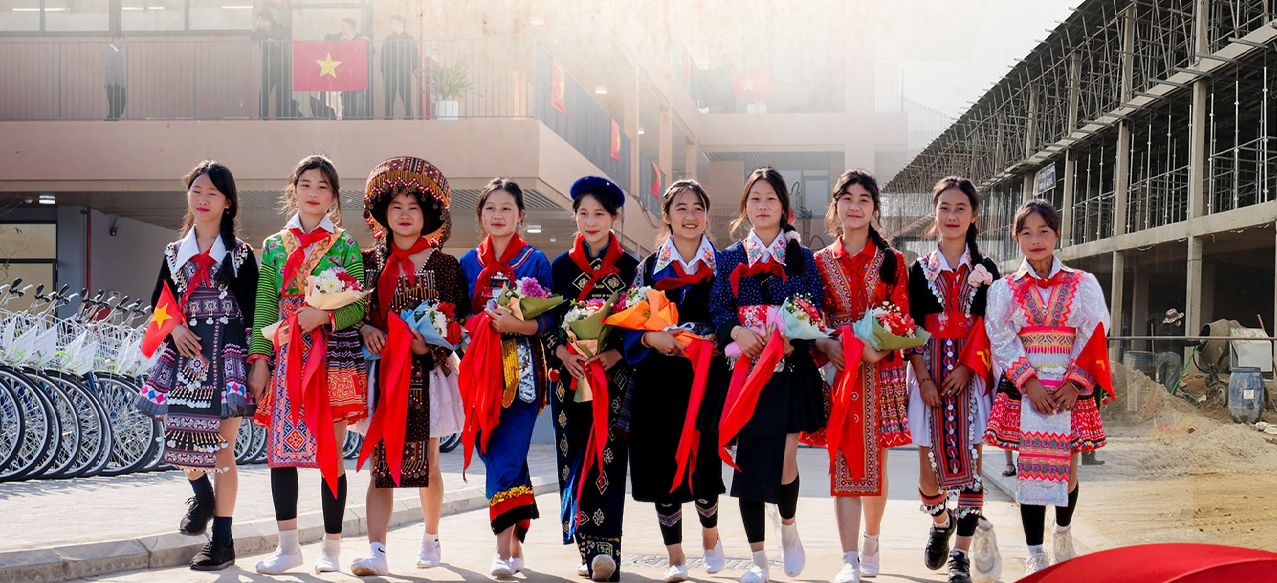
A network of multi-level ethnic minority boarding schools is taking shape along Vietnam’s land borders in what has become an unprecedented nationwide campaign. Yet behind the political determination driving the initiative lies a growing list of pressures that are testing efforts to complete the projects before the start of the 2026-2027 academic year.
This is not simply a construction race. It is a race to keep children in school, to help border communities remain rooted in their homeland, and to reinforce the nation’s frontiers through investment in people.
Across many border communes, students still walk dozens of kilometers through forests to attend classes. During the rainy season, swollen streams and landslides often force children to miss school for extended periods. In some remote villages, completing lower secondary education remains a difficult journey for many ethnic minority families.
For that reason, the new boarding schools are being built not only to address classroom shortages but also to narrow the opportunity gap between border regions and more developed lowland areas.
Schools as infrastructure of sovereignty
A new era of development requires a new vision for border governance - one in which educational infrastructure serves not only local communities but also creates a foundation for long-term stability and public trust.
Against this backdrop, directives from General Secretary and State President To Lam, along with conclusions issued by the Politburo regarding investment in multi-level ethnic minority boarding schools, have opened a new chapter for education in border areas. In this vision, schools are regarded as infrastructure that contributes directly to national sovereignty, making educational investment a responsibility that extends far beyond the education sector alone.
In Notice No. 81-TB/TW dated July 18, 2025, the Politburo emphasized that investing in schools for land-border communes is a central and important task in socio-economic development and the implementation of ethnic minority policies. The goal is to improve educational attainment, enhance human resource quality, develop local ethnic minority leadership, raise living standards, and strengthen national defense and security.
The statement underscores that these schools are not merely educational facilities. In a deeper sense, they are civilian landmarks standing at the nation’s frontier.
In Notice No. 177-TB/VPTW dated April 25, 2025, summarizing conclusions from General Secretary To Lam, authorities stressed that schools must include adequate classrooms, laboratories, clean water systems, kitchens, bathrooms, sanitation facilities, playgrounds and accommodations for teachers. The notice also highlighted the importance of teaching the language of neighboring countries to students in border communes to encourage future people-to-people exchanges.
Following these directives, the Government, ministries and agencies, together with 22 provinces and cities sharing land borders, have moved quickly to implement the program. Officials have characterized it as a special campaign in which progress is measured not only in construction milestones but also in educational opportunities for children living along the frontier.
Racing against terrain, weather and rising costs
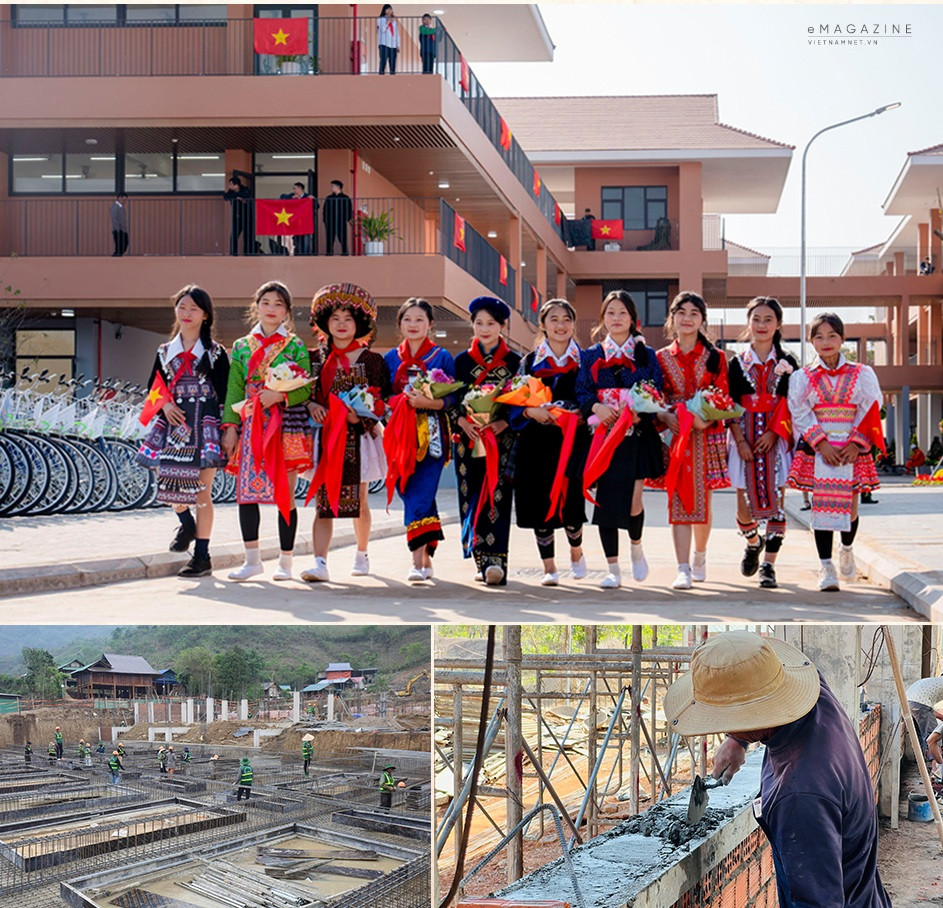
On paper, progress appears substantial.
Among 108 schools launched last year across 19 provinces, one has already been completed, while nearly all projects have finished land clearance. Many sites have advanced to major structural construction stages.
For the 121 schools simultaneously launched on March 19, 2026, across 17 provinces, 25 projects have completed site clearance, 57 are actively undergoing clearance and preparation, and several have already received investment approval.
Behind those figures, however, lies a far more demanding reality.
Investors, contractors and construction teams are stretching their capacities, working through harsh weather conditions to keep projects on schedule.
In Si Lo Lau, a border commune in Lai Chau Province, construction of a boarding primary and lower secondary school is currently focused on site preparation. Rugged terrain and difficult transportation routes have made it challenging to move machinery and building materials into the area.
According to Nguyen Van Tuan, the project’s site manager, nearly 300 workers and numerous machines have been mobilized since May 10 to accelerate earthworks, drainage systems and retaining wall construction.
With the rainy season approaching, completing these foundations is critical to ensuring subsequent construction phases can proceed.
“We have prepared contingency plans, including keeping two excavators on standby along transportation routes to respond immediately to landslides and maintain uninterrupted access for materials and equipment,” Tuan said.
Si Lo Lau is not alone.
Across multiple projects, construction teams face difficult geological conditions, including mud pockets, unstable foundations and landslide-prone slopes. In many locations, engineers have been forced to revise foundation designs and adopt piling solutions, adding complexity and extending construction timelines.
Material supplies and labor shortages represent another major challenge.
According to the Ministry of Education and Training during an online conference with 22 provinces and cities on May 15, 2026, many localities are facing serious shortages of construction workers. Building materials remain scarce, prices fluctuate frequently and transportation costs continue to rise.
As a result, actual funding requirements for the first 100 schools have increased by nearly VND 3.908 trillion, equivalent to about USD 150 million, compared with initial estimates.
Additional costs are also emerging from complicated geological conditions, expanded student enrollment plans and the inclusion of supplementary facilities for accommodation, physical education and cultural activities required by modern boarding school standards.
The challenge of implementation
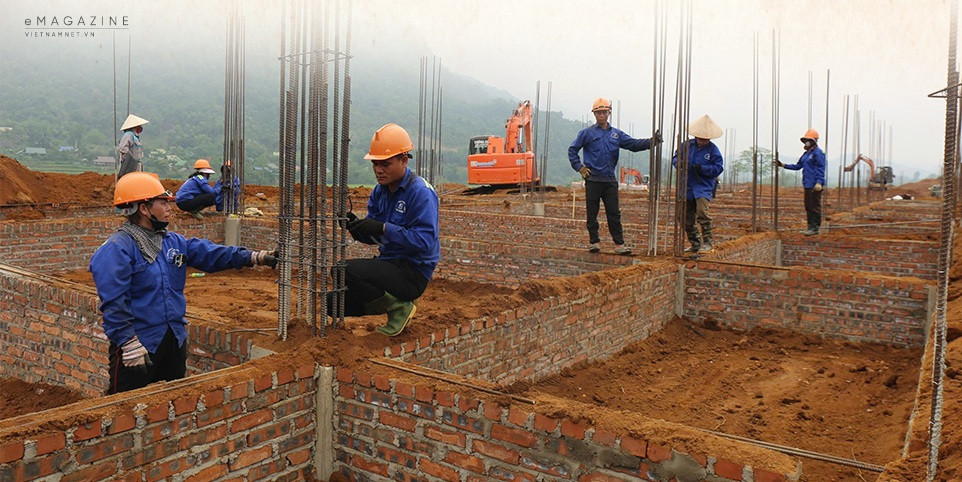
Yet perhaps the greatest pressure does not come from concrete, steel or construction sites.
It lies in implementation capacity.
This concern was highlighted by the Ministry of Education and Training during its May 15, 2026 online conference with border localities.
According to the ministry, many provinces have yet to fully grasp the strategic significance of the border school initiative, resulting in uncertainty during implementation and delays in project approval.
The ministry also noted that leadership and organizational efforts in several localities remain slow and do not fully comply with the Government’s principle of “six clarities”: clear responsibilities, clear tasks, clear accountability, clear authority, clear timelines and clear outcomes.
Officials specifically warned against a growing tendency among some administrators to avoid decision-making out of fear of making mistakes while handling a large volume of new and urgent work.
This is a particularly significant concern.
In special campaigns such as the border school initiative, the greatest risk is not always a lack of funding or materials. Delays caused by hesitation and risk aversion can be equally damaging, especially when every lost day means thousands of border-area students continue studying under inadequate conditions.
Many localities are implementing projects under special investment mechanisms that allow design and construction activities to proceed simultaneously. In an environment where regulations remain relatively new and deadlines are extremely tight, projects cannot succeed if decision-makers are unwilling to act.
That is why the Government’s emphasis on the “six clarities” framework goes beyond administrative procedure. It reflects a broader call for decisive action in a campaign where there is little room for delay or avoidance of responsibility.
The countdown to the new school year
Under current plans, all first-phase schools must be completed before August 30, 2026, in time for the new academic year.
However, several localities, including Cao Bang, Nghe An, Da Nang, Tuyen Quang and Quang Tri, are already behind schedule.
The Ministry of Education and Training has warned that eight schools are unlikely to meet the August deadline. The main reason is the need to revise construction plans after encountering difficult geological conditions, including unstable soil, mud pockets and landslide risks that require deep piling and bored pile foundations.
The mounting pressure has prompted the Government to intensify oversight.
On May 23, 2026, the Prime Minister issued Official Dispatch No. 42/CD-TTg calling for faster implementation of multi-level boarding schools serving primary and lower secondary students in land-border communes.
The directive requires stricter monitoring of progress and stronger inter-agency coordination to resolve problems directly at project sites. Local governments have also been instructed to launch a “100-day peak campaign” to ensure completion of 100 pilot schools before August 30, 2026.
The Prime Minister further emphasized the importance of regular reporting, requiring local authorities to submit detailed monthly updates on construction progress and completed work volumes to the Ministry of Education and Training by the 25th of each month for consolidation and reporting to senior Party and State leaders.
The message from the Government is unmistakable: the border school campaign cannot be allowed to lose momentum.
A delayed project in a major urban center may simply be another public investment issue. A delayed project along the frontier, however, can widen development gaps, deepen educational inequalities and prolong disparities in opportunity between border regions and the rest of the country.
It can also extend shortages in human resources, weaken living standards and undermine the foundations of public trust in some of the nation’s most strategically important areas.
The construction sites scattered across Vietnam’s mountains will eventually be completed. The concrete structures rising today will become brightly lit classrooms serving generations of students.
More importantly, those schools will allow more children to remain in education, provide young people with better training opportunities and help build a generation of ethnic minority citizens equipped with the knowledge and skills needed to shape the future of their communities.
Sy Hao - Thai An
.svg)
