 Vietnamnet.vn

 Podcast



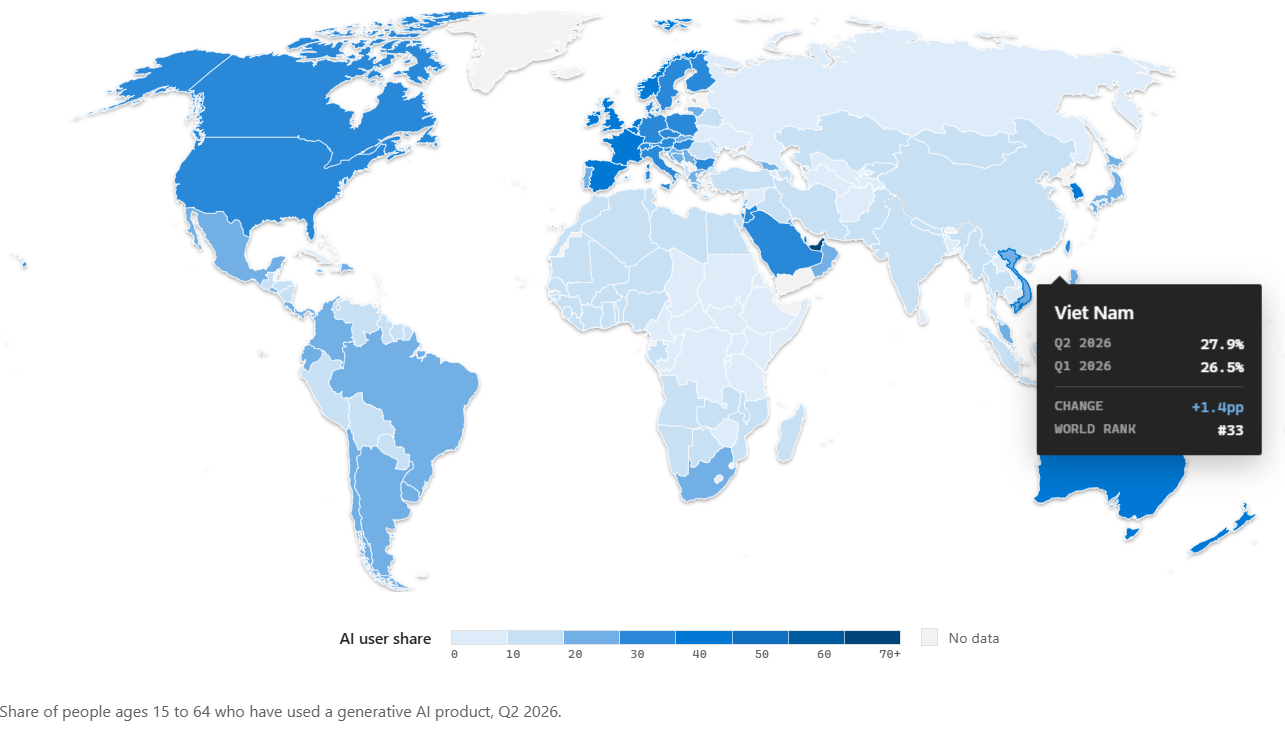
Microsoft’s recently released AI Diffusion Report for Q2 2026 showed that the share of Vietnam’s working-age population, defined as people aged 15-64, using artificial intelligence rose from 26.5% in the first quarter to 27.9% in the second.
The index is compiled using anonymized data collected through Microsoft systems and adjusted to account for differences in operating system market share, devices, Internet penetration and population size.
At 27.9%, Vietnam is approaching the adoption rate among developed economies, or the Global North, of 28.8%. It is also well above the global average of 18.8% and the 16.2% recorded across developing economies, or the Global South.
Within Southeast Asia, Vietnam outperformed most countries in AI adoption, trailing only Singapore at 64.3%. It ranked ahead of Malaysia at 22.6%, the Philippines at 20.7%, Indonesia at 14.8% and Thailand at 13.4%.
Microsoft’s report also highlighted significant differences in how the technology is being used across regions. In developing economies, the share of AI use devoted to self-directed learning and skills development was 29.2% higher than the global average. For homework and academic support, the figure was 32.3% higher.
The trend is consistent with data Google released in July on its Gemini platform. Vietnam had the highest share of education-related prompts among six Southeast Asian countries surveyed, accounting for 17% of all interactions during the first three months of 2026.
Each month, more than 160,000 Vietnamese students use Gemini Canvas to prepare for exams, while teachers generate around 55,000 requests for teaching assistance every day.
Notably, 89% of Gemini prompts in Vietnam are entered directly in Vietnamese, the highest rate of local-language use in the region. Programming accounts for another 4% of prompts, while 5% are related to mathematics.
Beyond education, Vietnamese users are applying generative AI to a wide range of professional tasks, including creating and editing text, programming, image design, information searches and technical support.
Despite the rapid expansion of AI adoption in Vietnam, differences in access between groups of countries remain heavily dependent on infrastructure.
Microsoft identified electricity, Internet connectivity, digital skills and support for local languages as key factors influencing the ability to scale AI adoption.
The rapid growth of open-weight AI models is also helping organizations cut costs and more easily customize models using local data. The number of Spaces on the Hugging Face platform surged from 124,000 at the end of 2023 to 1.46 million by September 2026.
Experts, however, caution that software solutions cannot substitute for upgrades to physical infrastructure and improvements in the digital capabilities of the workforce.
Du Lam
.svg)
