 Vietnamnet.vn

 Podcast



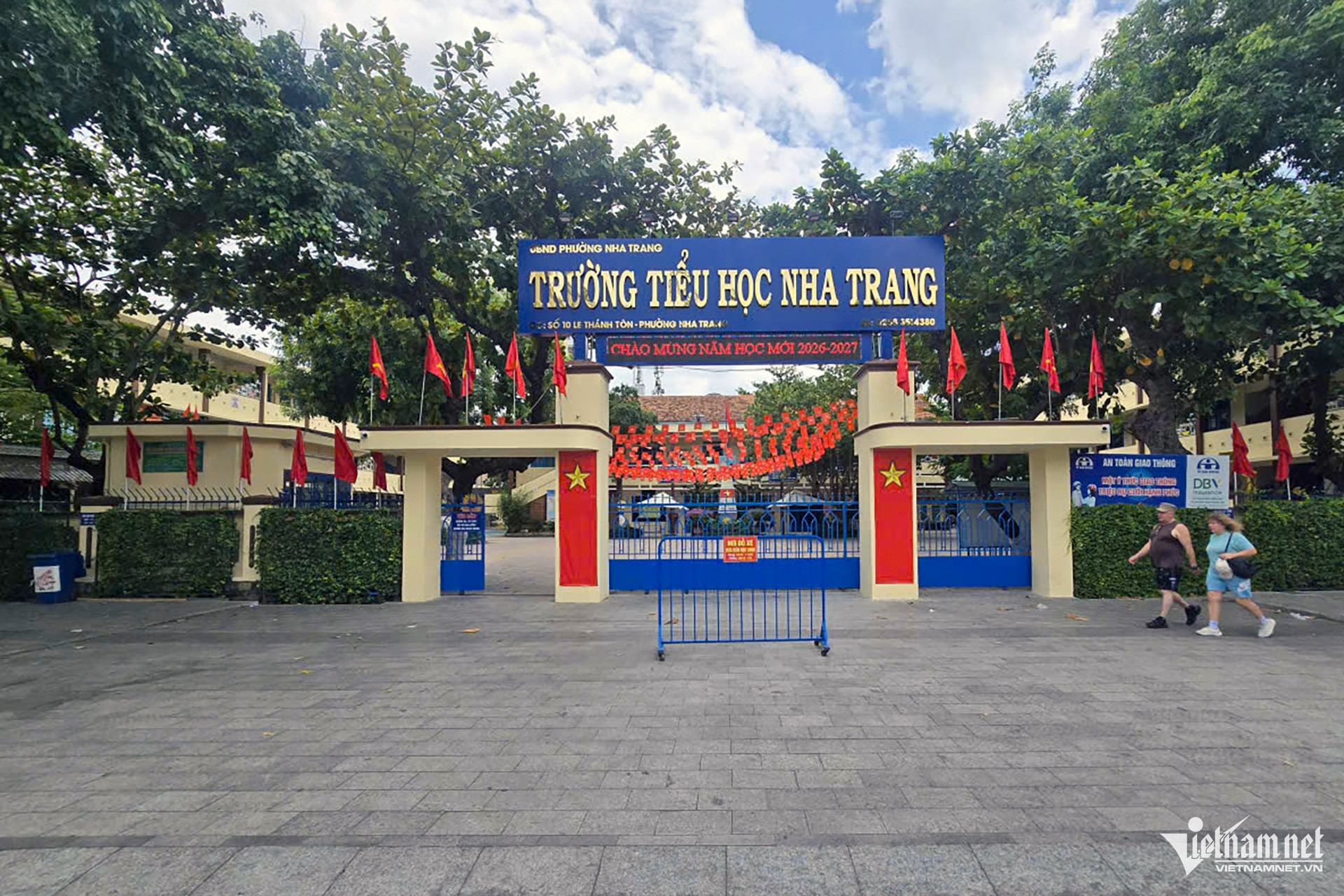
A school of more than 10,500 pupils
The Nha Trang Ward People’s Committee in Khanh Hoa Province has established Nha Trang Primary School by merging 13 primary schools in the area.
Under the new model, the school has its main campus at 10 Le Thanh Ton Street, along with 12 satellite campuses and five additional school sites. It has more than 10,500 pupils divided into 287 classes, with a workforce of 524 teachers and staff.
Notably, the school has 13 vice principals, corresponding to the number of schools involved in the merger. Its sheer scale makes Nha Trang Primary School one of the largest general education institutions in Vietnam in terms of pupil numbers and affiliated campuses.
The restructuring of Nha Trang Ward’s school network has also created unusually large institutions at other education levels. At the preschool level, 13 schools have been merged into a single institution with 124 groups and classes serving nearly 2,800 children. Meanwhile, a lower secondary school formed from the merger of seven schools now has 205 classes and nearly 8,800 students.
‘Merging schools does not automatically mean streamlining’
The emergence of schools on such an exceptional scale has raised questions about how effectively they can be managed after consolidation.
Dr. Le Dong Phuong, a former official at the Vietnam Institute of Educational Sciences, said the decision to merge 13 primary schools into an institution serving more than 10,500 pupils may not have fully taken into account the consequences for teachers and education administrators.
Managing a school, he argued, is not simply a matter of reducing the number of administrative units. Behind every school are pupils, teachers, administrators and educational relationships that must be organized and managed.
“Elsewhere, three to five schools might be merged into one. Here, they have merged 13 at once,” Phuong said.
He warned that such an approach could lead to school management being treated like an exercise in administrative bookkeeping. Schools, however, are distinctive organizations whose effectiveness cannot be measured solely by how many administrative units disappear after a merger.
“This does not sufficiently take into account the human factor and the relationships between pupils, teachers and administrators. The consequences for school management will be considerable and not easy to resolve,” Phuong said.
If the goal of consolidation is to streamline the apparatus and improve management efficiency, he said, policymakers need to consider reasonable limits on school size rather than focusing solely on reducing the number of administrative units.
As schools grow excessively large, management becomes increasingly difficult, while administrators may struggle to keep track of educational activities and individual pupils across different campuses.
“The best solution, in my view, is to separate it into schools of around 2,000 pupils as soon as possible. Allowing this model to remain in place for too long could have many consequences,” Phuong said.
He added that if problems have already emerged during the restructuring process, authorities should be willing to make adjustments.
Nguyen Van Ngai, former deputy director of the Ho Chi Minh City Department of Education and Training, said he was surprised by the decision to consolidate 13 schools into a single institution.
Ngai said school mergers are being carried out under a broader policy and are necessary in some circumstances. However, with as many as 13 schools involved in the Nha Trang case, he questioned whether local authorities had sufficiently assessed the plan and clearly defined the purpose and objectives of the merger.
His main concern is management capacity after consolidation. If 13 schools are reorganized into one institution, with one main campus and the other 12 operating as satellite campuses, he questioned whether a single leadership team could effectively oversee such an extensive system.
The key is not size, but organization and management
Offering a different perspective, an education administrator in Ho Chi Minh City said a school with more than 10,500 pupils was not necessarily too large. What mattered, he argued, was not the number itself but how the institution was organized and managed.
“A large school does not mean the principal has to directly manage every class, teacher or pupil. The current model consists of a main school, satellite campuses and additional school sites, with each satellite campus overseen by a vice principal. These are also administrators who managed the schools before the merger, so they understand their local areas, teaching staff and pupils,” he said.
In management terms, he added, the model could operate effectively if authority, responsibilities, data systems and oversight mechanisms were all clearly defined.
Companies can manage thousands or even tens of thousands of employees through delegated management structures, he noted. Universities likewise oversee tens of thousands of students through faculties, institutes, departments and multiple layers of administration.
For that reason, he said, the figure of 10,500 pupils alone should not be used to conclude that the school is too large or inherently difficult to manage. The real question is whether the post-merger governance model is appropriate, whether each level has sufficient delegated authority, and whether coordination and oversight mechanisms work effectively.
Le Huyen
.svg)
