 Vietnamnet.vn

 Podcast



The viral clip showing market surveillance officers inspecting 80kg of dried cicada shells on a passenger bus in Lang Son over the past few days has triggered intense debate across Vietnamese social media.
Some argued the authorities were simply doing their job.
Goods circulating on the market, they said, must have documents proving origin in order to control quality, prevent counterfeit products and combat commercial fraud.
But many others asked a different question altogether: how exactly is someone collecting cicada shells in the forest supposed to produce an invoice?
And from that moment, the story stopped being just about a few sacks of dried insects.
Instead, it touched a much deeper feeling that many people increasingly recognise in everyday life - the widening distance between how the administrative system operates and how ordinary people actually survive.
Because behind those bags of cicada shells are not images of large companies or professional traders, as some might imagine.
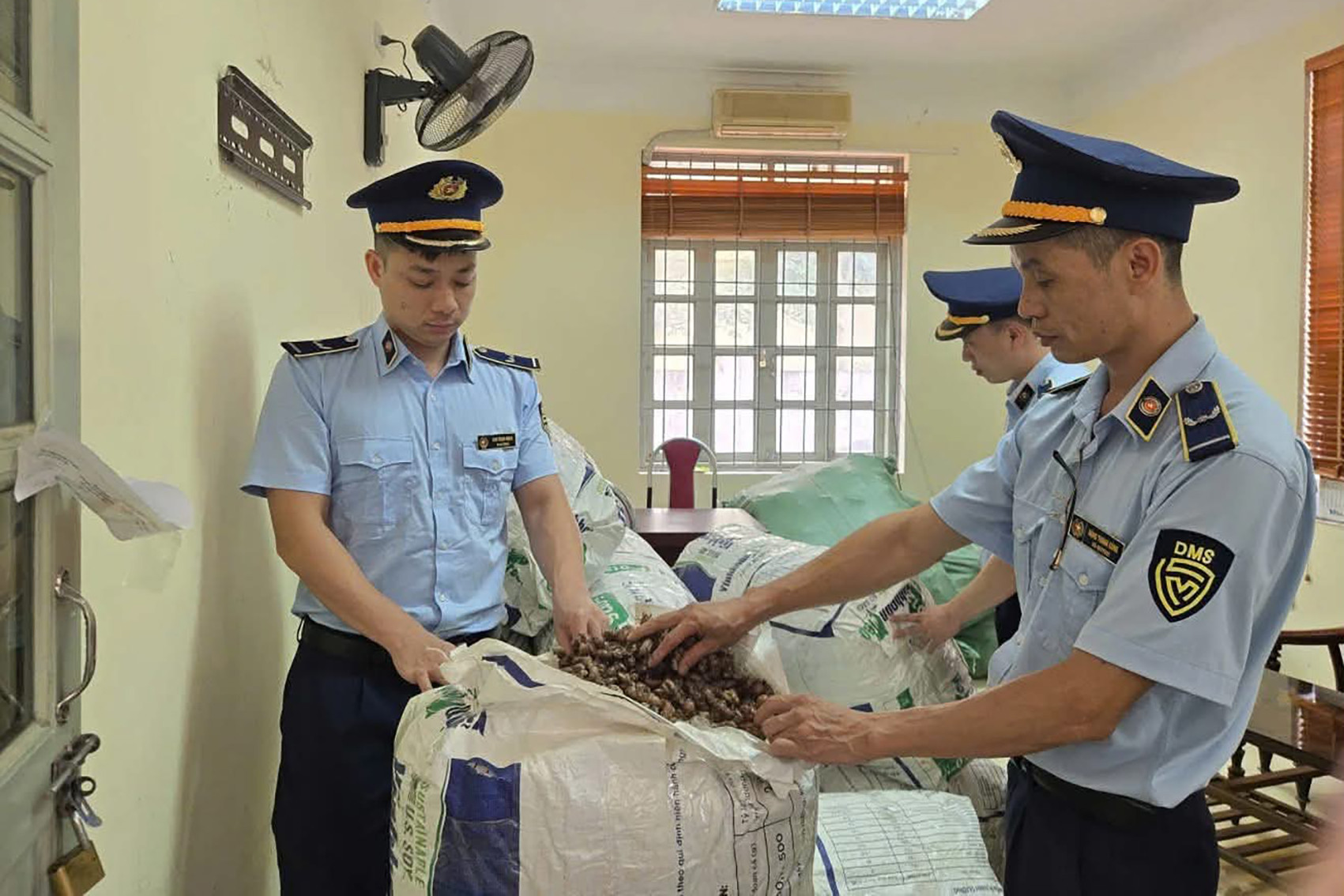
Market surveillance officers in Lang Son inspect the 80kg shipment of dried cicada shells. - Photo: D.X
Recent reports about the “cicada shell boom” in the Central Highlands and northern mountainous provinces paint a very different picture.
These are people from remote communities walking through forests at midnight with flashlights, searching for cicada shells attached to tree trunks and bushes.
Among them are women, elderly people and even children following their parents into the woods.
Some have reportedly been bitten by venomous snakes.
Others spend entire nights collecting only a few hundred grams of dried shells.
One child in the Central Highlands reportedly needed two days just to gather around 1kg of cicada shells to sell.
A woman in Gia Lai said she walks from evening until dawn, and on lucky nights she earns only enough money to buy rice for her family for a few days.
When cicada season ends, they return to unstable farm work and temporary labour jobs.
For many ethnic minority families, this is not a “business sector” in the conventional sense, and certainly not a path to wealth.
It is simply a seasonal source of income that helps make life slightly less difficult.
And it is precisely because of these very human stories that the 80kg cicada shell case in Lang Son sparked such a strong public reaction.
From the perspective of state management, it is understandable that authorities want goods moving through the market to have traceable origins, especially at a time when society is increasingly concerned about unsafe food, unregulated medicinal materials and commercial fraud.
In recent years, Vietnam has tightened regulations on invoices, declarations and origin tracing.
That direction is not wrong.
But reality remains far more complicated.
Much of rural and mountainous Vietnam still operates through tiny, highly informal transactions.
An ethnic minority resident collecting cicada shells in the forest will almost certainly never possess a VAT invoice.
For many of them, invoices are as unfamiliar as a foreign language.
Likewise, traders purchasing goods from hundreds of scattered households in mountainous regions can hardly be expected to maintain documentation standards identical to those of a major company.
Perhaps that is why, after public backlash, market surveillance authorities themselves clarified that “documents” could be interpreted more flexibly - including handwritten purchase lists, collection records or local government confirmations.
That detail alone is worth reflecting on.
At first, the requirement sounded rigid: “Invoices and documents are mandatory.”
But eventually, the authorities themselves returned to verifying handwritten lists, signatures and commune-level confirmations.
That reveals something important.
Even the management system understands that applying strict corporate-style paperwork requirements to informal rural supply chains would make compliance nearly impossible.
In the end, real life is always more complicated than written regulations.
Vietnam is moving toward tighter traceability, digital management and greater market transparency.
That is an inevitable and necessary trend.
But at the same time, this remains a country where tens of millions of people still rely on household economies, cash transactions, fragmented supply chains and deeply rural forms of survival.
A person collecting cicada shells in the forest likely never imagined they would one day become part of a national debate over invoices and supply-chain transparency.
That is why many people following the case are not truly worried about a few sacks of goods being inspected.
What concerns them more is the growing sense that ordinary people are finding it increasingly difficult to make a living without becoming entangled in some form of paperwork.
Notably, even local authorities do not appear to view the collectors themselves as lawbreakers.
A forestry official pointed out there are currently no regulations prohibiting people from entering forests to collect cicada shells.
And perhaps that leads to the most important question raised by the entire controversy: not everything can be managed in exactly the same way.
A large corporation is fundamentally different from a mountainous household selling a few seasonal sacks of medicinal materials.
Small-scale livelihood activities may require more practical oversight, simpler procedures and a gradual roadmap that allows people to become more formalised over time rather than forcing them into systems they are not equipped to navigate.
Because when a mountain villager collecting cicada shells must suddenly worry about invoices and declarations, the national debate is no longer really about cicadas at all.
Tu Giang
.svg)
