 Vietnamnet.vn

 Podcast



On January 24, 2025, the Politburo issued Resolution No. 59-NQ/TW on international integration in the new context. This groundbreaking directive marks a historic turning point in Vietnam’s global engagement and sets the path for a new era of development.
Affirming cultural strength in global discourse
In the cultural domain, the implementation of the strategic directions outlined in Resolution 59 is urgent. It contributes to building a progressive Vietnamese culture rich in national identity, while establishing Vietnam’s cultural status and brand on the global stage.
More than half a century ago, at the 1973 Paris Peace Conference that sought to end the Vietnam War, the image of Nguyen Thi Binh, Head of the Provisional Revolutionary Government delegation of South Vietnam, in her traditional ao dai entered history as a symbol of resilience, intellect, and cultural identity. That moment was a vivid demonstration of cultural soft power. In today’s context of national rise, cultural identity must continuously evolve, integrating modern and international elements to win hearts across the world.
Pride in cultural heritage abroad
Phan Bich Thien, Chairwoman of the Vietnamese Women’s Forum in Europe, shared that every Vietnamese community event in Hungary risks being confused with other Asian cultures if the traditional ao dai is absent. But when the ao dai appears, recognition is instant. Locals exclaim, “Vietnam! Vietnam!” Despite living in Europe for over 40 years, she wears the ao dai with pride at every occasion. Her two daughters, born and raised in Europe, also love wearing the ao dai. Today, not only women but many Vietnamese men also confidently wear the ao dai during celebrations.
In September 2024, the Vietnamese Ao Dai Heritage Club was launched in Europe, affirming the garment’s cultural value. In an era of globalization and information overload, individuals and nations must constantly ask: “Where do we stand in this flat world?” The answer lies in cultural identity. Many young Vietnamese who studied abroad from a young age find themselves unsure when asked about their homeland due to limited cultural grounding.
Motivated by personal need and national pride, many young people are returning to explore and promote Vietnamese culture. A prime example is the bilingual book Dệt nên triều đại (Weaving a Dynasty) by the Vietnam Center (VNC), which explores Vietnam’s royal costumes. Co-author Le Ngoc Linh admitted that she only truly appreciated Vietnam’s cultural value after moving abroad, where longing for her roots fueled a deep pride in sharing Vietnamese heritage with the world.
Cultural identity: the core of global integration
Vietnam’s culture is more than just ao dai and conical hats. With thousands of years of history, the country boasts a priceless treasure trove of cultural values: over 40,000 relics, 8,000 festivals, and thousands of intangible cultural heritages ranging from folk knowledge to performing arts.
Vietnam’s cultural unity thrives in diversity, spanning the colorful expressions of its 54 ethnic groups. This includes unique forms found in highlands, river deltas, coastal, and maritime regions.
Acknowledging these immense values, the Communist Party previously issued Resolution No. 5 of the 8th Central Committee on building an advanced Vietnamese culture deeply rooted in national identity. This resolution laid the cultural foundation for international integration and was later reinforced in Party views that describe culture as the spiritual cornerstone of society, a goal and driving force for socio-economic development.
New, practical perspectives have led to specific measures for cultural preservation, affirming Vietnam’s global cultural presence. Today, one cannot speak of Vietnam without mentioning the Imperial Citadel of Thang Long in Hanoi - its thousand-year-old dynastic sediment and untapped archaeological treasures. UNESCO experts call it a model for heritage preservation. Likewise, Hue’s ancient capital, with its moss-covered palaces and memories of Vietnam’s final monarchy, embodies the solemn beauty of royal culture.
Hoi An Ancient Town in Quang Nam still preserves centuries-old evidence of international trade. Meanwhile, Trang An in Ninh Binh is a harmonious convergence of man-made and natural heritage. Vietnam’s intangible cultural heritages, recognized by UNESCO - such as the Central Highlands gong culture, Hue royal court music, Bac Ninh folk songs, the worship of Mother Goddesses, and Thai Xoe dance - continue to shine globally.
The more Vietnam protects and promotes its cultural heritage, the more it affirms its internal strength. These heritages are not dormant - they drive socio-economic development, cultural industry growth, and global appreciation, drawing more visitors to Vietnam.
Creativity to expand and inspire
Vietnam is entering a new era, facing new demands and challenges. Resolution 59 lays out concrete tasks for the culture and tourism sectors, urging all stakeholders to act proactively. Beyond enhancing cultural soft power, Vietnam must build a competitive cultural industry.
For years, cultural preservation in Vietnam followed a “freeze and protect” model. While effective in some ways, this approach limited adaptability. Professor Nguyen Chi Ben, former Director of the Vietnam National Institute of Culture and Arts, argued that creativity must be integral to preservation. Without innovation, traditions lose relevance and fade from everyday life.
UNESCO’s 2005 Convention on the Protection and Promotion of the Diversity of Cultural Expressions echoes this idea, emphasizing the need to express, enrich, and share cultural heritage through creative methods, production, and enjoyment of cultural products and services.
In practice, merging tradition with contemporary and international values strengthens Vietnam’s cultural soft power and global recognition. For example, while thousands of media products have celebrated Bac Ninh culture, it was the viral success of singer Hoa Minzy’s Bắc Bling music video that propelled Quan Ho folk songs, Dau Pagoda, But Thap Pagoda, and Phu Lang pottery village to a global audience. The video reached 223 million views in just three months.
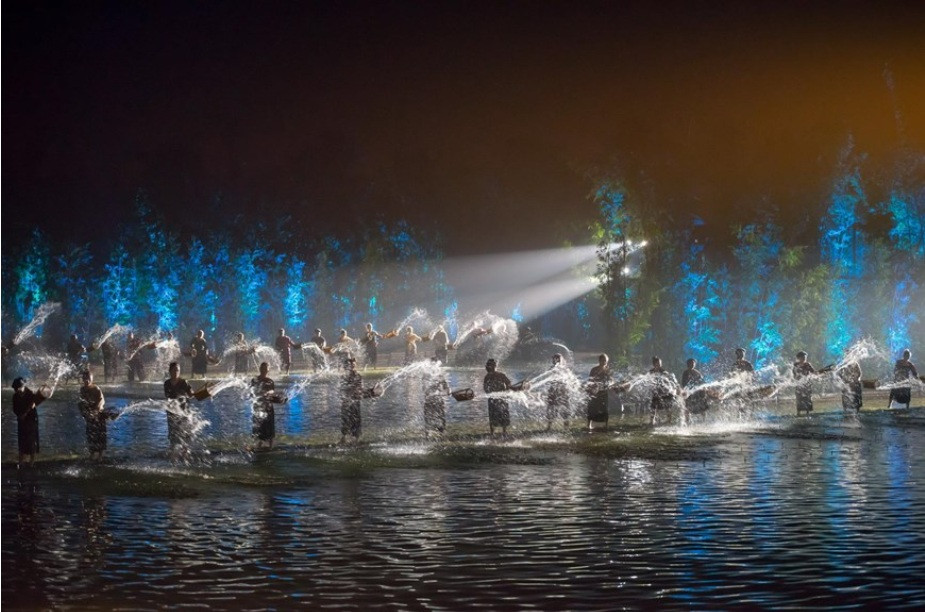
Without creative storytelling, conveying the everyday spiritual and intellectual life of Northern Vietnam’s people - from farming and education to spiritual rituals - would be challenging. But the live performance The Quintessence of Tonkin (by Tuan Chau Hanoi Company) encapsulates it all in a 75-minute show. Similarly, the real-scene show Hoi An Memories tells the layered cultural story of the ancient town. Both shows have earned international acclaim.
Creative methods rooted in heritage are increasingly diverse - ranging from direct reinterpretation to inspiration-based innovation and traditional-modern integration.
A striking example is director Nguyen Quoc Hoang Anh, founder of the “Len Ngan” cultural collective. With his team, he stages multidisciplinary performances blending traditional arts like tuong, cheo, and chau van with contemporary forms such as jazz, hip-hop, and electronic music. This fusion resonates with youth and international audiences alike.
Complementing Resolution 59, the Politburo has issued additional directives: Resolution No. 68 on private economic development, and Resolution No. 57 on science, technology, innovation, and national digital transformation. These policies provide a powerful foundation for Vietnam’s cultural industry, inspiring investment, innovation, and global positioning of Vietnamese culture.
Tien Phong
.svg)
