 Vietnamnet.vn

 Podcast



Vietnam's demographic dividend is expected to end in 2036, three years earlier than previously projected, while the country is forecast to become an ageing society sooner than expected, according to the latest population projections released by the General Statistics Office.
The revised outlook highlights a narrowing window for Vietnam to maximise the economic benefits of its large working-age population before demographic ageing places increasing pressure on the labour market and social welfare system.
Just a decade of opportunity remains

Vietnam officially entered its demographic dividend period in 2007, when children aged 0–14 accounted for less than 30% of the population and people aged 65 and above represented less than 15%.
During this phase, there are roughly two working-age people supporting every dependent, creating favourable conditions for economic growth and human capital development.
Between 2024 and 2035, the working-age population (15–64 years) is projected to remain high, declining only slightly from 67.4% to 66.9% of the total population.
Demographers say this large labour force continues to provide an important advantage for economic development.
However, by 2036, the proportion of people aged 65 and over is expected to reach 15%, marking Vietnam's official exit from the demographic dividend period.
That is three years earlier than projected in population forecasts published in 2019.
Nguyen Dinh Cu, former director of the Institute of Population and Social Issues at the National Economics University, said such an opportunity occurs only once in a country's history and typically lasts between 30 and 45 years.
Vietnam has already benefited from about 20 years of its demographic dividend and now has roughly 10 years remaining, he said.
Quality matters as much as numbers

Despite the favourable age structure, researchers caution that Vietnam's demographic dividend has so far been driven more by numbers than by workforce quality.
Experts argue improvements are still needed in education, vocational skills, labour productivity and workers' ability to adapt to technological change.
Nguyen Dinh Cu described the coming decade as a crucial period during which Vietnam could achieve economic breakthroughs similar to those experienced by Japan and South Korea.
He said the country should urgently improve three key indicators: increasing the share of working-age people who are employable, ensuring more of those who can work actually have jobs, and raising labour productivity and incomes.
He also called for greater investment in the physical health and development of young people.
Population ageing accelerating
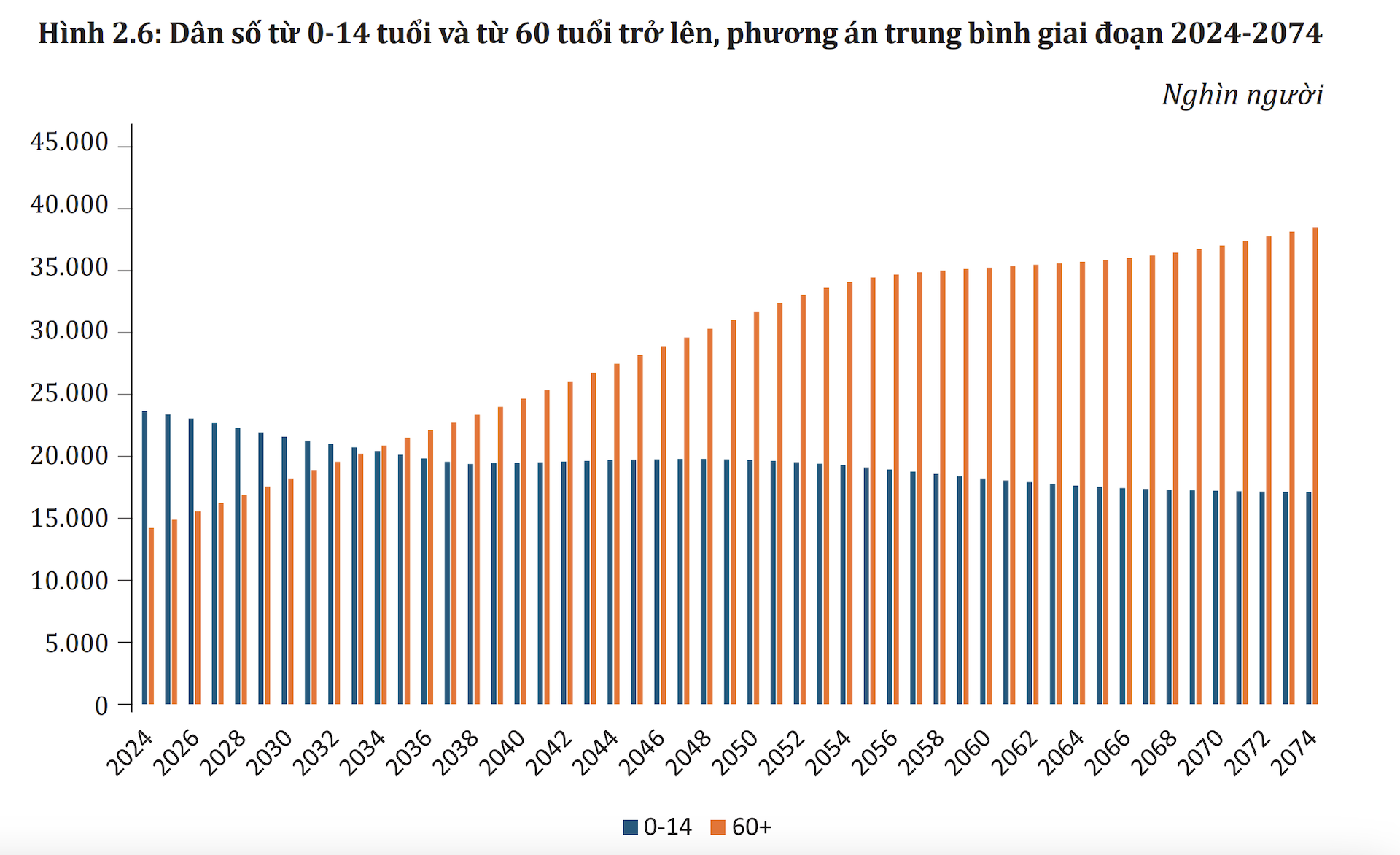
After 2036, Vietnam's population is expected to age rapidly.
The number of people aged 65 and above is projected to rise from 9.4 million in 2024 to 20.5 million by 2044, before reaching 31.2 million by 2074.
In 2024, Vietnam's ageing index stood at 60.2%, meaning there were about 60 older adults for every 100 children.
By 2034, older people are expected to outnumber children for the first time, marking Vietnam's transition into an ageing society under the medium population scenario.
This milestone is now forecast to occur two years earlier than estimated in 2019.
As a result, Vietnam is expected to experience a unique three-year overlap between 2034 and 2036, during which it will still benefit from a demographic dividend while simultaneously entering the ageing society stage.
Demographers say this overlap underscores the urgency of accelerating reforms to prepare for the country's demographic transition.
Growing pressure on the economy
By the end of the forecast period, there are expected to be nearly 225 older adults for every 100 children.
Whereas there is currently about one older person for every two children, by 2074 there will be roughly four older adults for every two children, significantly increasing pressure on the working-age population and Vietnam's social security system.
Vietnam's ageing society phase is projected to last from 2034 to 2049.
From 2050 onwards, the country is expected to enter a "super-aged" stage, with people aged 65 and above accounting for more than 21% of the population.
By 2074, older adults are projected to make up 27.3% of the population - similar to the level Japan faces today.
Meanwhile, life expectancy at birth continues to improve, reaching 74.7 years in 2024, an increase of 1.1 years compared with 2019.
Population projections indicate life expectancy will continue rising by 0.5 to 0.6 years every five years between 2024 and 2064, before the pace of improvement gradually slows.
Vo Thu
.svg)
