 Vietnamnet.vn

 Podcast



Once capable of generating billions of dong in annual revenue, sturgeon farming using natural spring water in the mountainous areas of Thanh Hoa Province is now facing mounting difficulties as falling prices and unstable demand push many households toward financial losses.
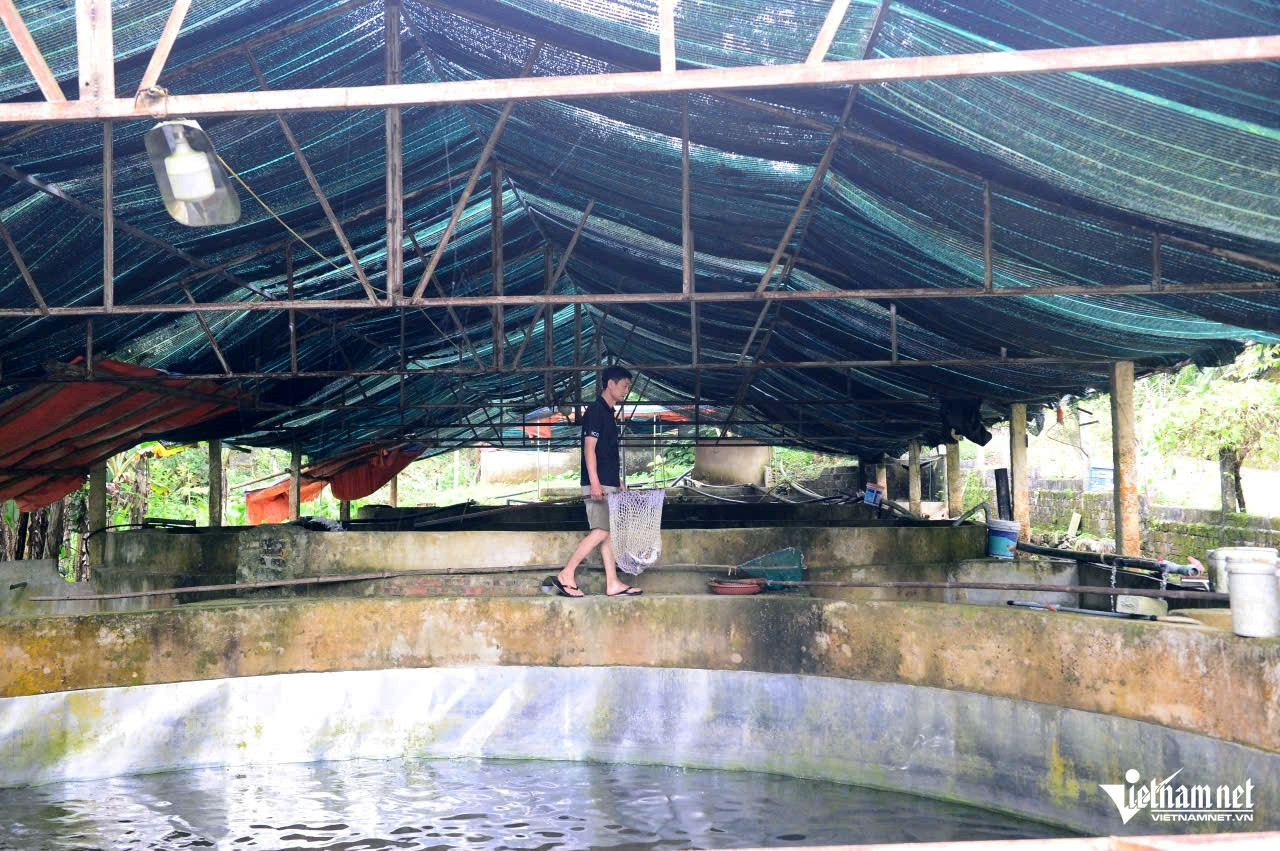
Deep in the mountainous commune of Linh Son, Thanh Hoa Province, the sturgeon farm owned by Ha Khac Sam sits quietly against a forested hillside, surrounded by streams flowing from the mountain’s headwaters.
Few would imagine that building the farm required an investment worth billions of dong. To sustain the operation, Sam constructed a system of pipes stretching more than 1.5 kilometers to channel water from the Ta Stream atop Pu Rinh Mountain in the Chi Linh range.
In 2010, he invested more than VND400 million ($15,300) to begin raising sturgeon. At first, he built three breeding ponds covering around 300 square meters and stocked more than 6,000 fingerlings.
But just nine months later, when the fish were nearly ready for sale, a devastating flood swept away the entire farm, leaving the family with nothing.
Refusing to give up, Sam borrowed more than VND1 billion ($38,300) in 2012 to expand the operation, building six commercial breeding ponds and five hatchery ponds.
During the early years, the business proved highly profitable. Each year, his family sold around 14 tons of commercial sturgeon. With prices ranging from VND250,000 to VND280,000 ($9.60-$10.70) per kilogram, annual revenue reached VND3.5-4 billion ($134,000-$153,000).
However, Sam said the situation has changed dramatically over the past two years as cheap imported sturgeon increasingly dominates the market.
“Previously, sturgeon sold for VND250,000 to VND280,000 per kilogram, but now we have to lower prices to around VND180,000-200,000 ($6.90-$7.70), and sales are still very slow,” he said. “Restaurants that used to buy fish from us regularly are now purchasing only small quantities.”
According to Sam, imported industrially farmed sturgeon can be sold at much lower prices, making competition extremely difficult. Meanwhile, naturally raised sturgeon like his require far higher investment and operating costs.
“Sturgeon raised in natural spring water has firmer, more flavorful meat and many diners consider it superior in quality,” he explained. “But most consumers mainly look at the price, so small-scale farmers like us struggle to compete.”
Rising costs and climate risks add pressure
Beyond declining prices, maintaining the farming system itself has become increasingly burdensome.
With 11 ponds currently operating, feed costs alone exceed VND100 million ($3,800) each month, creating heavy financial pressure as selling prices continue to fall.
Natural spring-water farming also comes with significant environmental risks. During the rainy season, runoff from upstream often turns the water muddy, carrying sediment that can shock the fish and cause mass die-offs.
“Last year, prolonged heavy rain made the water extremely muddy and many fish died. The losses were severe,” Sam said. “Sturgeon farming depends entirely on natural water sources, so farmers are constantly worried. Now that prices are also dropping sharply, people feel even more insecure.”
The situation has made many local households hesitant to expand production, despite sturgeon farming once being viewed as one of the most promising economic models in the mountainous areas of Thanh Hoa.
According to representatives of Linh Son Commune People’s Committee, the early success of Sam’s farm inspired several local families to follow the model. Currently, the commune has three sturgeon farms, though Sam’s remains the largest operation.
Local officials believe the model can only develop sustainably if farmers receive stronger support in connecting with buyers, building product brands and stabilizing market demand.
Le Duong
.svg)
