 Vietnamnet.vn

 Podcast



The workshop, chaired by Deputy Minister of Ethnic and Religious Affairs Nguyen Hai Trung, focused on two key areas of the draft implementing decree: religious and belief activities conducted in cyberspace, and worship activities held outside officially recognized religious establishments.
Participants included policymakers, legal experts and academics from the Ministry of Justice, Ministry of Public Security, Ministry of National Defence, Ministry of Culture, Sports and Tourism, the National Assembly's committees, the Ho Chi Minh National Academy of Politics, Vietnam National University, Hanoi, and the Hanoi Department of Ethnic and Religious Affairs.
Practical implementation is the biggest challenge
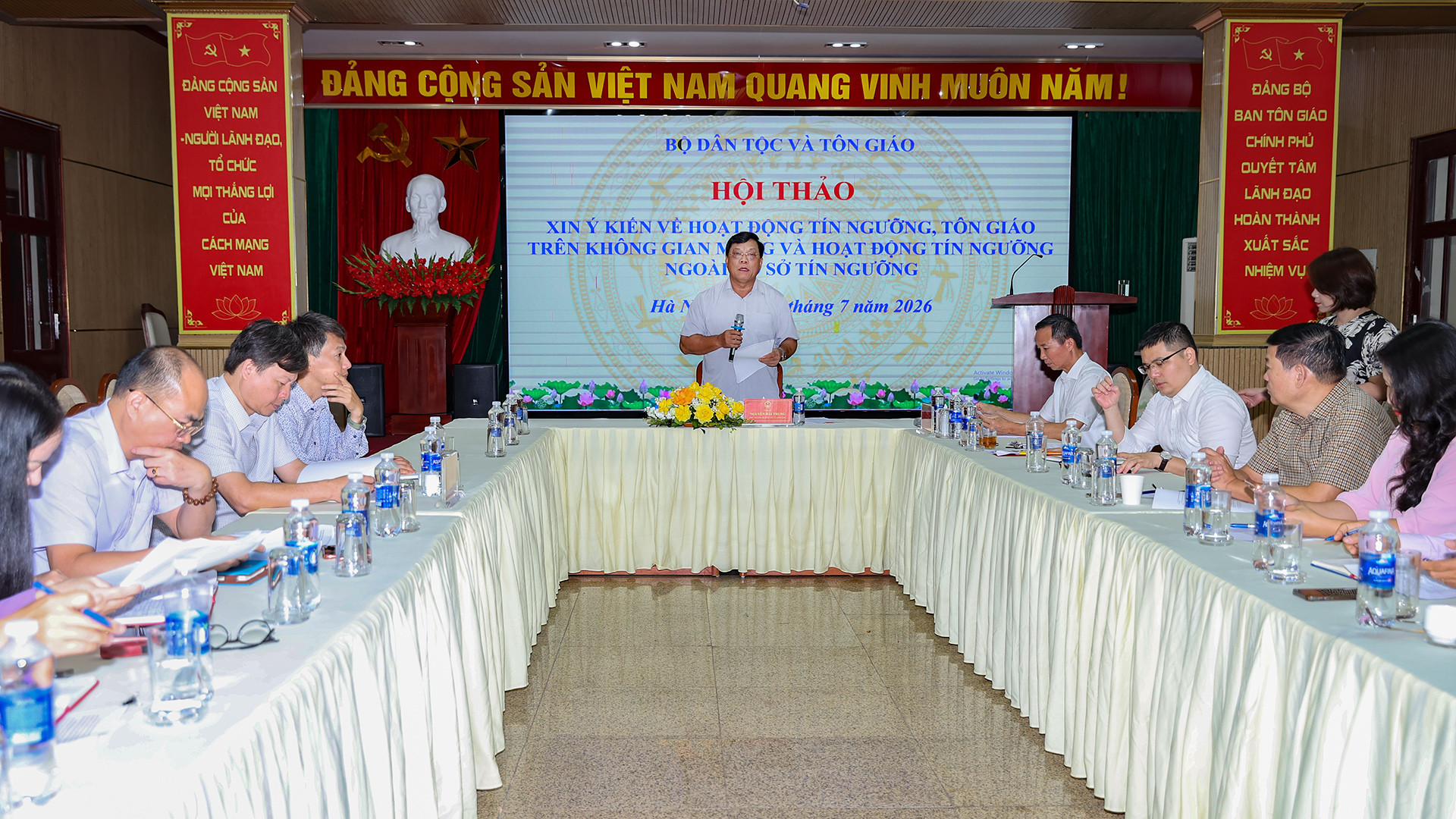
Participants attend the consultation workshop on the draft implementing decree for Vietnam's revised Law on Belief and Religion in Hanoi on July 9, 2026. Photo: Le Anh Dung.
Opening the workshop, Deputy Minister Nguyen Hai Trung noted that the revised Law on Belief and Religion, passed by the 14th National Assembly, will take effect on January 1, 2027.
The amended law requires the Government to issue detailed regulations for approximately one-third of its provisions. A draft decree containing seven chapters and 78 articles has already been prepared.
Nguyen Hai Trung described drafting the implementing decree as both a highly significant and particularly challenging task.
"Whether the law can truly be implemented depends entirely on how detailed and practical this decree is. Without clear provisions, the law risks becoming ineffective in practice," he said.
Rather than seeking comments on the entire draft at once, the drafting committee has adopted a more focused consultation process, organizing discussions around specific policy issues to draw on specialized expertise.
The Deputy Minister said this approach would help improve the quality and practicality of the final decree.
Online religious activities require clear legal safeguards
The revised law introduces a new provision governing belief and religious activities conducted online, defining eligible participants and the responsibilities of relevant organizations and authorities.
Workshop participants broadly agreed that online religious activities should be subject to the same rights and obligations that apply offline.
They proposed limiting online religious activities to legally recognized religious organizations and individuals while ensuring that misuse of digital platforms to spread false information or defame others is dealt with in accordance with the law.
Experts also recommended requiring electronic identity verification for online religious activities, strengthening oversight of websites and social media accounts, and developing an appropriate legal framework to address cross-border religious content.
Registration needed for certain public religious activities
Participants also discussed regulations governing religious and belief activities conducted outside officially recognized religious facilities.
Many argued that the decree should clearly define which activities require prior registration, particularly those held in public spaces or likely to affect public order and security.
Experts stressed the need to prevent the commercialization of spiritual activities, especially cases in which religious elements are used within tourism developments for commercial gain.
At the same time, they cautioned against creating unnecessary administrative barriers that could restrict citizens' constitutionally protected freedom of belief and religion or exceed the National Assembly's legislative authority.
Clear responsibilities and enforceable rules
Closing the workshop, Deputy Minister Nguyen Hai Trung thanked participants for their constructive recommendations and said the drafting committee would carefully consider all feedback.
He acknowledged that implementing the revised law presents significant legal and administrative challenges.
Regarding online religious activities, he said the current draft duplicates administrative procedures that already exist for offline activities and should therefore be reorganized.
He instructed the drafting committee to redesign the relevant provisions so they clearly identify eligible participants and permitted activities based on existing legal provisions.
Organizations and individuals should only be allowed to conduct religious activities online after completing the corresponding administrative procedures offline, including registration, notification or approval where required.
The Deputy Minister also called for clearer provisions defining the responsibilities of religious organizations, government agencies and relevant authorities responsible for cybersecurity and telecommunications.
He further recommended adding prohibited acts and enforcement measures applicable to violations committed online.
Regarding registration requirements for religious activities outside established places of worship, Nguyen Hai Trung said the criteria should focus on activities that could affect public order or social safety.
The regulations, he said, should be specific enough to support effective enforcement while remaining proportionate and legally justified.
He urged the drafting committee to continue working closely with experts and relevant agencies to refine the decree before submission.
Sy Hao
.svg)
