 Vietnamnet.vn

 Podcast



Vietnam has set an ambitious target of nurturing three to four new strategic technology unicorns by 2030, with priorities placed on artificial intelligence (AI), semiconductors, and green technology, as the country’s startup ecosystem enters a phase of deep regional integration.
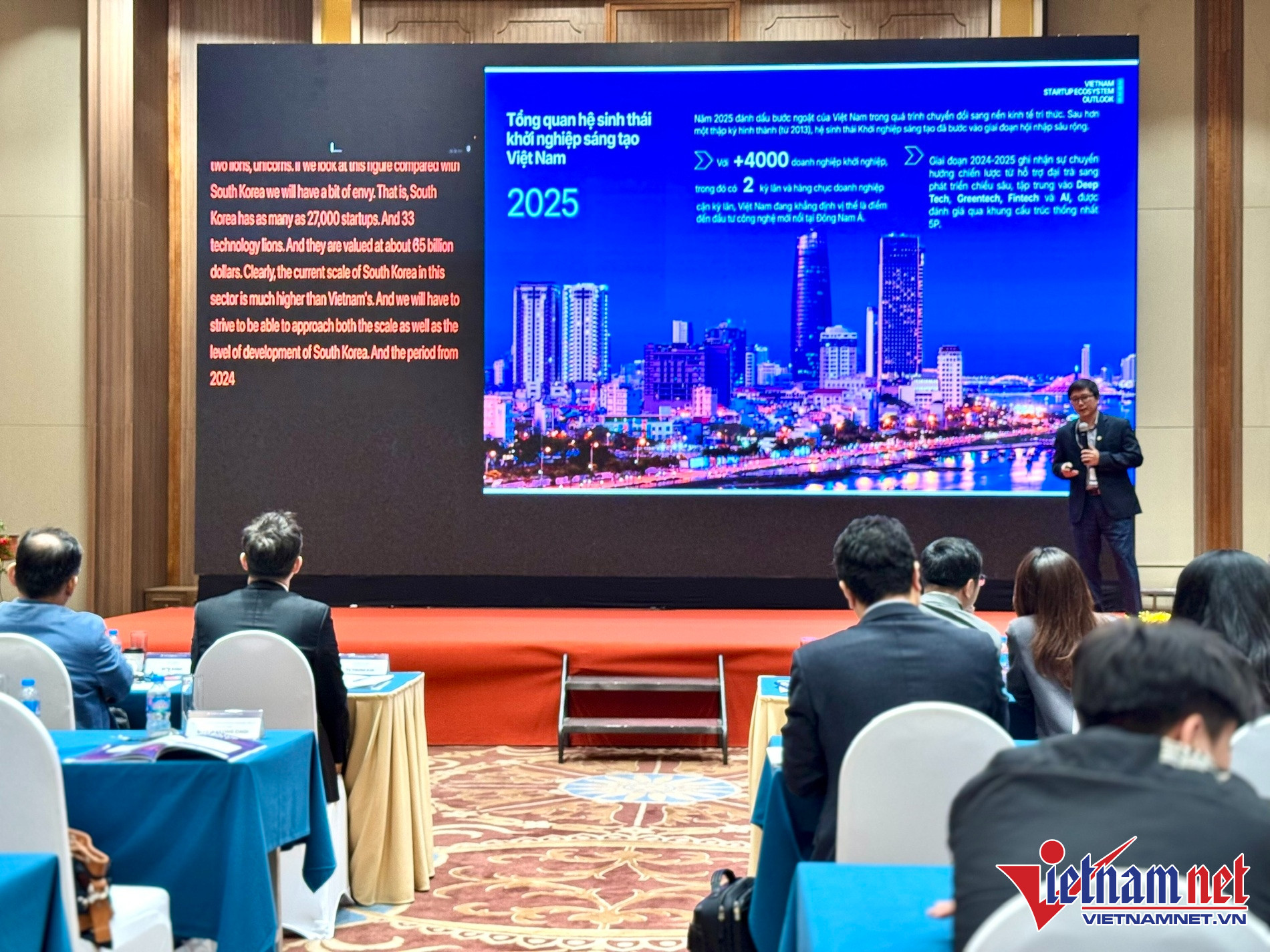
Luong Van Thuong, Head of the Innovative Startup Department under the Department of Startup and Technology Enterprises (Ministry of Science and Technology), presents an overview of the Vietnam Innovative Startup Ecosystem 2025 Report.
The Vietnam Innovative Startup Ecosystem 2025 Report, released on December 12 during Techfest 2025, highlighted that after more than a decade of development, the ecosystem is now strongly integrating into regional and global markets. Currently, Vietnam is home to over 4,000 startups, including two unicorns and dozens of near-unicorn enterprises, making the country an attractive hub for tech investment in Southeast Asia.
At the event, Luong Van Thuong, Head of the Innovative Startup Department under the Department of Startup and Technology Enterprises (Ministry of Science and Technology), stated: "Vietnam expects to have three to four more unicorns by 2030, focusing on 11 strategic technologies, with top priorities being AI, semiconductors, and green tech."
The 2025 report, considered more data-driven than previous editions, reflects a shift in policy - from broad-based support to targeted investment in high-impact sectors. A notable highlight is the plan to establish a National Venture Capital Fund with initial state funding of approximately USD 20 million, aiming to scale up to at least USD 100 million.
Local governments are also encouraged to create their own venture funds using municipal budgets as seed capital to attract private and international investors.
Explaining why the fund will be structured as a joint-stock or two-member limited liability company, Thuong noted: "We want the state to simply act as an investor, allowing private organizations and investors to participate and co-manage the fund. This is a 'public investment, private governance' model inspired by developed countries like Singapore and South Korea."
The report continues to evaluate the ecosystem based on the 5P model: Policy, Progress, Capital, Planet, and People. It notes institutional breakthroughs, particularly with Resolutions 57, 59, and 66, and a shift in startup focus from e-commerce to AI and the creative economy.
According to the United Nations Development Programme (UNDP), Vietnam has moved into a phase of deploying and systematizing AI. The country now hosts 765 AI/ML startups, and private capital in this sector surged eightfold in 2024, reaching USD 80 million. Total venture capital investment hit USD 398 million across 118 deals, led by B2B digital transformation, agri-tech, and AI.
Under the “Planet” pillar, the Net Zero 2050 target is spurring opportunities in clean energy, recycling, and carbon credit markets, though Vietnam still grapples with reliance on imported core technologies. In the “People” pillar, support for women and youth-led startups is being reinforced via Programs 939 and 1665, with deeper involvement from the Ministry of Foreign Affairs and the Ministry of Finance.
The report also tracks eight emerging sectors, including climate tech, creative economy, senior tech, edtech, plastic innovation, electric vehicles, and the global Vietnamese startup community. According to Thuong, Vietnam plans to pilot a carbon credit trading platform in 2026, while the senior startup program will position retirees as mentors for younger founders.
For the first time, the Ministry applied social listening analysis in compiling the report. It found 2025 to be a year of emotional turbulence: starting in gloom and concern, gaining momentum mid-year due to new policies, and ending in a bittersweet mix of pride and disillusionment, stirred by scandals involving prominent startup figures.
Du Lam
.svg)
