 Vietnamnet.vn

 Podcast



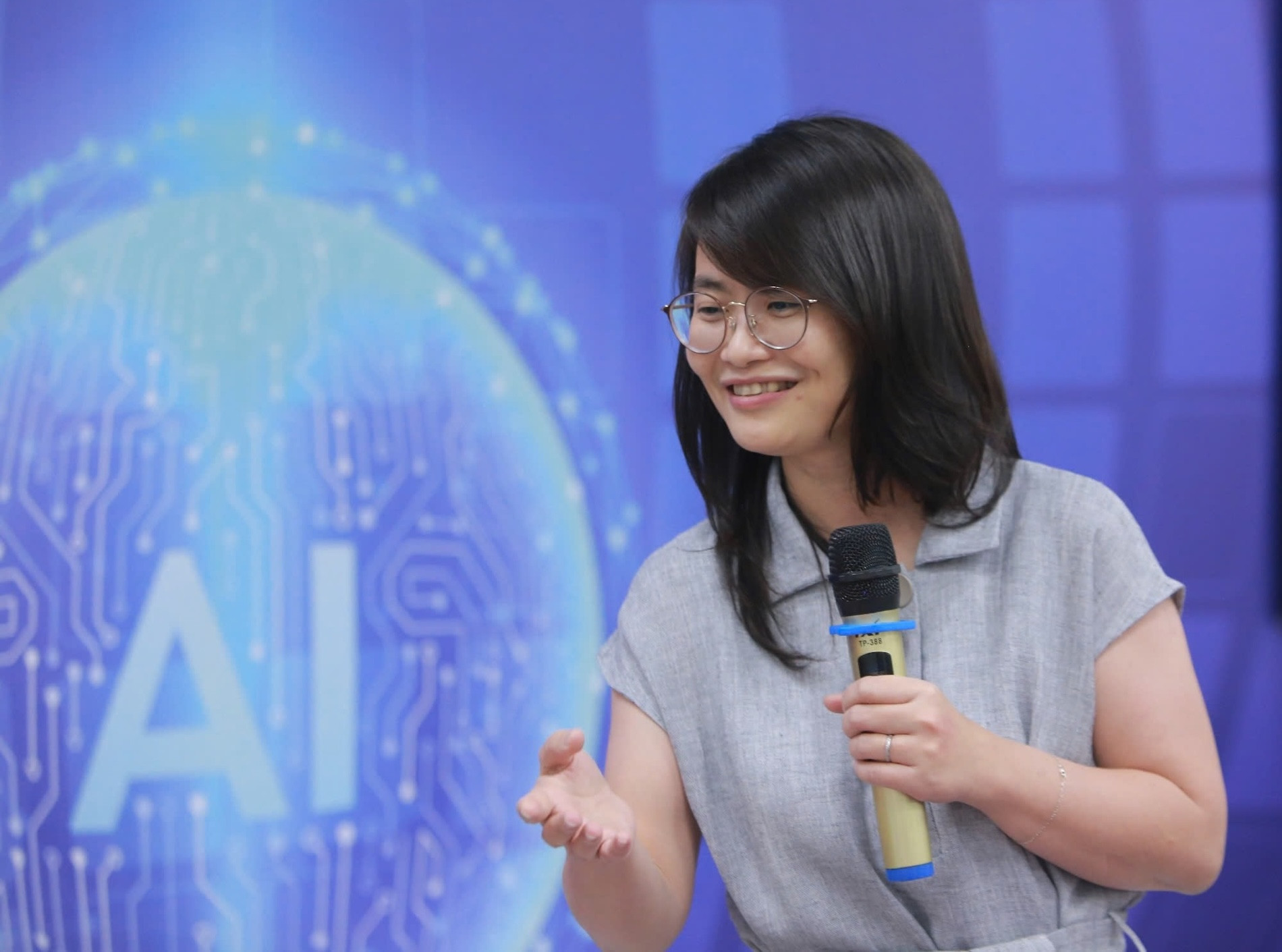
According to Nguyen Phi Le, most engineering programs at Vietnamese universities last four years. If all foundational and advanced AI knowledge is packed into that period alone, it may be difficult to achieve sufficient depth.
“AI is not just about programming. It requires a solid mathematical foundation, especially in probability and statistics, linear algebra and calculus. If students begin preparing for these areas from the end of lower secondary school and throughout high school, they will have a significant advantage when entering university,” she said.
In addition, AI is not simply a branch of computer science. Many students who excel in competitive programming are not necessarily well suited to AI.
The field requires strong modeling skills and deep mathematical reasoning, which differ from the algorithmic thinking used in traditional programming competitions.
For this reason, students interested in pursuing AI at an advanced level need proper guidance and systematic training beginning in high school.
Nguyen Phi Le noted that in some countries, secondary school students already study probability theory, discrete mathematics and programming languages such as Python, while also exploring basic AI problems.
With early preparation, students entering university can quickly move on to machine learning and model development rather than merely using AI as a tool.
She believes Vietnam should identify students with strong mathematical aptitude, logical thinking, programming ability and a genuine interest in AI.
Without early guidance that AI is not only something to use but also something they can train and design themselves, students may follow familiar academic paths and miss opportunities to pursue deeper research.
Elite AI training requires specialized programs
Currently, the Ministry of Education and Training has begun piloting AI education at the school level. However, Nguyen Phi Le noted that mass education and elite training are fundamentally different approaches.
General education helps students understand what AI is and how to use it responsibly.
But to become AI researchers or specialists, students must go further. They need to understand the mathematical foundations of AI, including probability theory and statistics, grasp basic concepts of matrices and machine learning algorithms, and eventually participate in real-world AI projects and academic research.
In recent years, Hanoi University of Science and Technology has organized the Vietnam Artificial Intelligence Championship to identify young talent.
The university has also established the AIstein Young Talent Club for high school students, giving them opportunities to study AI systematically, learn mathematical foundations and machine learning, participate in research projects and write academic papers related to AI.
However, Nguyen Phi Le believes that to develop a truly strong elite AI workforce, Vietnam must build structured curricula and teaching materials specifically designed for high school students with strong interest and ability in AI.
Such programs should follow a clear learning pathway rather than relying on short-term training initiatives.
She also suggested that Vietnam should establish specialized centers or collaborative models linking high schools with universities to both identify and train promising students.
This system could form a continuous pathway, supporting students in learning and researching AI from an early stage through university and even postgraduate studies.
In this process, policymakers play a particularly important role. Relevant ministries and agencies could organize a national competition for talented AI students or introduce policies that recognize and support students participating in international AI Olympiads.
Such initiatives would motivate both students and schools to invest more seriously in the field.
“In the context where international competitions such as the International Artificial Intelligence Olympiad (IAIO) and the International Olympiad in Artificial Intelligence (IOAI) have emerged since 2024 and are becoming increasingly popular, developing an official training strategy is becoming more urgent than ever,” Nguyen Phi Le said.
“Without early preparation, Vietnamese students will struggle to compete in this new arena.”
Thuy Nga
.svg)
