 Vietnamnet.vn

 Podcast



In June 2026, through an information-sharing channel between Vietnam’s Domestic Market Surveillance and Development Authority and US Homeland Security Investigations (HSI), the Vietnamese agency received initial intelligence about an operation suspected of manufacturing Nike shoes in Vietnam for export to the United States.
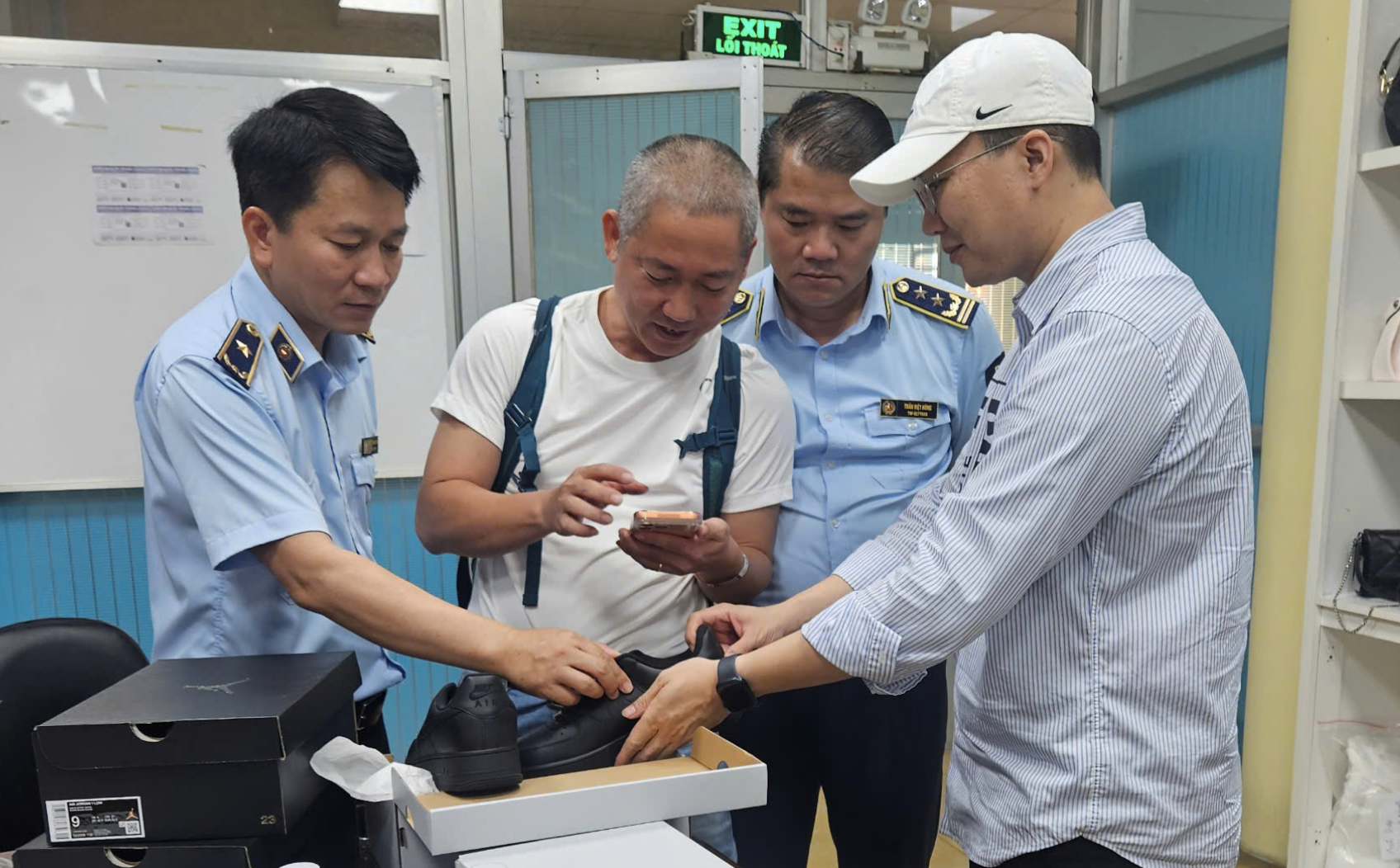
Immediately after receiving the information, the authority worked with HSI and moved swiftly to verify the intelligence, gather information and prepare an inspection plan, keeping the operation confidential to prevent the suspected goods from being dispersed.
The investigation revealed that the scale of the case was far greater than initially reported. From an estimated 12,000 pairs of suspicious shoes, authorities eventually identified nearly 50,000 pairs being processed at the manufacturing facility, with the suspected counterfeits virtually indistinguishable from genuine products to the naked eye.
Even the authentication code on each pair had allegedly been copied from genuine products. Most seriously, a portion of the goods had already been exported to the US market.
Believing that the remaining goods could be completed and subsequently exported, the authority on July 16 issued a decision to inspect compliance with laws governing the production and trading of goods at MP Company, headquartered in Ho Chi Minh City. The inspection was conducted in coordination with Department A05 under the Ministry of Public Security and local police.
At the time of the inspection, authorities discovered that the company was producing and storing large quantities of finished and semi-finished footwear bearing the “NIKE,” “NIKE AIR” and “AIR JORDAN” trademarks.
Inspectors recorded 25,396 pairs of finished shoes bearing Nike and Air Jordan trademarks, valued at more than VND12.3 billion (US$470,000). They also discovered 20,875 pairs of shoe uppers and 10,800 pairs of soles bearing Nike signs that were still being completed, valued at more than VND11.2 billion (US$430,000). Based on estimated market prices, the total value of the goods exceeded VND100 billion (US$3.8 million).
During the inspection, company representatives said all the goods had been manufactured under a processing contract signed with F.C.T Company. According to their explanation, raw materials were supplied by an overseas partner, while the Vietnamese company processed the products according to orders and returned the finished goods to the partner for export.

The company presented documents including the processing contract, email correspondence with its partner, what it described as authorization to use Nike trademarks, and export records to explain the origin of the shipment.
According to documents provided by the company, from the beginning of 2026 until the inspection, it had successfully exported 11 containers of finished footwear bearing Nike and Air Jordan trademarks to the US market, with a total declared value of more than VND25.46 billion (US$970,000).
However, according to written confirmation from Nike Vietnam and a letter from a senior director of Global Licensing at Nike Inc., Nike said it had never granted any license, licensing agreement or authorization to MP Company or L.L.C. It also said it had not authorized these organizations or individuals to represent or act on behalf of Nike in business activities.
Based on the physical inspection, documents supplied by the company, confirmation from the rights holder and information shared by HSI, inspectors determined that the goods showed signs of infringing and counterfeiting trademarks protected in Vietnam.
The case involves not only a substantial volume of goods but also a cross-border dimension, with organizations and companies in the United States, China and Vietnam involved.
Tran Huu Linh, head of the Domestic Market Surveillance and Development Authority, said: “The significance of this discovery goes beyond dealing with a single violation. It has revealed a method of infringement that may still be widespread in the market, involving multiple parties and potentially even collusion.”
The Domestic Market Surveillance and Development Authority has drawn up an inspection record and applied preventive measures in accordance with regulations. It is continuing to strengthen the case file and expand its investigation into the origin and provenance of raw materials and the parties importing the goods.
The authority plans to transfer the case to investigative agencies for further examination and strict handling, with the aim of uncovering the full extent of the suspected operation.
Tam An
.svg)
