 Vietnamnet.vn

 Podcast



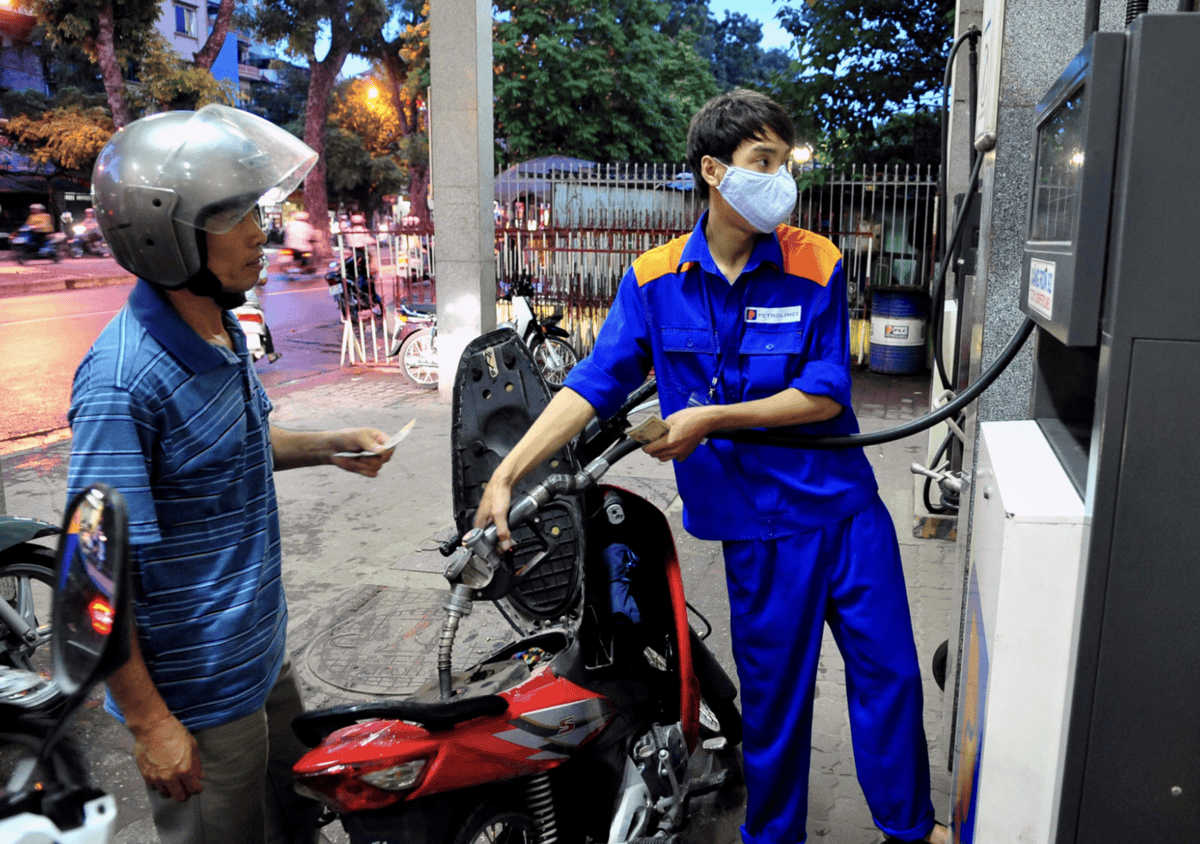
Concerns over a sharp surge in prices are emerging as the fuel price stabilisation fund of more than VND5.600 trillion is nearing depletion.
In a statement released on the night of March 19, the Ministry of Industry and Trade (MOIT) said the global fuel market during the review period from March 12-19 was affected by geopolitical factors.
Military conflicts involving the US, Israel and Iran continued to escalate, and major energy facilities in Iran were attacked, leading to the country declaring that it would retaliate by targeting multiple energy sites in the Middle East.
Iran also continues to control the Strait of Hormuz, and and the Russia–Ukraine conflict persists.
These factors have caused global fuel prices to fluctuate, with an upward trend dominating. In recent days, crude oil prices have exceeded $100 per barrel.
The average prices of refined fuel products between the March 12-19 review periods increased sharply across the board. RON92 gasoline used for blending E5 RON92 rose by $20.31 per barrel (+17.40 percent) to $137.07 per barrel; RON95 increased by $21.22 per barrel (+16.43 percent) to $150.39 per barrel; kerosene jumped to $202.56 per barrel, up nearly $45.29 per barrel (+28.8 percent); diesel rose by $30.44 per barrel (+18.61 percent) to nearly $194 per barrel; and mazut increased by $88.192 per ton (+13.14 percent) to $759.12 per ton.
Use of stabilisation fund
Based on recent global refined fuel-price movements and the principle of market-based management under state regulation, on March 19, MOIT and the Ministry of Finance (MOF) decided to use the fuel price stabilisation fund at VND3,000 per liter/kg for biofuel, unleaded gasoline, kerosene and mazut, and VND4,000 per liter for diesel.
After using the price stabilisation fund, from 11pm on March 19, the retail ceiling price of E5 RON92 was VND27,177 per liter, up VND4,673 per liter compared to the previous review period.
The RON95-III ceiling retail price was VND30,690 per liter, up VND5,115 per liter.
The Diesel 0.05S price has not exceeded VND33,420 per liter, up VND6,395 per liter.
The kerosene price has not exceeded VND35,926 per liter, up VND8,994 per liter.
Mazut 180CST 3.5S has not exceeded VND22,189 per kg, up VND3,528 per kg.
Since early March, this has been the eighth fuel price adjustment and the sixth consecutive time the two ministries have decided to use the stabilisation fund.
MOIT emphasized that without using the stabilisation fund in the March 19 adjustment, E5 RON92 would have risen to VND30,177 per liter; RON95-III to VND33,690 per liter; diesel 0.05S to VND37,420 per liter; kerosene to VND38,926 per liter; and mazut 180CST 3.5S to VND25,189 per kg.
Price management
To respond to fuel price fluctuations amid escalating conflict in the Middle East, in recent review periods the two ministries have implemented price management in line with government directives and Resolution No. 36.
Flexible price management, combined with the use of the stabilisation fund, has helped curb increases in domestic fuel prices, thereby supporting living standards and production and business activities.
Accordingly, the fuel price stabilisation fund of VND5,617 billion (as of September 30, 2025) has been used over five consecutive review periods (March 10–14). The disbursement level was VND4,000 per liter/kg for gasoline, kerosene and mazut, and VND5,000 per liter for diesel.
In the March 19 review period, the two ministries decided to gradually reduce the disbursement level (from the stabilization fund) to VND3,000–4,000 per liter/kg depending on the product, in order to maintain the remaining balance for future price stabilisation.
MOIT said that after using the stabilisation fund since the March 10 review period to now, the remaining balance is just VND2,600 billion.
Using the fund curbed a sharp rise in fuel prices. However, a leader of the Domestic Market Management and Development Department noted that with disbursement levels of VND4,000 per liter for gasoline and VND5,000 per liter for diesel, the fund can only support price stabilisation for about 15 days.
As a result, concerns over a sharp increase in fuel prices in the near future are emerging as the stabilisation fund of more than VND5,600 billion is nearing depletion.
However, MOIT and MOF are coordinating to develop solutions to submit to the Prime Minister, considering the possibility of advance funding or allocating contingency resources if global fuel prices continue to fluctuate. At the same time, the two ministries are studying proposals to report to the National Assembly Standing Committee on reducing the environmental protection tax on fuel to add fiscal tools for market stabilisation.
Tam An
.svg)
