 Vietnamnet.vn

 Podcast



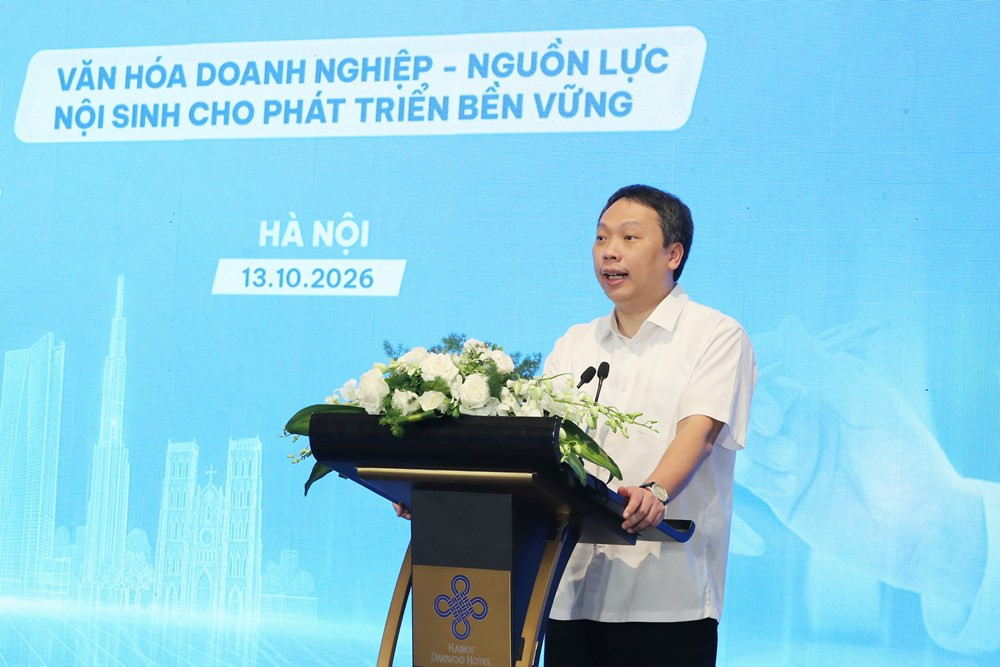
Vietnam's 2026 Corporate Culture Forum was held in Hanoi on October 13, organized by Van Hoa Newspaper and the Hanoi Small and Medium Enterprises Association under the direction of the Ministry of Culture, Sports and Tourism.
Under the theme "Corporate Culture - An Internal Driving Force for Sustainable Development," speakers highlighted the central role of cultural values in helping Vietnamese businesses achieve breakthroughs and build lasting success in a new era.
At the forum, Deputy Minister of Culture, Sports and Tourism Nguyen Huy Dung recalled a message previously delivered by Party General Secretary and State President To Lam at a national conference implementing Politburo Resolutions 79 and 80.
"If the economy determines how fast we can move, culture determines how far we can go," To Lam said.
Building corporate culture, Dung stressed, goes far beyond superficial activities. It is a decisive internal resource that enables individual businesses and the wider economy to achieve rapid and sustainable growth.
To translate that philosophy into practice, the deputy minister outlined eight core values to guide Vietnam's business community.
The first is integrity, respect for the law and keeping one's word. According to Dung, a company's commitment to trust and legal compliance is tested most clearly when it must choose between short-term gains and its fundamental principles.
He illustrated this point with a story about Japan's commitment to quality.
"Some noodle shops in Japan sell exactly 100 bowls a day, no matter how many customers are waiting. The reason is that the craftsman has only enough energy and dedication to maintain exceptional quality for those 100 bowls. Beyond that, fatigue sets in and quality begins to suffer," he said.
The example, he explained, demonstrates why honoring a commitment to quality should take precedence over maximizing sales volume.
The second value is putting genuine customer value at the heart of business decisions. Corporate culture is reflected in a company's willingness to continue supporting customers long after a product has been sold and payment received.
Dung shared another lesson, involving a South Korean semiconductor company learning from Japan's customer service philosophy.
He recounted how a retired Toyota engineer, upon noticing a Toyota vehicle with a broken windshield wiper during heavy rain in New York, immediately stepped forward to help the driver fix the problem.
Treating a product as one's own creation and accepting lifelong responsibility for it, he said, helps build the reputation of a national brand.
In Vietnam, Dung also cited the example of a tea grower in Thai Nguyen who sought to develop a brand called "Tra Chan," meaning Honest Tea, based on a firm commitment to using no chemical additives and maintaining uncompromising product quality and consumer trust.
The third value is respecting people, recognizing talent and developing capabilities. Businesses should put people at the center of their operations and create environments where employees can fully develop their potential and creativity.
The fourth is encouraging innovation, continuous learning and rapid adaptation. In a world of accelerating change, the ability to learn independently and respond flexibly is essential for businesses seeking not only to survive but also to achieve breakthroughs.
The fifth is making effective use of data and taking the lead in responsible artificial intelligence adoption. Digital transformation should go hand in hand with data-driven management and the ethical, responsible application of AI technologies.
The sixth is building a culture of leadership by example. Leading through personal conduct is deeply rooted in East Asian culture, Dung noted. Business leaders must honor their promises, take responsibility for their decisions and remain open to frank internal criticism.
The seventh is preserving Vietnamese identity while embracing global knowledge and integration. Businesses should enter international markets with confidence in their national cultural values and identity, while drawing on the best knowledge and achievements from around the world.
The eighth is aligning corporate missions with national development goals. As businesses grow, they must demonstrate a long-term commitment to their communities and the country.
According to Dung, connecting a company's mission with the nation's prosperity is the essential foundation for building an enterprise capable of enduring across generations.
Tinh Le
.svg)
