 Vietnamnet.vn

 Podcast



Rising geopolitical tensions are forcing authorities to act decisively to prevent supply disruptions and economic spillover.
Phrases such as “intensifying inspections,” “tightening management of distributors,” “combating smuggling,” and “strictly handling hoarding and trade fraud” have appeared with increasing frequency in recent directives.
Notably, these measures were underscored in Conclusion No. 14-KL/TW on ensuring fuel supply and pricing under new conditions, issued by the Politburo. Their scale and intensity point to an urgent reality: the State is compelled to use its “visible hand” to prevent disruptions in the flow of energy.
Escalating tensions between the US, Israel and Iran have delivered a direct shock to global energy supply chains. Strategic transport routes face heightened risks, insurance costs are surging, and supply has become more unpredictable. For import-dependent economies like Vietnam, there is little room to remain insulated.
The State’s response follows a consistent logic - extending control across every stage of the supply chain. The National Steering Committee 389 has called for close monitoring of each retail outlet, while forces including police, market surveillance, customs, border guards, coast guards and tax authorities are coordinating oversight from import to distribution.
In many localities, dedicated task forces have been established to monitor operations on the ground, requiring fuel retailers to commit to uninterrupted supply and even maintaining round-the-clock supervision to track market developments.
Regulatory oversight has also extended into the transport sector, where fuel costs account for a significant share of operating expenses. Businesses are now required to declare and publicly list prices, with arbitrary increases prohibited. With both input costs and cost transmission channels under scrutiny, it is evident that the market is no longer operating primarily on price signals but is being stabilized through administrative direction.
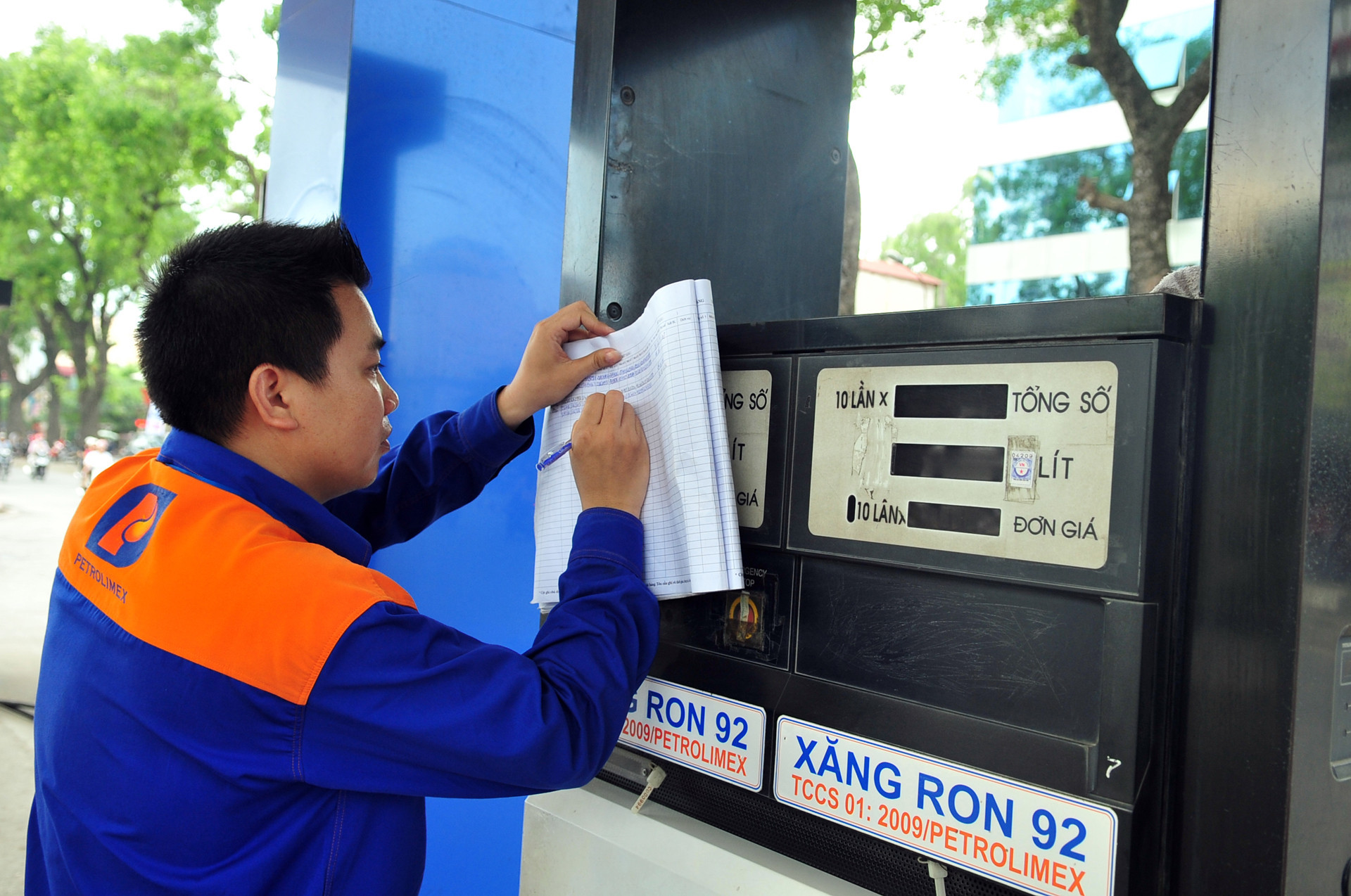
Recent developments in Hanoi illustrate the extent of this “visible hand.” Market surveillance forces have been deployed directly to monitor individual fuel stations, inspecting supply, pricing and operating hours. As a result, a network of hundreds of retail points is under near-continuous supervision.
On the surface, the market remains stable. Most stations continue to operate normally, with no long queues forming. However, localized disruptions have begun to appear in some areas, where supply is no longer as consistent and must await replenishment from distributors.
Importantly, inspections have not uncovered large-scale hoarding or speculative behavior. This suggests that the issue does not stem from widespread market manipulation, but rather from supply pressures and the way the distribution system responds under tighter controls. In other words, the system is being pushed into a state of strain.
To better understand this, it is necessary to consider the structure of Vietnam’s fuel market. Imports account for around 30 percent of supply, but do not flow directly to consumers. Instead, they pass through a network of approximately 26 primary distributors and more than 250 secondary distributors before reaching retail outlets.
With roughly 30 percent of demand reliant on imports, external fluctuations are transmitted almost immediately into the domestic market. In such conditions, the key question is no longer how much prices will rise or how frequently adjustments occur, but whether supply can be maintained continuously - and whether bottlenecks might emerge and spread across the broader economy.
From a conventional economic perspective, this approach appears to run counter to supply and demand principles. Yet in a situation where supply faces potential disruption, those very principles may not be sufficient to ensure stability.
Fuel is a commodity with highly inelastic demand in the short term. Businesses cannot halt production, transport cannot cease operations, and daily life cannot quickly adapt to shortages. Allowing prices to adjust freely in the face of a major shock could trigger widespread instability rather than equilibrium.
In this context, administrative measures are not a rejection of the market, but a means of protecting it at a time when it cannot fully self-correct.
This approach is also reflected in price management. Raising the adjustment threshold from 7 percent to 15 percent indicates a willingness to accept a certain delay in price changes, helping to avoid frequent fluctuations and maintain a sense of stability.
However, when input costs rise rapidly while retail prices lag behind, pressure shifts to businesses. This may lead them to become more cautious in importing fuel or even scale back operations to reduce risk.
The simultaneous deployment of multiple administrative tools reflects another reality: the system’s limited resilience. With fuel reserves still relatively thin, the economy lacks sufficient buffers to absorb external shocks, causing each fluctuation to pass quickly into the domestic market. Without a substantial cushion to absorb pressure, the State is compelled to intervene to keep supply flowing.
Yet while necessary, administrative measures can only serve as short-term solutions. Fuel does not move from ports to stations on its own; it depends on businesses that invest capital, bear risks and make daily operational decisions. Without adequate incentives, they may withdraw, unable to sustain operations under conditions of prolonged losses or excessive uncertainty.
The challenge, therefore, is not only to tighten control to stabilize the market, but also to ensure that the market retains its underlying momentum.
Policy, in this case, cannot stop at regulation. It must also create conditions that enable businesses to continue importing and distributing fuel - from ensuring reasonable profit margins to reducing the gap between costs and regulated prices.
Because if incentives are lost, no degree of control will be sufficient to maintain the flow. At that point, the issue will no longer be whether prices are high or low, but whether the market can continue to function at all.
In normal times, markets operate according to the law of value. But in moments like these, when supply is under strain, relying entirely on market mechanisms is no longer a safe option. The State must intervene - not because the market is flawed, but because, at certain times, it is simply not enough.
Lan Anh
.svg)
