 Vietnamnet.vn

 Podcast



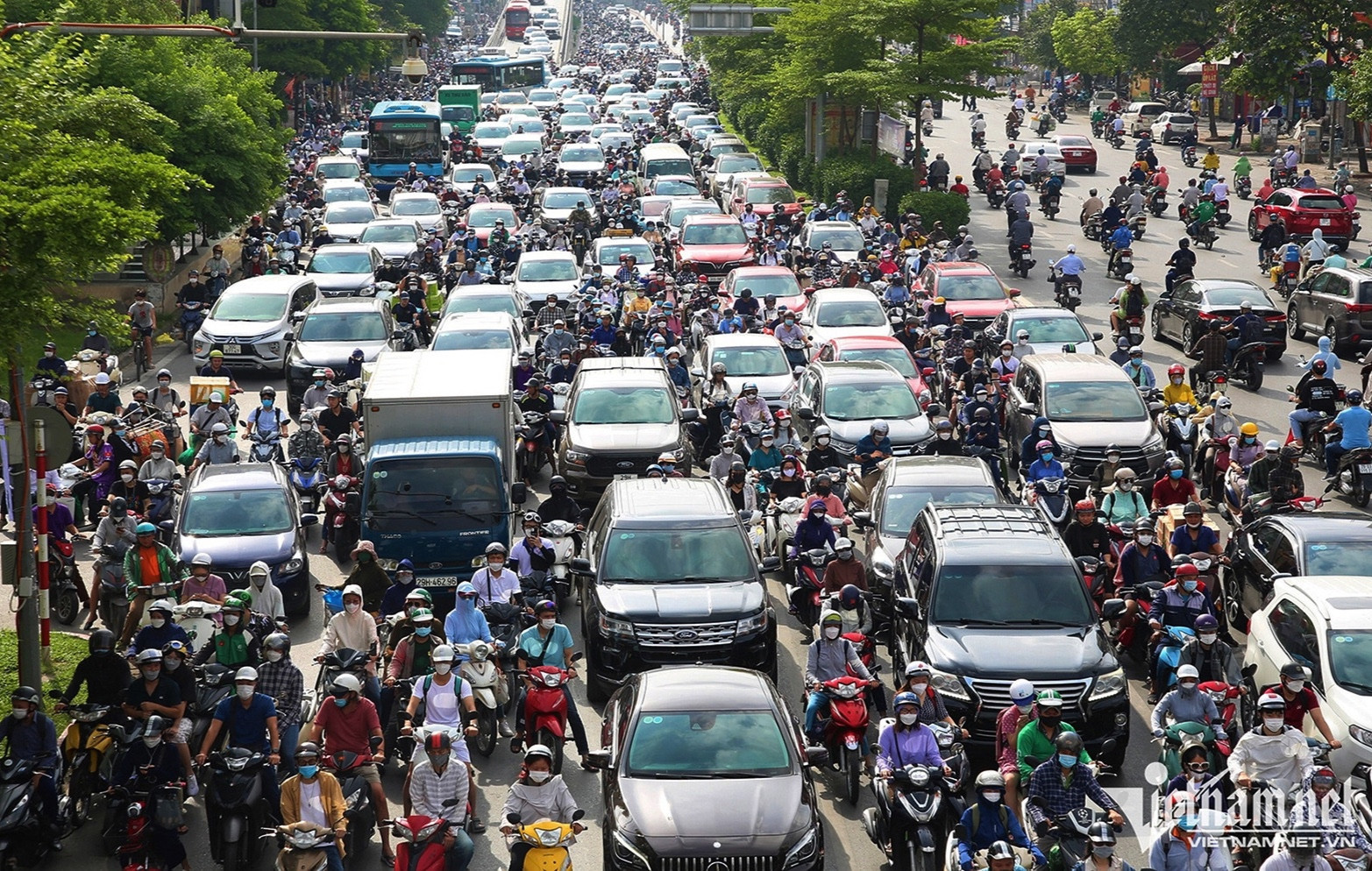
Road expansion alone cannot solve congestion
The proposal to charge vehicles entering the area within Ring Road 1 starting in 2028 is undoubtedly one of Hanoi's more difficult policy decisions.
For nearly a decade, the idea has repeatedly surfaced only to be postponed amid unresolved debate. From the initial policy direction announced in 2017, to the proposal for 87 toll collection points in 2021, and now to plans for implementation in the coming years, the same concerns continue to dominate discussions: Is public transport good enough? Will residents support the policy? Where will traffic be diverted? Can technology meet the management requirements?
These are all legitimate questions. But if Hanoi remains focused solely on asking questions, it risks continuing the cycle that has defined the past several years - extensive discussion with limited action.
For a city of more than 10 million people, relying solely on wider roads and additional bridges offers no lasting solution to congestion.
Reducing traffic requires influencing demand for private vehicle use. Congestion charging is one of the tools available to achieve that objective.
What must be clearly understood is that urban road pricing is not primarily intended to increase government revenue. Its purpose is to influence travel behavior, encourage residents to reduce their dependence on private vehicles, and promote more efficient and sustainable modes of transportation.
Some argue that Hanoi should wait until public transport is fully developed before introducing congestion charges. But if the city waits for every condition to be ideal, implementation could be delayed for many more years.
Public transportation development is a long-term process, while congestion is a daily reality that wastes time and fuel and steadily erodes the quality of urban life.
Rather than delaying action, Hanoi could adopt a phased approach - beginning with a limited pilot program, evaluating its impact, and refining operational mechanisms before wider implementation.
What has Hanoi prepared so far?
The city is gradually building many of the foundations required for what has long been considered one of the most difficult policies in urban transport management.
In terms of public transportation, Hanoi is pursuing a green transition strategy aimed at reducing dependence on private vehicles. The bus network continues to expand, connecting residential areas and new urban developments on the outskirts with the city center.
The urban railway system is also beginning to establish its first high-capacity transit corridors. The Cat Linh - Ha Dong metro line has been operating steadily, while the Nhon - Hanoi Railway Station line is gradually taking shape, laying the groundwork for a broader metro network in the future.
At the same time, a series of major transport infrastructure projects are being accelerated, including Ring Road 2, Ring Road 2.5, radial transport corridors, and the expansion of National Highway 1 between Ring Road 1 and the Phap Van - Cau Gie interchange.
These projects are expected not only to ease pressure on central districts but also to create conditions for dedicated bus lanes, pedestrian infrastructure, cycling routes and transfer hubs linked to public transportation systems.
Technological conditions have also changed dramatically since Hanoi first proposed congestion charging.
Databases covering residents, vehicles and inspections are becoming increasingly integrated, while electronic toll collection systems continue to expand. The widespread deployment of traffic cameras makes automatic vehicle identification and license plate-based toll collection entirely feasible without the need for physical toll booths.
Of course, the city still needs to invest further in park-and-ride facilities, parking areas linked to bus and metro services, and policies that support residents transitioning to public transport.
Reducing or waiving public transport fares for residents within charging zones could also help build public consensus.
At the same time, gradually relocating universities, hospitals, government offices and other major trip-generating facilities to suburban areas would help redistribute population and economic activity, reducing travel demand into the city center and easing pressure on the urban core.
The hardest part is taking action
Any policy affecting millions of people will inevitably generate differing opinions. That is entirely normal.
Public debate helps improve policy design, but it should not become a reason for indefinitely postponing reform.
A city of more than 10 million residents cannot function on a fear of change.
What residents need is not simply a new policy, but one that is transparent, equitable, technology-driven and grounded in sound scientific analysis.
Hanoi has spent years discussing restrictions on private vehicles. Perhaps the time has come to move from discussion to implementation.
Congestion charging is not the final goal. It is a tool to achieve broader objectives: reducing traffic congestion, improving environmental quality, enhancing quality of life and building a more modern, livable and sustainable capital city.
Vu Diep
.svg)
