 Vietnamnet.vn

 Podcast



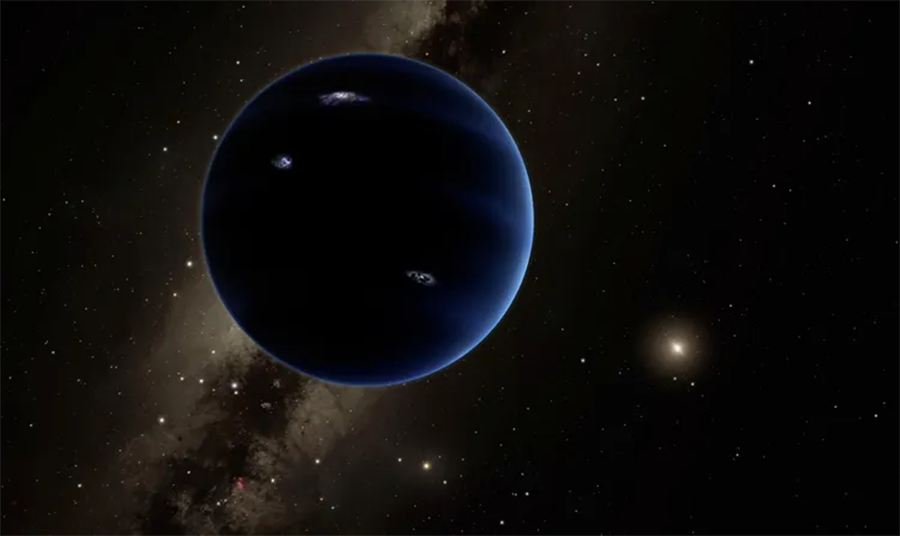
The hunt for this mysterious world has gone through several phases.
The discovery of Neptune in 1846 demonstrated that the existence of a planet that had not yet been directly observed could be inferred from its gravitational effects on other celestial bodies.
Astronomers subsequently began searching seriously for another planet, a quest that appeared to reach its conclusion in 1930 when Clyde W. Tombaugh discovered Pluto.
Decades later, however, Pluto was reclassified as a dwarf planet in August 2006, removing it from the Solar System’s official list of planets.
The decision sparked a debate that continues today over the nature and status of this object in the Kuiper Belt.
Beyond the debate over whether Pluto should be considered a planet, however, another question remains unanswered: Is there a true ninth planet somewhere in the distant Solar System?
Some astronomers believe new observations could bring scientists closer to an answer.
From ‘Planet X’ to the Planet Nine hypothesis
The story of an unconfirmed ninth planet stretches back to the early decades of the 20th century.
Astronomers reasoned that, just as Neptune had been inferred from irregularities in the motion of Uranus, signs of even more distant planets might be detectable through anomalies in the orbits of known objects.
American astronomer Percival Lowell was among the leading proponents of this idea.
He believed irregularities in the orbits of Uranus and Neptune could indicate the existence of an undiscovered distant planet, which he called “Planet X.”
Today, Planet X is sometimes used loosely in reference to the same idea as Planet Nine. The two concepts, however, have important differences.
Early searches for Planet X focused on the movements of Uranus and Neptune.
Data gathered after Voyager 2 flew past the two planets in the 1980s showed that their orbits could be explained without requiring another unknown planet.
The modern Planet Nine hypothesis instead focuses much farther away, particularly on the orbital behavior of small objects in the outer Solar System.
In 2016, California Institute of Technology astronomers Konstantin Batygin and Michael Brown argued that an undiscovered planet could explain unusual orbital patterns among some extremely distant trans-Neptunian objects.
Searching for gravitational fingerprints
The Planet Nine hypothesis is not based on astronomers having seen the planet. They have not.
Instead, scientists are looking for the gravitational “fingerprints” that a massive planet could leave on smaller objects in the outer Solar System.
In 2024, the Caltech researchers published further findings focusing particularly on objects with long orbital periods and relatively low orbital inclinations, including bodies whose paths cross Neptune’s orbit.
Batygin told Space that these objects are dynamically unstable, meaning their population must continually be replenished.
According to Batygin, the 2024 study found that Planet Nine could naturally produce the population observed today, while a model without the hypothetical planet was strongly inconsistent with the data after observational biases were taken into account.
Batygin argues that Planet Nine could explain several unusual features observed in the outer Solar System.
These include orbits that appear to cluster in particular directions, the extremely distant perihelia - the points closest to the Sun - of some objects, bodies moving on retrograde orbits, and objects with trajectories highly inclined relative to the Solar System’s usual orbital plane.
If these phenomena share a common cause, a massive planet orbiting at a great distance could offer an explanation.
The missing piece: Seeing Planet Nine
Despite the indirect evidence, one major problem remains: no one has directly detected Planet Nine.
Batygin describes direct detection as the missing piece in the evidence being assembled around the hypothesis.
While acknowledging that finding the planet remains difficult, he argues that the available data still require a convincing explanation.
If the observed dynamical structure is real, Batygin said, there is currently no alternative theoretical explanation that he considers comparably compelling.
That does not mean Planet Nine definitely exists.
In science, a hypothesis must continue to produce predictions consistent with observations, with confirmation ultimately requiring detection of the object itself or independent evidence demonstrating its effects.
One major source of hope is a new generation of telescopes.
Among the most anticipated is the Vera C. Rubin Observatory in Chile, designed to survey the sky on an unprecedented scale and at remarkable speed.
New observations could reveal many more extremely distant objects in the Solar System.
With a much larger sample, scientists will be better positioned to determine whether the unusual orbital patterns are genuine - or simply the result of observational bias.
Hai Phong
.svg)
