 Vietnamnet.vn

 Podcast


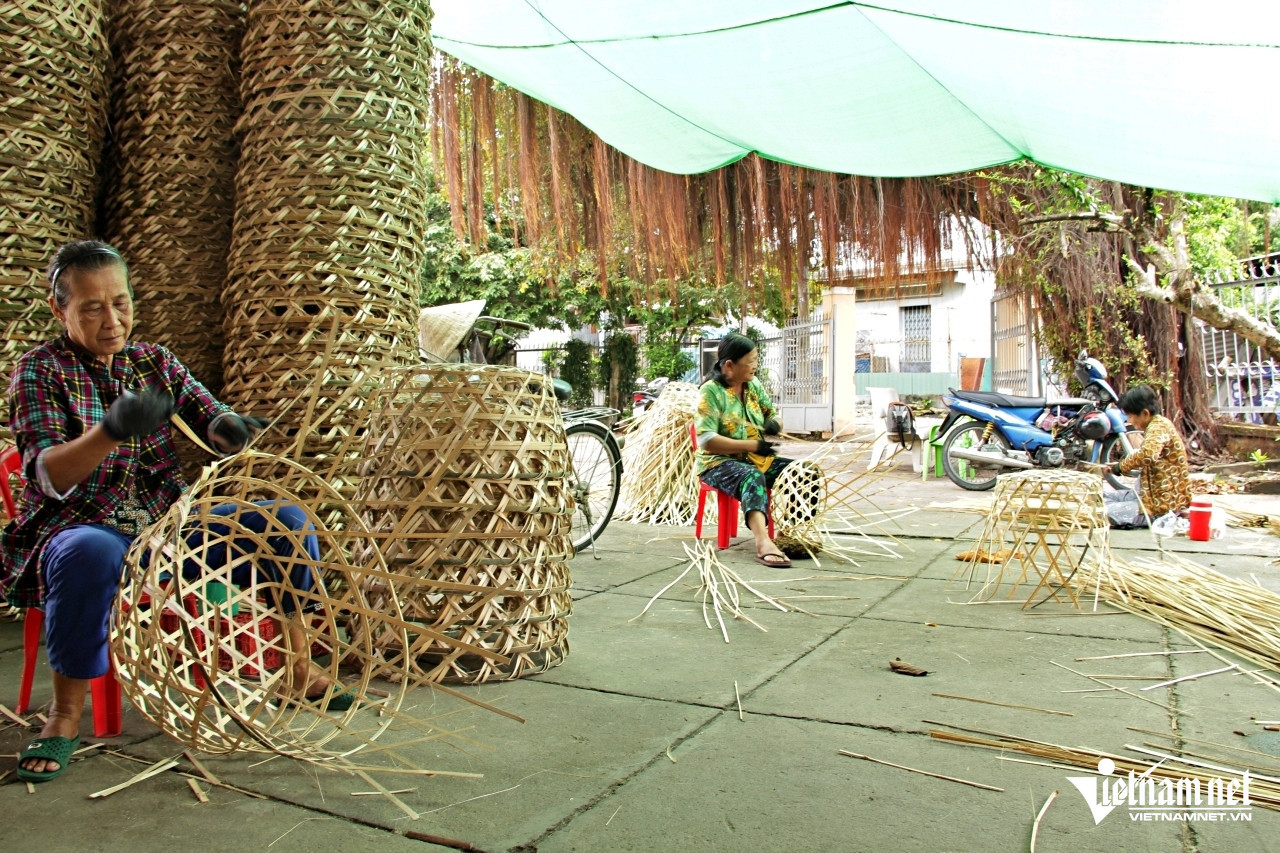
One rainy morning in September, Tam (Xuan Thai Son commune, HCMC) and her workers hurried to place bamboo strips and unfinished handmade baskets woven from bamboo and rattan-like materials under a corrugated-metal roof.
Despite intensifying rain, Tam and her fellow artisans continued the work they had practiced since childhood. In Xuan Thoi Son commune, Tam remains among the few artisans preserving traditional hand-woven bamboo baskets.
She noted that bamboo basket weaving represents one of HCMC's traditional handicrafts. Tam cannot pinpoint the exact origins of the craft, knowing only that her family pursued it across generations since her grandparents' era.
"My mother recounted that when she married into the family, her husband's family already practiced basket weaving. She then adopted the craft. My parents taught me from early childhood, and I could weave by age 13 or 14.
“In those days, nearly all local residents relied on basket weaving for their livelihoods. After 1975, artisan households organized into state-managed cooperatives.
“During that period, the craft flourished with substantial market demand. Beyond domestic sales, Xuan Thoi Son bamboo baskets were exported to Taiwan (China), Australia, and other international destinations," she recalled.
Seated nearby, Do Thi Lan, 63, has similarly pursued basket weaving since age 9 or 10. Previously, Lan crafted baskets independently at home. She practiced the trade until age 50, retiring when physical stamina proved insufficient for cutting bamboo, splitting strips, and weaving.
Yet as age advanced, Lan missed the craft. Seeking to rediscover joy in her lifelong craft, she returned to assist Tam with contract production.
According to Tam, traditional manual basket crafting comprises seven primary steps: splitting bamboo strips; shaving strips (using knives to render bamboo strips thin and flexible); forming the base; erecting the frame; weaving; installing the rim (securing the mouth and body with a rigid outer ring); and threading the rim.
Among these steps, shaving bamboo strips demands exceptional technical skill and experience. Inexperience leads to material damage and waste.
Previously, Tam used shaving machinery to increase productivity. However, after operating machinery for a period, she observed that machine-shaved strips had scratched surfaces, rendering them susceptible to mold, and discoloring them during storage. So, she abandoned mechanical equipment to return entirely to manual production.
Searching for craft preservationists
Tam's traditional manual production facility produces 200-250 baskets daily. Finished baskets are supplied to fish wholesalers at major wholesale markets.
However, the widespread adoption of plastic bags and styrofoam boxes, combined with limited storage space for bamboo baskets, led many fish vendors to cease purchasing traditional baskets, compounding difficulties for craft workers. Over time, numerous facilities and households abandoned the trade to pursue alternative livelihoods.
Tam shared: "Beyond market contraction, manual basket weaving fails to attract young people. The labor is strenuous while earnings remain low. Locally, no young individuals pursue the craft today. Active artisans are all aged 50 or above. Within my family and Lan's family, children and grandchildren have chosen different career paths.
“I feel deeply saddened seeing our local traditional craft fading toward extinction. Once our generation passes away, no one may remain to continue this trade."
That reality drives Tam to persist despite physical demands. For years, she has attempted to recruit successors, offering free training and instruction to young people willing to learn traditional bamboo basket weaving.
Despite her efforts, beyond three to four workers aged 60 to 70, she has recruited no younger apprentices. Even subcontracting households supplying her facility consist entirely of individuals aged 50 and above.
"Currently, I do not consider retirement and intend to preserve the craft as long as physical health permits. Spending decades splitting bamboo, shaving strips, and weaving baskets, I have deep affection for the craft passed down from my grandparents.
“And I care deeply for my co-workers. They are all in their 60s and 70s and share my devotion to this traditional trade. If I retire, they will lose both their livelihood and the joy derived from a lifelong craft."
Ha Nguyen

