 Vietnamnet.vn

 Podcast



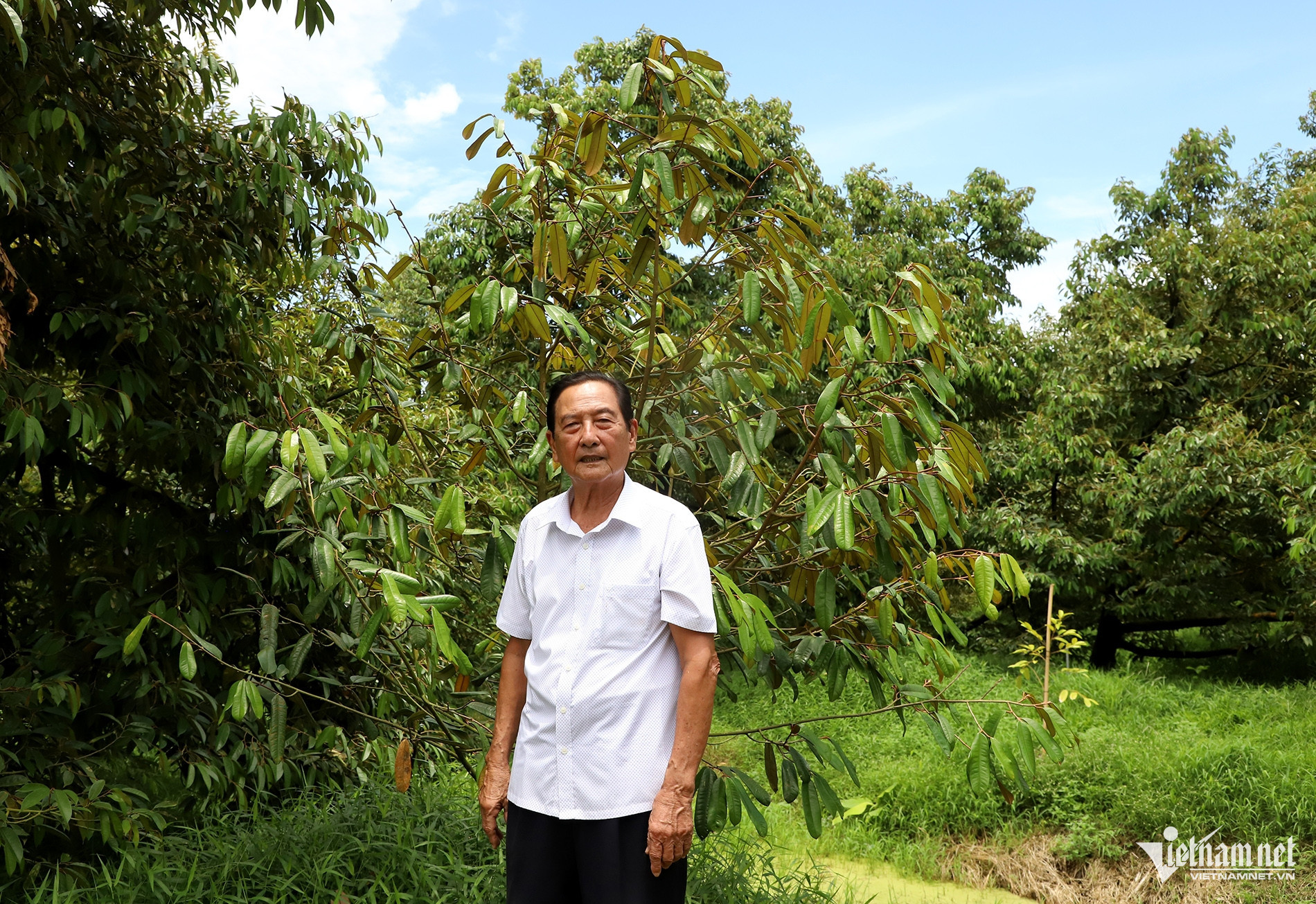
In mid-September, on his 5.5ha orchard in Tan Binh Commune, Can Tho City, Sau, 82, also known as Sau Bo, was busy tending 1,000 durian trees. Each year, his orchard supplies more than 100 tons of Monthong durians for export.
Pioneer in bringing durian trees to the locality
Sau said that around 1976, he and his wife started their own household and received 10 cong of land (1 cong = 1,000 sqm) from his family, five of which were used to grow rice.
Life was difficult. Unwilling to accept poverty, he repeatedly looked for ways to switch crops. He moved from rice to sugarcane and then to oranges. Despite working tirelessly, his family’s financial situation did not improve much because short-term fruit crops quickly became unproductive and prices were unstable.
A turning point came when the former Hau Giang Provincial Farmers’ Association took him to the formerly named Tien Giang Province to visit and study fruit-growing models. “I saw that durian trees could produce crops for many years and offered high yields and economic value, so I decided to grow them,” Sau recalled.
After returning home, he converted five cong of rice fields to grow around 100 Kho Qua Xanh durian trees (green bitter melon durian). He said that, at the time, no one else in the district was growing the variety.
After nearly five years of care, the first durian trees began producing fruit.
According to Sau, rice sold for only around VND1,000 per kilogram at the time, while Kho Qua Xanh durians fetched VND10,000 per kilogram. The orchard’s roughly 100 trees produced 2.5-3 tons of fruit per crop.
“At that time, I saw that durians generated such high profits that I decided to convert all my cultivated land to durian production,” he said.
When Thailand’s Monthong durian variety began appearing on the market, he continued researching it and found that it produced large fruit with tasty flesh, small seeds and high selling prices. He gradually cut down Kho Qua Xanh trees and replaced them with the new variety.
When his Monthong trees began bearing fruit, Sau was able to sell the durians for VND50,000-60,000 per kilogram at certain times. He accumulated capital from successful harvests and bought land whenever nearby residents decided to sell.
Today, his durian orchard covers a total of 55 cong, or 5.5ha, with around 1,000 trees, mainly Monthong, Musang King and Black Thorn varieties. Several dozen of the trees are 45 years old.
Every year, Sau Bo supplies more than 100 tons of VietGAP-certified durians to export companies. The orchard has been granted a growing-area code. Its average annual revenue is VND6-8 billion, and after deducting costs, Sau said his profits amount to approximately VND5 billion.
Farmers must work alongside scientists
According to Sau, during his 45 years of farming, he has rarely experienced a situation in which bumper harvests resulted in falling prices. However, the transition from traditional farming to high-quality durian production for export has involved considerable risks.
At one point, traders returned as much as 50 percent of his harvest.
Undeterred, he brought damaged durians and diseased branches to the Department of Crop Science at Can Tho University and asked Professor Tran Van Hau to “diagnose” the problems. There, he was instructed on how to identify diseases, balance nutrients and care for the trees.
That initial offer of support led to a special friendship between the farmer and the scientist that has lasted for many years. Professor Tran Van Hau not only guided him in techniques for controlling flowering and fruit setting and managing water, but also visited the orchard in person to conduct surveys and brought students there for field experiments.
“Durian trees are extremely ‘fussy.’ Even after they have flowered and set fruit, giving them just a little too much water can cause the entire orchard’s fruit to drop within three days. It is difficult to achieve sustainable success in farming without working hand in hand with scientists,” Sau said, summarizing his formula for success as farmers + scientists = success.
Beyond relying on field experience, Sau is also proficient in using a smartphone to keep production records, trace product origins, manage growing-area codes and monitor fluctuations in market prices.
To ensure the sustainable development of his orchard, he prioritizes the use of organic fertilizers and reduces his reliance on chemical fertilizers.
Hoai Thanh
.svg)
