 Vietnamnet.vn

 Podcast



In the expansive spring hues of the Central Highlands, Quang Hoa village appears prosperous and serene, shaded by deep green coffee and durian trees and dotted with traditional stilt houses. Here, the Nung An people continue to cultivate seasons of abundance.
The journey to prosperity on new land

Mong Thanh Hon, head of Tam Dien hamlet, is one of Quang Hoa’s billion-dong earners.
Quang Hoa village, in Tam Dien hamlet, Tam Giang commune, Dak Lak province, lies nestled in a deep valley surrounded by rolling hills that stretch endlessly. Amid the vast greenery, the red-tiled roofs of traditional stilt houses stand out, testament to the villagers’ comfortable and thriving lives.
Recalling the early days when Nung An families left Cao Bang to settle here, Nong Van Minh, born in 1970, said the area was once wild and covered in dense forest. Life was marked by hardship. Determined to stay, villagers first planted short-term crops before gradually learning to cultivate coffee.
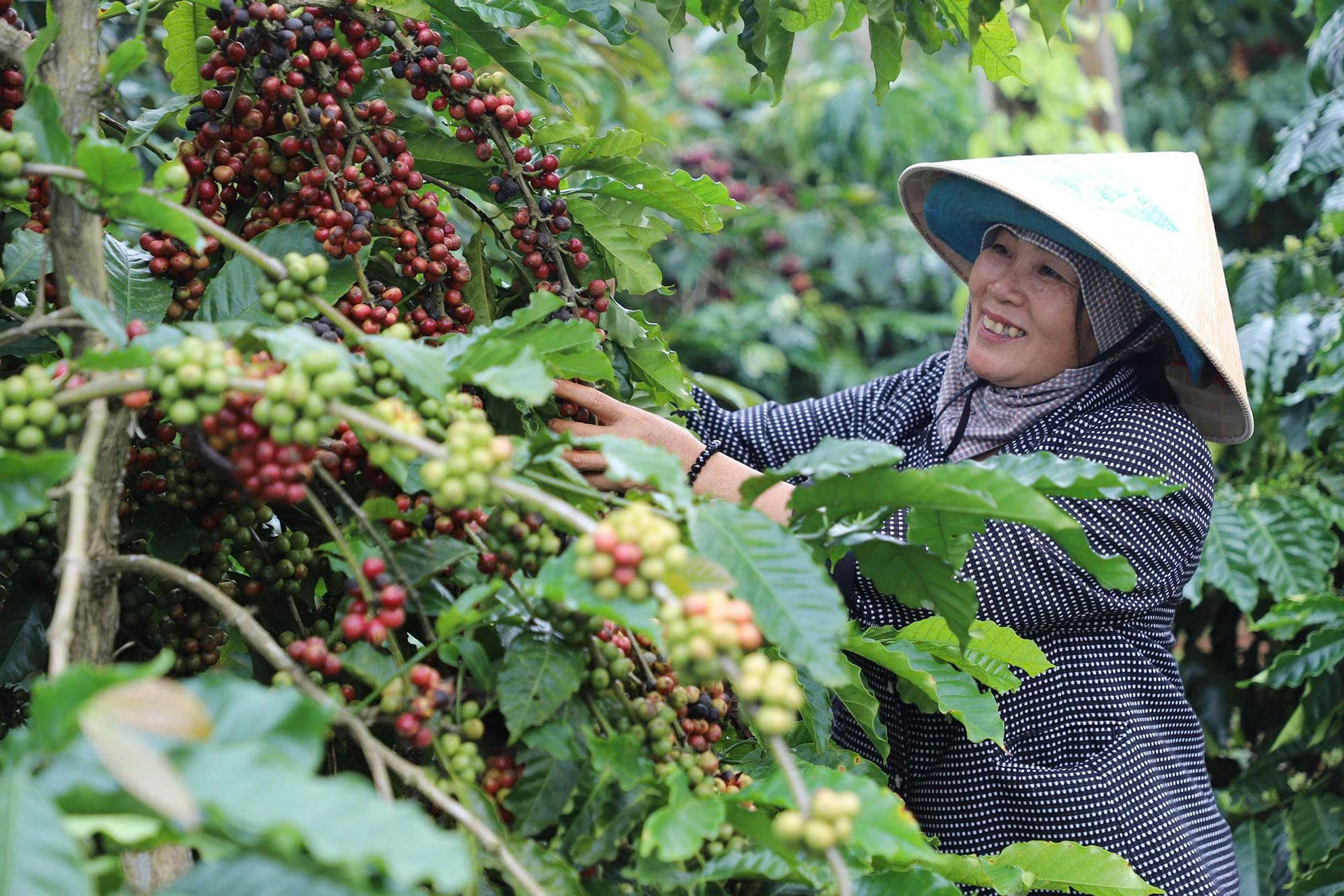
They boldly invested in seedlings, improved the soil, experimented and patiently learned. In 1991, the first coffee harvest ripened red on the hillsides, opening a new path. From a few small plots, families expanded their acreage and soon intercropped with durian, macadamia and other fruit trees. The land suited the crops, and the people found their rhythm. With each season, lives changed.
Pointing to his lush coffee garden interwoven with durian trees, Minh said: “My family has more than one hectare. This year the coffee harvest is good, probably over three tons of beans, bringing in more than VND400 million (US$16,000).”
Standing before his more than 30-year-old stilt house, Mong Thanh Hon, head of Tam Dien hamlet, shared that the hamlet has 115 households with 541 residents, divided into two villages. Quang Hoa is home entirely to Nung An people, while Coc Xoai village is inhabited by Tay and Nung families.
According to Hon, Quang Hoa alone has 53 households with more than 270 residents. Each household owns between two and four hectares of intercropped coffee. Even the lowest-income family earns several hundred million dong a year, while most generate billions. Nearly every household has one or two tractors, and 11 families now own cars.
“My family has three hectares, with an average yield of four tons per hectare. For the past two years, prices have been favorable, so we earn more than VND1 billion a year (US$40,000). But what matters most is not just the economy - it’s our unity and the way we rise together,” Hon said.
Preserving identity
Despite economic growth, Quang Hoa village has carefully preserved its traditional culture. Along the village roads, four-roofed stilt houses - the distinctive architecture of the Nung An - stand proudly. Each house is supported by 30 to 56 wooden pillars, with wooden stairs leading to the main hall. Inside, a hearth provides warmth, and the ancestral altar occupies a place of honor.
“However wealthy we become, we will never abandon the stilt house. It is a treasure passed down by our ancestors,” Hon said.
Two years ago, one household suffered a fire. While the flames were still being extinguished, villagers rushed in to help save the main wooden frame. Later, the entire community contributed labor to rebuild the house according to its original design.
In Quang Hoa, culture extends beyond architecture. The Nung An continue to wear traditional attire, play folk instruments, perform then singing and conduct ritual ceremonies. Most notably, they preserve heo phuon singing - a lyrical form of call-and-response love songs, gentle as a stream and as heartfelt as whispered memories. During gatherings, heo phuon melodies echo beneath stilt-house roofs, reconnecting villagers with their northern homeland.
Nong Thi May, born in 1965 and a respected heo phuon artisan, said: “We were born in stilt houses and grew up in stilt houses. Wherever we go, whatever we do, we must preserve our home and our songs. Only then can we keep our roots.”
Local authorities have also shown keen interest in safeguarding cultural identity. Le Ky Su, Chairman of the Tam Giang Commune People’s Committee, noted that the commune is home to 21 ethnic groups, with more than 51 percent belonging to ethnic minorities, primarily Tay and Nung migrants from northern provinces.
“Quang Hoa village has preserved almost intact its traditional stilt-house architecture and revived heo phuon singing. This is a valuable cultural resource that can both be conserved and potentially developed into community-based tourism in the future,” Su said.
Thanks to the harmonious blend of cultural identity and agricultural prosperity, Quang Hoa is rich not only in material wealth but also in spirit and tradition. In the heart of the highlands, the village stands as a vivid testament to a community that has overcome hardship, safeguarded its heritage and risen with confidence.
The “billionaire” village in the highlands is wealthy not only in money, but in pride, in tradition and in the enduring soul of its homeland.
PV
.svg)
