 Vietnamnet.vn

 Podcast



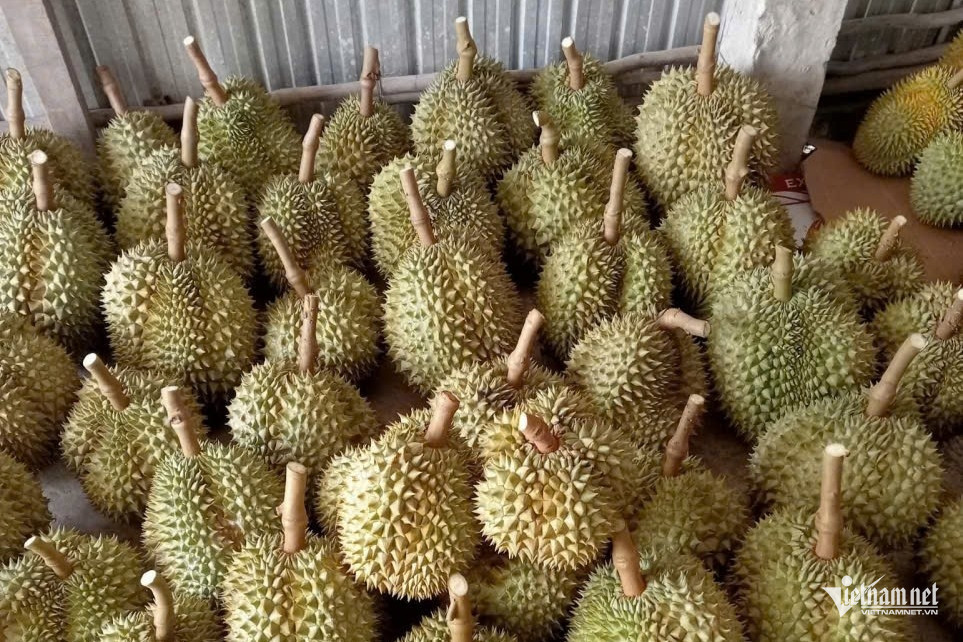
This year's durian season, many orchard owners in the Mekong Delta struggle as durian prices have plummeted, selling at VND30,000-40,000 per kilogram at markets.
Meanwhile, the business of Giau, the owner of a 15,000 sqm durian orchard in Quang Man Hamlet, Giong Rieng Commune (An Giang Province), still prospers as she combines agricultural sales with ecotourism development.
Even during the peak ripening season of Western region durians, Giau still managed to sell at high prices at the orchard. Ri6 durian is priced at VND80,000 per kilogram, Thai durian at VND120,000 per kilogram, and Musang King durian at VND160,000 per kilogram, which is two to three times higher than the market price.
This year, the orchard’s durian output is expected to reach around 7 to 8 tons. Though the new season has just begun, Giau's family has already consumed more than 5 tons.
According to Giau, in mid-June when officially opening to welcome guests, the orchard received 50 to 60 visitors each day. On weekends, the number of visitors increased to several hundred, and the thatched huts in the orchard were almost always fully occupied.
To achieve this success, Giau’s family spent many years struggling with business calculations. Giau said that her parents-in-law owned 30 cong of land (nearly 3 hectares) for rice cultivation. Despite many years attached to rice plants, the family remained trapped in the cycle of "good harvest, low prices," with an income only enough to cover daily living expenses.
Refusing to depend on rice plants forever, Giau and her husband discussed with their parents and decided to use 15 cong of inefficient rice land to grow durian. That was a difficult decision due to the large investment costs, a waiting period spanning many years, and ever-present risks.
The couple traveled to many large, well-known orchards in Can Tho to learn cultivation techniques. After accumulating enough experience, the family invested in 200 high-quality saplings of three varieties: Ri6, Monthong (Thai durian), and Musang King.
For five years, the orchard was cared for organically with the expectation of creating a clean, distinct product. By 2025, the first 90 durian trees began to yield a harvest of about 4 tons of fruit.
Before the joy was complete, the market fell into a state of oversupply. Durian prices dropped sharply, forcing many orchard owners to liquidate their crops. Instead of accepting cheap sales to traders, Giau's family decided to find their own output by opening the orchard to welcome tourists.
Giau recorded the entire process of caring for the orchard, from flower pollination and fruit nurturing to the fruit ripening naturally on the trees. These short images and videos frequently posted on her personal Facebook account helped many people know about it.
Visitors coming here not only buy durian but also stroll through the orchard, personally select ripe fruits, cut them down directly, and enjoy them on the spot.
The efficiency came faster than expected. Right in the first harvest season, the entire batch of more than 4 tons of durian was completely bought by customers visiting the orchard within just over a month.
The selling price at the orchard was accepted by customers because they witnessed it with their own eyes, chose to buy fruit right on the trees, and felt secure about product quality.
In addition to selling fruit, Giau’s family serves many countryside dishes, helping visitors gain more experiences during their stay.
The new business model not only generates income for the family but also offers employment for seven to 10 local workers during peak days, with an income ranging from VND200,000 to VND300,000 per day.
Giau confided that to pursue this model, gardeners must accept making the investment, especially paying attention to improving the quality of the durian fruit. After each harvest season, orchard owners must perform a very strict nutrient recovery process, which takes a lot of effort and expense.
On the remaining 15 cong of land, Giau’s family has planted new durian trees, while intercropping various short-term fruit trees and vegetables such as Ruby guava, rambutan, kumquat, bitter melon, cucumber, and yardlong beans to utilize the land and gain extra income while waiting for the trees to grow.
In the coming time, she nurtures a plan to build ecological homestays right inside the orchard to serve the vacation needs of tourists seeking a green space from afar.
Tao Dat
.svg)
