 Vietnamnet.vn

 Podcast


Unraveling the mysteries of Taoism's sacred caves and blessed lands
In the worldview of Chinese Taoism, mountain caves are more than geological formations. They are regarded as sacred realms inhabited by deities and immortals.
Speaking at a recent academic seminar hosted by the Faculty of History and Culture at the University of Social Sciences and Humanities, Vietnam National University, Hanoi, Professor Tsuchiya Masaaki of Senshu University's Faculty of International Communication explained the origins of the Taoist concept known as Dong Tian Phuc Dia, or Grotto-Heavens and Blessed Lands.

Tsuchiya, who also serves as acting president of the Japan Society of Taoistic Research, said the concept originated in ancient reverence for mountains and rivers.
It developed significantly during China's Han Dynasty, when people believed divine beings inhabited the interiors of mountains and communicated with the outside world through caves.
The term refers to sacred mountainous landscapes and extraordinary caves believed to concentrate spiritual energy and provide auspicious places for religious cultivation.
During the Tang Dynasty, Taoist master Sima Chengzhen played an important role in systematizing and refining the classification of Taoism's sacred sites.
In his work Tiandi Gongfu Tu (Chart of the Palaces and Mansions of Heaven and Earth), he established a hierarchy comprising the Ten Great Grotto-Heavens, 36 Lesser Grotto-Heavens and 72 Blessed Lands.
The Blessed Lands were regarded as auspicious places inhabited by immortals and particularly suitable for spiritual cultivation.
Some ancient Taoist texts contain an even more mysterious idea: that the various Grotto-Heavens are interconnected by vast underground passageways.
To investigate these historical accounts, Tsuchiya undertook extensive field surveys at sites associated with the tradition.
"In theory, a Taoist Grotto-Heaven must have rocky mountains, caves and a richly varied natural landscape," he explained. "Although ancient Chinese texts state that all Grotto-Heavens contain caves, I was somewhat skeptical. So I decided to conduct field investigations to determine whether every Grotto-Heaven actually had a cave."
His research produced unexpected findings.
Not every location identified as a Grotto-Heaven contained caves matching the descriptions in ancient texts.
At sites such as Lushan, Nanjing and Mount Wangwu, regarded as Taoism's foremost Grotto-Heaven, he found similarities between historical illustrations and actual terrain.
Some locations featured caves extending deep into mountains, including spaces once used for religious rituals.
Other designated sacred sites, however, had no caves.
Tsuchiya suggested that geological transformations may help explain how the religious concept developed.
"Originally, caves existed inside the mountains. Geological changes subsequently caused their roofs to fracture and collapse, creating what is known as a sky opening, where the cave ceiling falls away and exposes an open space extending from the top to the floor below," he said. "We believe this remarkable natural phenomenon in karst landscapes stimulated people's imagination and was directly connected to the emergence of Taoist cave beliefs."
Karst landscapes develop mainly in limestone regions, where rainwater, flowing water and groundwater gradually dissolve soluble rock, creating caves, sinkholes and other distinctive formations.
Traces of Taoist Grotto-Heavens in Vietnam and a discovery at Hang Son
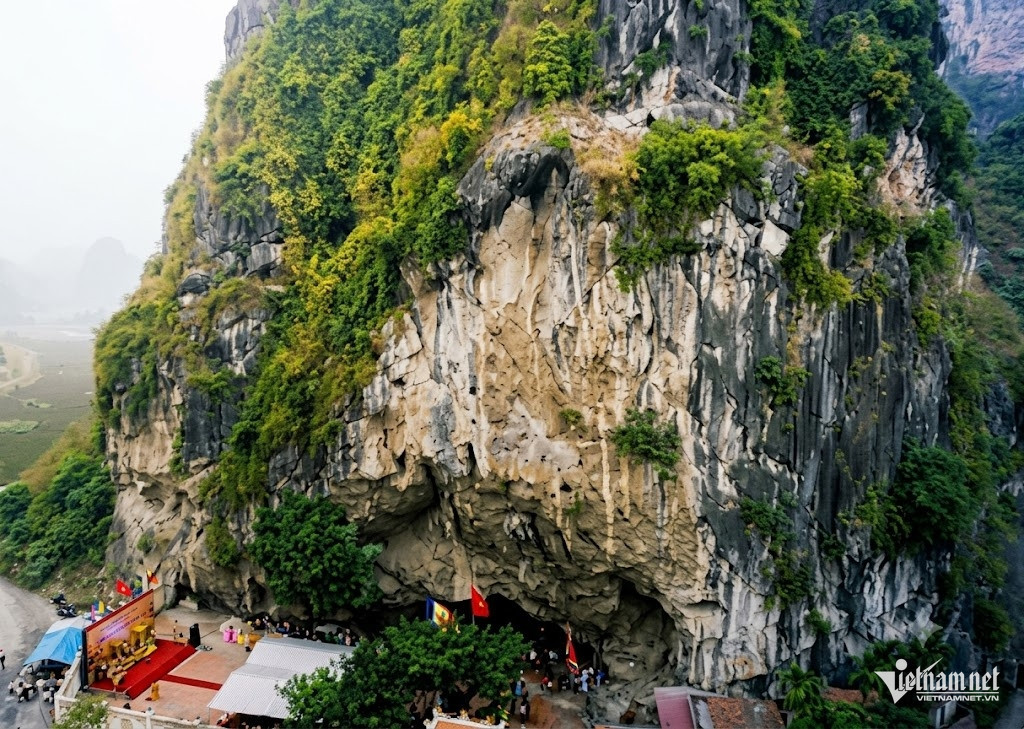
The concept of Grotto-Heavens and Blessed Lands was not confined to China. It spread to neighboring countries through religious practitioners and the circulation of Taoist texts.
According to Tsuchiya, Taoism had already reached Vietnam during the Tang Dynasty through successive waves of religious transmission.
Illustrations of several well-known Vietnamese caves, including Dau Go Cave in Ha Long Bay, Quang Ninh Province, appeared in ancient Taoist writings.
"I believe the Grotto-Heaven tradition may have been introduced to Vietnam around that time and could have influenced Vietnamese Taoist beliefs," he said. "Recently, I had the opportunity to visit Hang Son Cave in Quang Ninh, where I noticed features remarkably similar to those of China's second-ranked Grotto-Heaven."
He emphasized that Vietnam's caves represent a fascinating research subject deserving much greater scholarly attention.
Several researchers believe Hang Son Cave, located in the Yen Tu mountain region of Quang Ninh, preserves distinctive evidence of Taoist religious activity.
Nguyen Van Anh, PhD, dean of the Faculty of History and Culture at the University of Social Sciences and Humanities, Vietnam National University, Hanoi, highlighted several unusual features of the site.
"The cave walls are naturally covered in a reddish substance believed to be cinnabar, a fundamental ingredient used by Taoist practitioners in preparing elixirs of immortality," he explained. "Three Chinese characters, Bao Phuc Nham, are carved into the rock. The inscription has been identified as the calligraphy of retired Emperor Tran Minh Tong, engraved on the Double Ninth Festival, the ninth day of the ninth lunar month in the tenth year of the Khai Huu era, 1338, during the reign of Emperor Tran Hien Tong."
Cinnabar, a naturally occurring mercury sulfide mineral, held particular significance in traditional Taoist alchemy and the pursuit of immortality.
Nguyen Van Anh added that the cave contains numerous stone inscriptions documenting Taoist activities.
Most notably, historical documents dating to China's Song Dynasty reportedly identified Hang Son as one of the 72 sacred Blessed Lands.
This reference suggests that the cave may have occupied a recognized place within the broader sacred geography of East Asian Taoism.
The combination of ancient inscriptions, possible alchemical materials and references in historical texts makes Hang Son an important location for investigating the relationship between Taoist traditions and Vietnam's religious landscape.
Research into cave worship and cultural exchanges across East Asia is helping scholars better understand the historical and spiritual significance of these heritage sites.
It also opens new avenues for examining how Taoist beliefs spread, evolved and left their mark on Vietnam's extensive network of caves and sacred mountains.
Binh Minh

