 Vietnamnet.vn

 Podcast



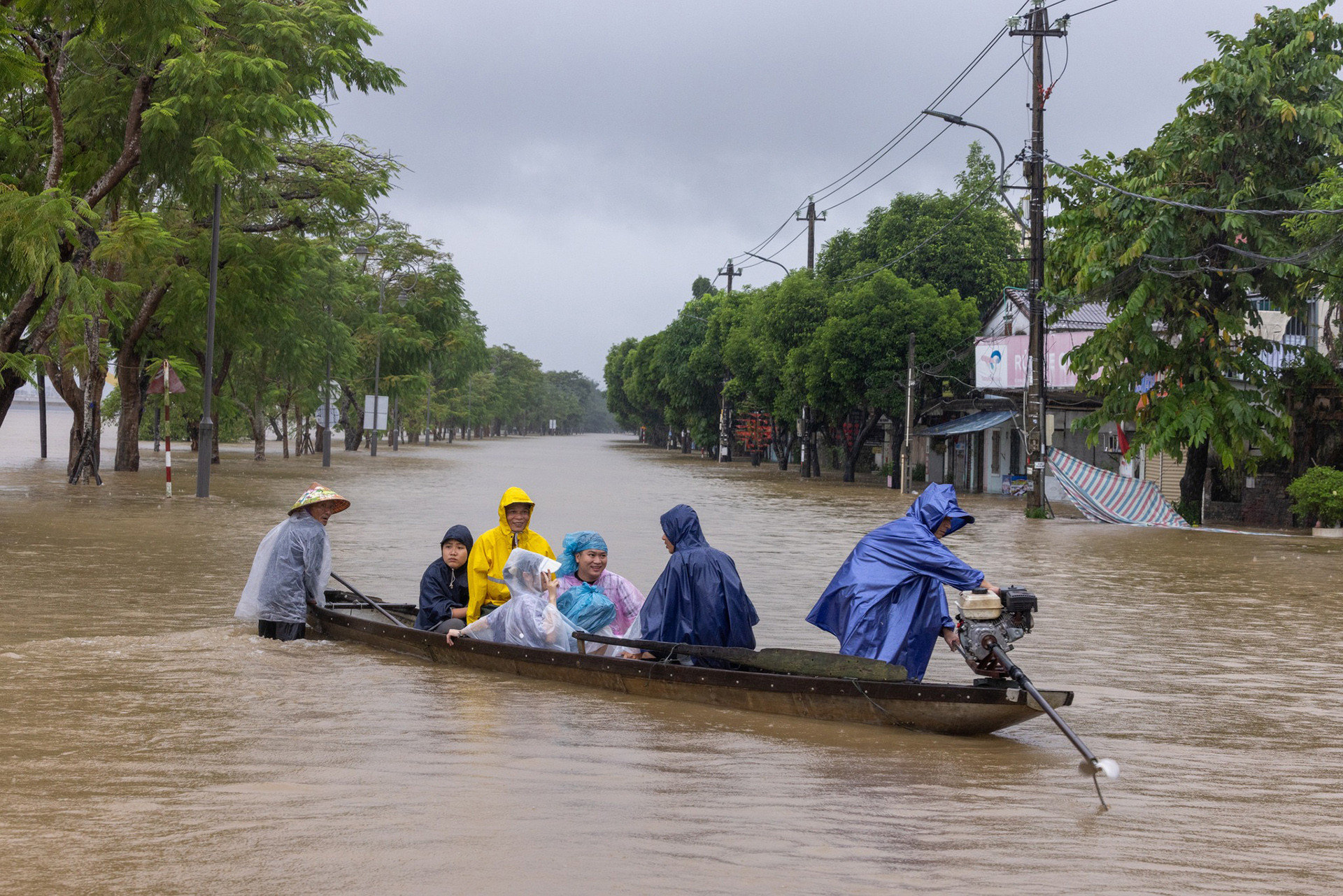
According to the National Center for Hydro-Meteorological Forecasting, from last night through this morning (November 3), areas from southern Ha Tinh to Da Nang experienced moderate to heavy rain, with some places facing very heavy rainfall and thunderstorms. Notable figures include Ban Nuoc station (Ha Tinh) with 242mm, Bach Ma peak (Hue) with 270mm, and Thang Binh station (Da Nang) with 376mm.
The prolonged downpour has caused water levels on rivers across Quang Tri, Hue, Da Nang, and Quang Ngai to surge beyond dangerous thresholds. Key rivers including the Kien Giang, Bo, Huong, and Vu Gia - Thu Bon have surpassed level 3 flood alerts, triggering widespread flooding.
As of 8 a.m., river levels were recorded as follows: Huong River at Kim Long station reached 3.89 meters (0.39m above alert level 3), Bo River at Phu Oc station at 4.81 meters (0.31m above alert), Vu Gia River at Ai Nghia station at 9.74 meters (0.74m above alert), and Thu Bon River at Cau Lau station at 4.23 meters (0.23m above alert).
In the next 12 hours, water levels on the Huong, Bo, Vu Gia, and Thu Bon rivers are expected to continue rising and remain above alert level 3.
Over the following 12-24 hours, these rivers will fluctuate at high levels, staying at or above level 3.
The meteorological agency has issued flood warnings for 29 communes and wards in Hue and 40 in Da Nang.
From now through November 5, floodwaters on rivers in Ha Tinh, Quang Tri, and Quang Ngai are also expected to rise again. In this floodwave, peak river levels on the Ngan Sau, Ngan Pho (Ha Tinh), Gianh, Kien Giang, and Thach Han (Quang Tri) rivers may reach levels 2 to 3, with some exceeding level 3.
Additionally, between now and the end of November 4, regions from Ha Tinh to Hue are forecast to receive 150-250mm of rain, with localized areas exceeding 400mm. Da Nang is expected to see 100-200mm, with certain areas receiving more than 250mm. There is a risk of intense rainfall exceeding 200mm in three hours.
On the night of November 4, the region from Ha Tinh to Quang Tri will still see moderate to heavy rain (20-40mm), with localized areas receiving over 70mm. From November 5 through the morning of November 6, rain intensity will gradually decrease.
Notably, Kalmaegi is expected to become the 13th storm of the 2025 season as it enters the East Sea on November 5. By around November 7, the storm may make landfall, with the highest risk area spanning from Da Nang to Khanh Hoa.
The storm may bring strong winds and heavy rainfall to the south-central, central-central, and Central Highlands regions between the nights of November 6 and 9. Forecasts may change, so authorities and residents are advised to stay updated.
Given that central Vietnam has already endured historic rainfall totals over the past week, resulting in saturated soil, any further storm impact could lead to severe flash floods and landslides.
42 people dead or missing due to central region flooding
From October 30 to the morning of November 3, Central Vietnam endured relentless downpours, with widespread rainfall of 300-500mm, and localized levels reaching 800-1,000mm. Bach Ma peak in Hue alone recorded a record-breaking 1,202mm.
According to a report from the Department of Dyke Management and Natural Disaster Prevention and Control (Ministry of Agriculture and Environment) on November 3, the storm has caused serious damage to people, property, and infrastructure.
To date, 42 people have been reported dead or missing. This includes 37 confirmed deaths: 7 in Quang Tri, 15 in Hue, 12 in Da Nang, and 3 in Lam Dong. Five people are still missing: 1 in Quang Tri and 4 in Da Nang.
Another 78 people have been injured, most of them in Da Nang (65), with others in Hue, Quang Ngai, and Quang Tri.
Over 12,600 houses remain submerged, with more than 100 homes completely destroyed or swept away. Some 7,900 hectares of rice and crops have been damaged, while around 64,000 livestock and poultry were washed away.
Transport remains severely disrupted, with 50 blocked points reported along national highways, particularly on the Ho Chi Minh Road (western branch) and the Truong Son Dong route.
As of now, electricity has been restored for more than 556,000 households, though about 1,500 customers in Da Nang remain without power.
Bao Anh
.svg)
