 Vietnamnet.vn

 Podcast



As the crisis in DRAM and storage components continues to ripple through the technology sector, a new report warns that higher smartphone prices are unavoidable. Entry-level devices are expected to bear the brunt of the impact.
According to Counterpoint Research, prices for DRAM and NAND memory are set to climb sharply in the second quarter of 2026, affecting all segments of the smartphone market, which is broadly divided into three tiers.
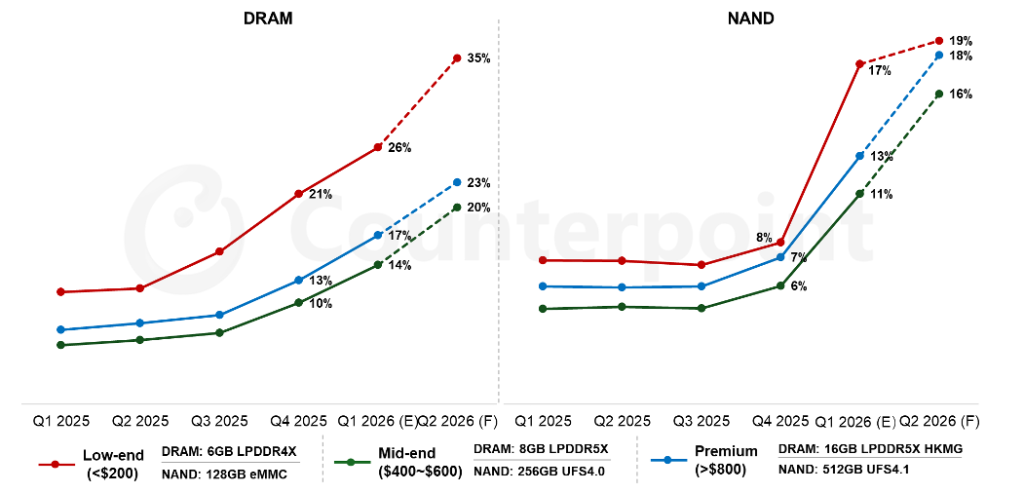
Fluctuations in memory costs across budget, mid-range and premium smartphones. Source: Counterpoint Research
Devices priced below US$200 are categorized as budget models. For these phones, rising component costs are becoming increasingly unsustainable. A typical device equipped with 6GB of LPDDR4X RAM and 128GB of eMMC storage now allocates as much as 43% of its total bill of materials to just these two components.
Analysts say the budget segment will suffer the most, with ripple effects expected across Chinese smartphone brands and chipmaker MediaTek.
Even premium devices, typically priced above US$800, are not immune. Production costs for high-end smartphones could rise by US$100-150 in the second quarter alone.
For a hypothetical flagship device featuring 16GB of LPDDR5X RAM and 512GB of UFS 4.1 storage, these two components would account for 23% and 18% of total manufacturing costs, respectively.
Mid-range devices, priced between US$400 and US$600, are also experiencing cost increases, though the impact is less severe. A typical configuration with 8GB of LPDDR5X RAM and 256GB of UFS 4.0 storage sees these components making up 20% and 16% of the bill of materials.
The report outlines two possible strategies for manufacturers to cope with the crisis: reducing reliance on the low-end segment and scaling back shipments of budget devices, or cutting non-essential specifications to offset rising costs.
For now, budget smartphones are increasingly viewed by analysts as a short-term loss-making segment.
The study concludes that retail price increases across the smartphone market in 2026 are inevitable.
Signs of this trend are already emerging, with price hikes recorded in Samsung’s mid-range Galaxy A series and in several tablet models from Lenovo.
Du Lam
.svg)
