 Vietnamnet.vn

 Podcast



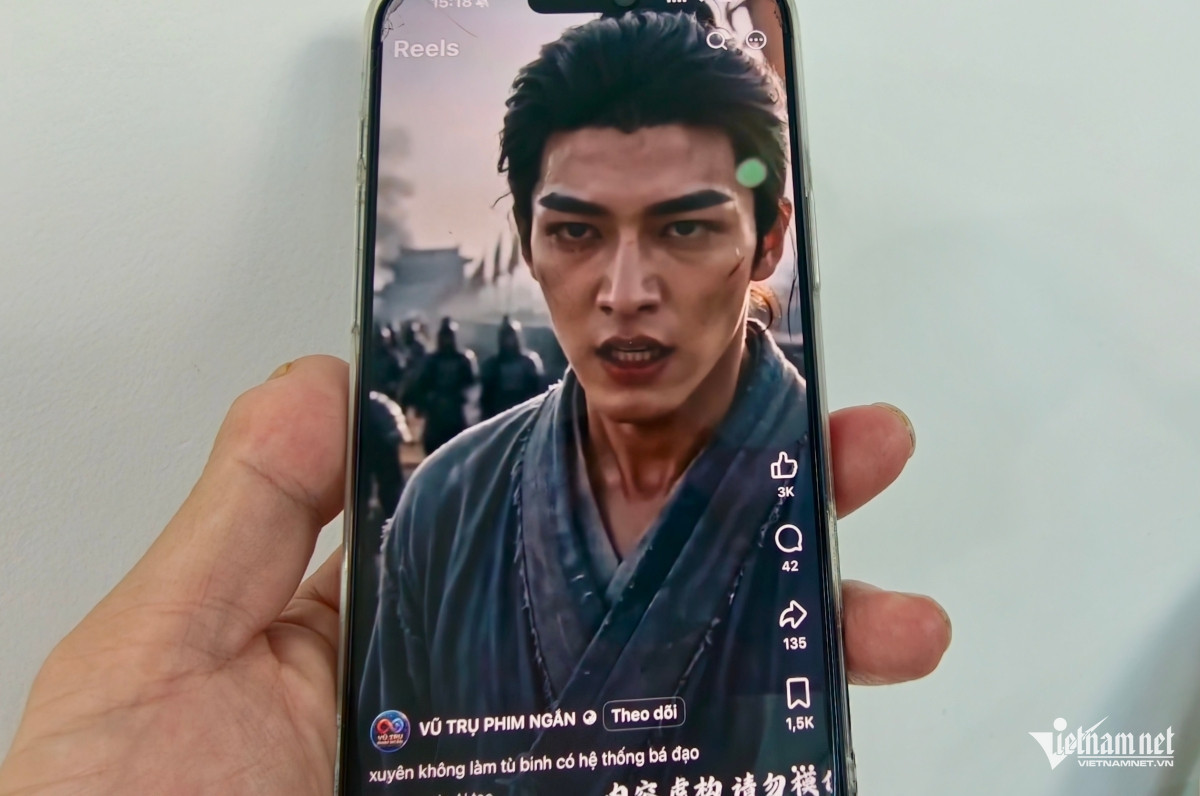
It is no coincidence that China has moved to restrict so-called "domineering CEO" dramas and other productions featuring unrealistic or illogical storylines in recent years.
The country has also tightened scrutiny of AI-generated films and requires such content to be clearly labeled.
Yet when certain types of content face restrictions in China, companies producing AI-generated short dramas there may look to overseas markets.
As a result, Chinese AI short dramas built around familiar themes such as powerful CEOs, time travel, reincarnation and immortal masters descending from the mountains are increasingly appearing across social media and digital platforms in Vietnam.
Open Reels or Watch on Facebook, TikTok or YouTube, and viewers can readily encounter streams of AI-generated short dramas originating from China.
Their plots are often deliberately exaggerated and detached from reality. Some "CEO" dramas revolve around the head of a major corporation marrying a poor woman. Time-travel stories might send a disgraced prince back to feudal times armed with missiles, while reincarnation plots feature characters who die, return to life with knowledge of future events and use it to become wealthy.
Many of these productions are now created using AI technology, leaving viewers frequently encountering similar storylines and characters whose artificial appearance can feel far removed from reality.
Beyond social media, such short dramas are also reaching Vietnamese audiences through OTT platforms including WeTV and iQIYI.
Experts say the lack of adequate oversight surrounding this content is creating potentially troubling consequences, particularly for younger audiences.
According to Tuan Nguyen, CEO of NetSpace, the proliferation of AI-generated short videos from China across Vietnamese social media is producing several areas of concern.
The problem, he said, is not that the content comes from China, nor simply that it is created with AI. The greater concern is the enormous scale and speed at which it can be distributed, without a corresponding level of oversight.
The first consequence is information pollution.
AI can generate thousands of videos within a short period, using eye-catching imagery, sensational storylines and human-like voices. Much of the content is designed to maximize views, with some videos even attempting to circumvent restrictions through sexually suggestive, adults-only imagery.
When algorithms repeatedly push such videos to users, it can become difficult for viewers to distinguish factual information from fabricated content. Those with limited exposure to technology may be particularly vulnerable to believing what they see online.
Over time, the greater danger may not simply be that people believe an individual fake video, but that they gradually lose trust in online information altogether.
The second concern involves perceptions and culture, particularly among children and users who have limited ability to verify what they see.
Short videos are engineered to trigger curiosity and emotion and keep audiences watching. As a result, they often prioritize sensationalism, superstition, violence, distorted history or questionable attitudes toward life.
If large quantities of such content are consumed every day, experts warn that they could gradually influence Vietnamese viewers' tastes, language, behavior and values.
A third consequence is the potential damage to Vietnam's domestic content creation ecosystem.
Vietnamese creators may invest considerable time, manpower and money in producing high-quality content, while an AI system can effectively industrialize video production at minimal cost.
When platforms prioritize views and time spent rather than assessing the origin, quality or social value of content, low-quality material can overwhelm more substantive work. Genuine creators are then forced to compete on an increasingly uneven playing field.
There are also risks involving copyright infringement, unauthorized use of people's images and voices, celebrity impersonation, misleading advertising and deepfake-enabled scams.
Complicating matters further, some channels can be operated entirely from overseas while still reaching Vietnamese users, attracting audiences and generating revenue in the country, making it difficult to determine who should ultimately be held accountable.
Vo Quoc Hung, growth director at Tonkin Agency, said his greatest concern about the growing presence of Chinese AI-generated videos and short dramas is their potential to manipulate viewers' information environment and perceptions.
He pointed to low-quality scripts transformed into videos and short dramas featuring powerful CEOs, time travel and immortal masters as examples of content that can create distorted perceptions of everyday life and aesthetics while spreading inaccurate information.
Beyond that, he warned that such content could stifle genuine creativity because AI-generated videos and short films can be produced cheaply and in virtually unlimited quantities.
Nhan Nguyen, who works in digital marketing in Ho Chi Minh City, similarly argued that videos unable to appear on Chinese platforms because of the country's stringent content controls may be redirected toward other markets, including Vietnam.
This poses risks, he said, because such videos and short dramas may circulate without sufficient oversight in Vietnam.
Content moderation systems on platforms such as Facebook, YouTube and TikTok also remain limited in some respects, particularly when dealing with AI-generated videos.
The consequences of allowing content deemed unsuitable elsewhere to circulate widely could be especially serious for young people and minors, he warned.
Repeated exposure could influence how children perceive life, with potentially negative effects on both individual development and the wider social environment.
Le My
.svg)
