 Vietnamnet.vn

 Podcast



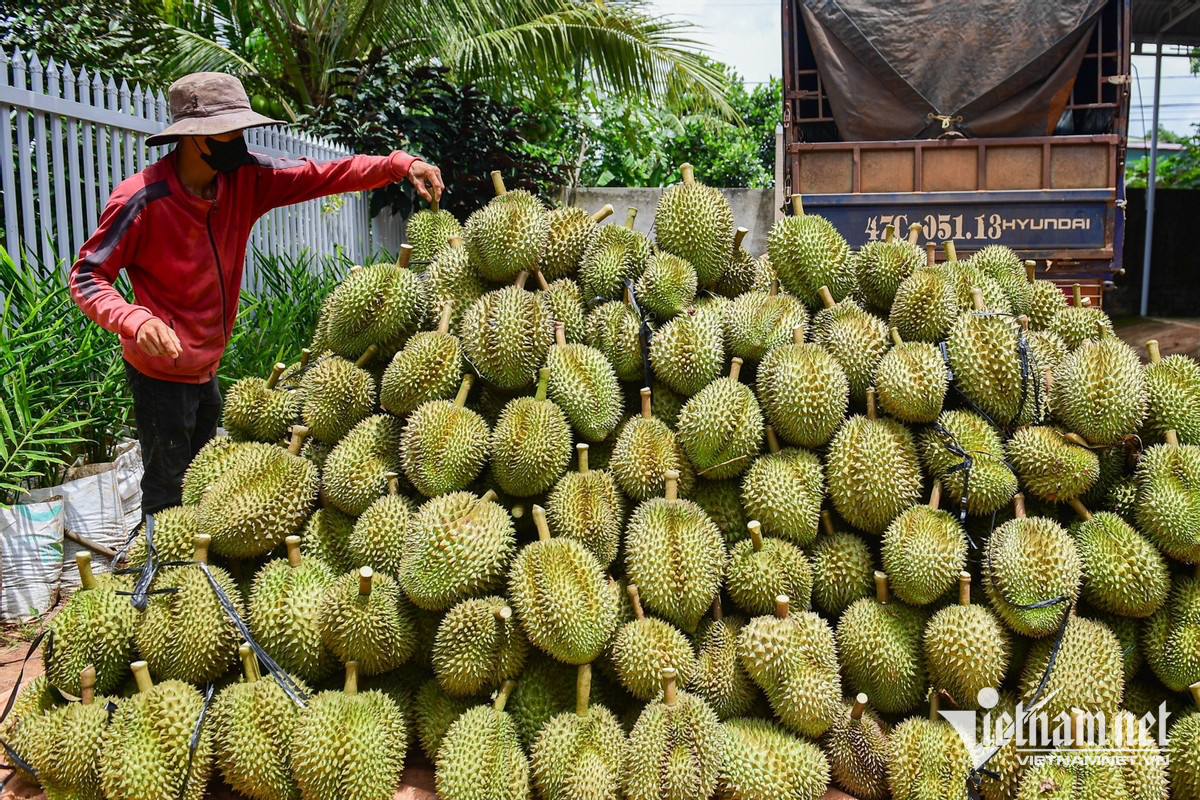
According to the Vietnam Fruit and Vegetable Association, China remained its number one consumer, importing $987.9 million worth of Vietnam’s durian, up 43.1 percent compared to the same period in 2025 and accounting for 91 percent of Vietnam's total durian export value in the first half of 2026.
It is estimated that exports could generate roughly $4 billion by the end of the year. During peak harvest, export turnover in August and September could hit around $1 billion per month.
Although exports continue to post strong gains in turnover, domestic and export prices have dropped sharply.
In mid-July, the Ministry of Industry and Trade (MOIT) stated that Vietnamese Monthong durian sold in China for 20–30 yuan per 0.5 kilograms ($2.79–4.18), significantly lower than the 35–45 yuan recorded during the same period last year.
Similarly, at wholesale markets in China, Grade-A Vietnamese Monthong durian prices dropped from 36.5 yuan per 0.5 kilograms (USD 5.09) to 13 yuan per 0.5 kilograms (USD 1.81) between April and June.
Domestically, data from the Gia Sau Rieng website showed that on August 3, Ri6 durian prices in the Southeast region ranged from VND25,000 to VND60,000 per kilogram, while Monthong fetched VND40,000 to VND85,000 per kilogram. In the Central Highlands, Ri6 and Monthong prices stood at VND 25,000–54,000 per kilogram and VND32,000–74,000 per kilogram, respectively.
Nguyen Van Tao, a durian farmer in Dak Nong, said that last year before harvest, traders came directly to his orchard to purchase all top-grade fruit at VND70,000 per kilogram. Last year, top-grade fruit accounted for over 70 percent of his family's harvest.
"Durian prices are lower this year. Harvest is only about 15 days away, but traders are no longer placing deposits to lock in purchases like before," he said.
Supply volume
The CEO of a major fruit and vegetable export enterprise in Vietnam on August 3 acknowledged that during the first seven months of this year, his company's durian export volume grew roughly 8 percent year on year, yet total value declined significantly.
"Durian output in Vietnam is expanding rapidly every year," the CEO said. Meanwhile, durian consumption remains heavily dependent on the Chinese market.
Importantly, China previously relied solely on Thailand and Vietnam for durian supplies. Now, durians from multiple Southeast Asian nations are flooding into this billion-person market. When supply increases sharply as demand grows slightly, durian prices are pulled down.
A report from the Ministry of Agriculture and Rural Development showed that in 2022, when Vietnam officially exported durians to China for the first time, the nation's total durian cultivation area stood at roughly 110,000 hectares. By the end of June this year, that figure reached 198,600 hectares, representing an increase of over 80 percent.
First-half durian output reached an estimated 603,300 metric tons even before peak harvest, up 12.7 percent compared to the same period in 2025.
Dang Phuc Nguyen, General Secretary of the Vietnam Fruit and Vegetable Association, acknowledged that farmgate durian prices fell below grower expectations this year.
He attributed the price decline to newly planted areas from previous years entering production, causing output to surge. While output totaled just over 1 million metric tons last year, it could surpass 2 million metric tons this year.
Furthermore, Thailand, Malaysia, Cambodia, and Laos are increasing durian exports to China, intensifying market competition.
At the same time, China has tightened inspections over growing area codes, packing facility codes, and cadmium and Rhodamine B testing parameters. Extended inspection processes leave many shipments waiting at border crossings, deteriorating durian quality. Consequently, buyers push prices down to offset risks.
"That is why durian prices are lower this year than last year," Nguyen clarified. In addition, heavy rainfall also reduced the yield of Grade-A fruit.
To boost exports, authorities have worked to open export channels. For instance, following extended negotiations, India officially opened its market to Vietnamese durian in mid-July.
Securing official access to India creates new growth opportunities for Vietnamese durian. As a market with a massive population and strong demand for imported food products, India is expected to help diversify export destinations and reduce reliance on traditional markets.
The Government issued Resolution 36/2026 simplifying administrative procedures for growing area codes and packing facility codes. The new process makes document review faster and more transparent. As China approves more growing area codes, larger volumes of durian become eligible for export to the market.
Tam An
.svg)
