 Vietnamnet.vn

 Podcast



The groundbreaking of the Hanoi - Quang Ninh high-speed railway, valued at US$5.6 billion, on April 12 has sent a clear signal: the 2026–2030 term is opening with large-scale construction sites to realize the goal of double-digit growth.
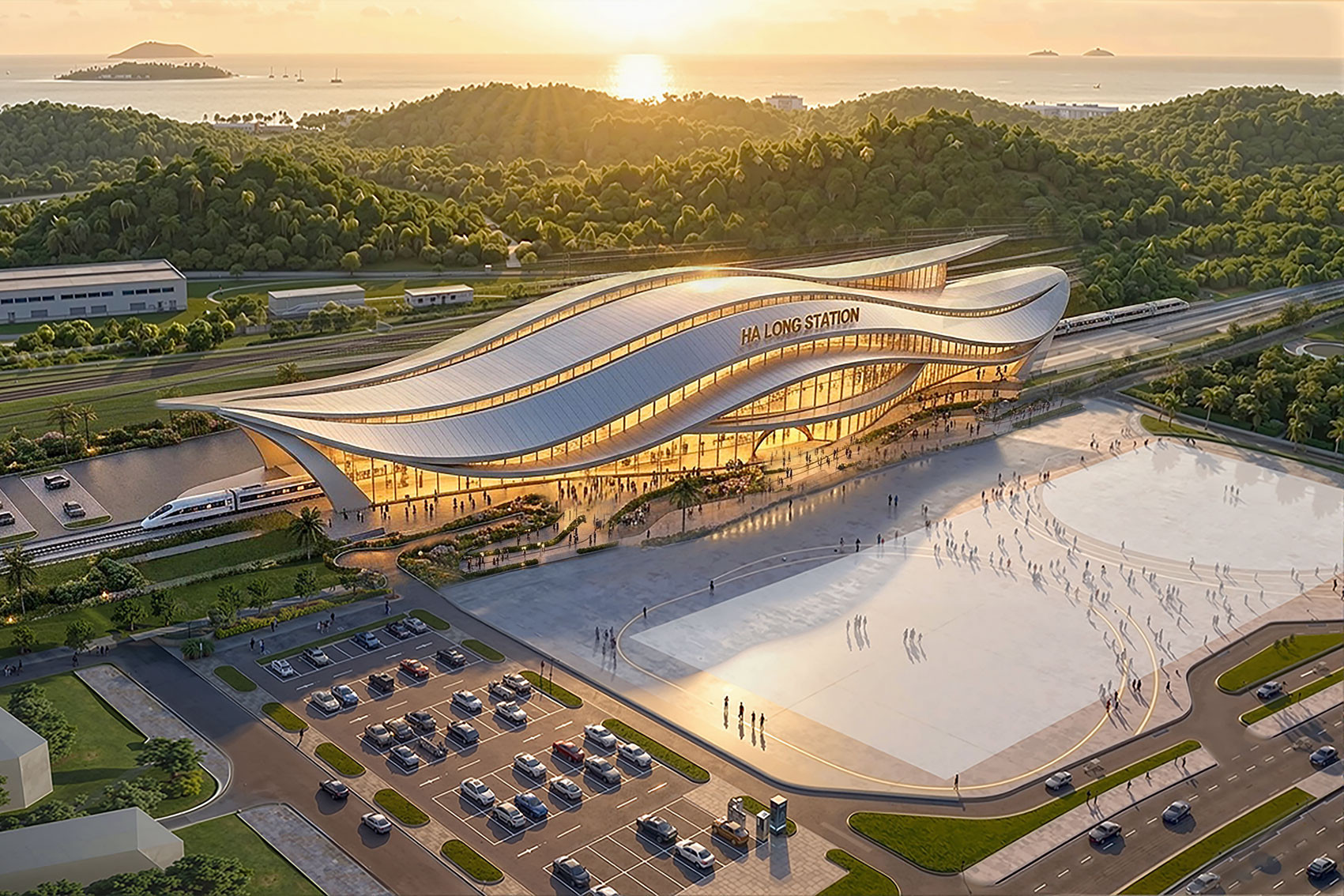
But the VND140 trillion (approximately US$5.6 billion) investment for this railway is only a small slice of a much larger picture. Over the next five years, Vietnam aims to mobilize total social investment of VND38.5 quadrillion (US$1.54 trillion), equivalent to 40% of GDP, significantly higher than the roughly 33% seen in the 2020–2025 period.
To achieve double-digit growth, the economy must enter a phase of massive resource mobilization. While medium-term public investment in the previous term stood at VND2.87 quadrillion (US$115 billion), the 2026–2030 period is projected to reach VND8.22 quadrillion (US$329 billion). Direct mobilization from the state budget is also expected to rise from around VND2.4 quadrillion (US$96 billion) to VND6.5 quadrillion (US$260 billion), nearly 2.7 times higher.
More notably, of the VND8.22 quadrillion, central budget capital is projected at about VND3.8 quadrillion (US$152 billion), while local budgets account for VND4.42 quadrillion (US$177 billion), signaling a strong decentralization of resource allocation to localities.
A significant shift in policy thinking is that the number of public investment projects is expected to decrease by around 30% compared to the 2021–2025 period, in order to increase scale, efficiency, and the spillover impact of each project.
Instead of spreading resources thinly, the new term is oriented toward fewer projects, each large enough to drive growth, create jobs, and expand development space.
However, with larger capital comes the question of feasibility. Phan Van Mai, Chairman of the Economic and Financial Committee, emphasized that balancing resources for the 2026–2030 plan will be a major challenge, as it depends directly on sustaining double-digit growth, actual budget revenues, and debt discipline.
A notable point in the appraisal is that the entire design is tied to the double-digit growth target. State budget revenue over the next five years is expected to increase by about 1.7 times, while the share of development investment spending is projected to reach 40% of the budget, significantly higher than in the previous period.
This indicates that VND8.22 quadrillion is not merely expenditure but “seed capital” to ensure that public investment accounts for around 20% of total social investment, thereby leading private capital flows.
In simpler terms, the entire term cannot be built on the assumption that everything will go smoothly. Investment planning must include contingency scenarios, align with actual revenue capacity, and adhere to borrowing limits to avoid shifting pressure to future periods.
Across the country, the scale becomes even more evident when looking at upcoming mega projects: VND1.7 quadrillion (US$68 billion) for the North-South high-speed railway, about VND3.4 quadrillion (US$136 billion) for power generation and transmission, more than VND3.065 quadrillion (US$123 billion) for metro systems in Hanoi and Ho Chi Minh City, around VND280 trillion (US$11 billion) for the Ninh Thuan nuclear power project, and roughly VND400 trillion (US$16 billion) for Long Thanh International Airport.
Just the three major sectors - high-speed rail, power, and metro - already exceed VND8 quadrillion in capital demand. The power sector alone requires VND3.4 quadrillion, while metro systems need VND3.065 quadrillion, bringing their combined demand to VND6.46 quadrillion (approximately US$259 billion).
Never before have so many large-scale construction sites appeared simultaneously across the development map, from railways and energy to metro systems and expanding mega-urban areas.
Looking at growth space, the capital pressure is even greater. Hanoi is estimated to require about VND5 quadrillion (US$200 billion), while Ho Chi Minh City needs a similar amount for the 2026–2030 period. Together, these two growth poles alone account for nearly VND10 quadrillion (US$400 billion), or about 30% of the nation’s total capital demand.
At a more visible layer of the market, 27 mega urban projects currently underway or in preparation carry total capital of about US$115 billion, equivalent to more than VND3 quadrillion. Beneath this is a broader base of 3,297 real estate projects nationwide with total capital reaching VND7.42 quadrillion (US$297 billion), nearly equal to the entire five-year public investment plan.
In 2025, Vietnam organized three waves of groundbreaking and inauguration for 564 key projects with total capital exceeding VND5.12 quadrillion (US$205 billion) - a record year for construction. Yet even this figure falls short of the off-budget capital the economy must mobilize annually in the new term: VND6.1 quadrillion (US$244 billion).
What was once considered a peak level of annual investment is now becoming the baseline for each year of the 2026–2030 period.
So where is the money?
The VND8.22 quadrillion in public investment can only serve as seed capital. The decisive factor lies in the remaining VND30.5 quadrillion (US$1.22 trillion), or about VND6.1 quadrillion per year, which must come from domestic enterprises, foreign direct investment, international capital, household savings, and funds currently tied up in thousands of projects.
By the end of 2025, total deposits in the banking system had reached a record VND15.3–16.2 quadrillion (US$612–648 billion). Household deposits alone stood at around VND8 quadrillion (US$320 billion), while corporate deposits exceeded VND8.35 quadrillion (US$334 billion).
These figures are striking. Household deposits alone exceed the amount of capital the economy needs to mobilize in a single year. Meanwhile, total deposits equal more than half of the non-budget capital required for the entire 2026–2030 period.
The question, therefore, is no longer where the money is. The challenge is how to move a portion of this vast pool out of its defensive state and into factories, infrastructure, innovation, and new construction sites - while maintaining stability in prices, interest rates, exchange rates, and public debt safety.
The task for the next five years is not just about finding capital, but also about avoiding pressure on interest rates and liquidity as demand surges. It also involves preventing capital from flowing into speculative assets, which could trigger inflation, financial instability, or systemic risks.
If 2020–2025 was a period of accelerating public investment, then 2026–2030 will be a far greater test. The key lies in transforming this nearly threefold increase in capital into real construction sites, real factories, real productive capacity - and ensuring that it creates stable jobs, higher incomes, and more sustainable livelihoods for households.
Tu Giang
.svg)
