 Vietnamnet.vn

 Podcast



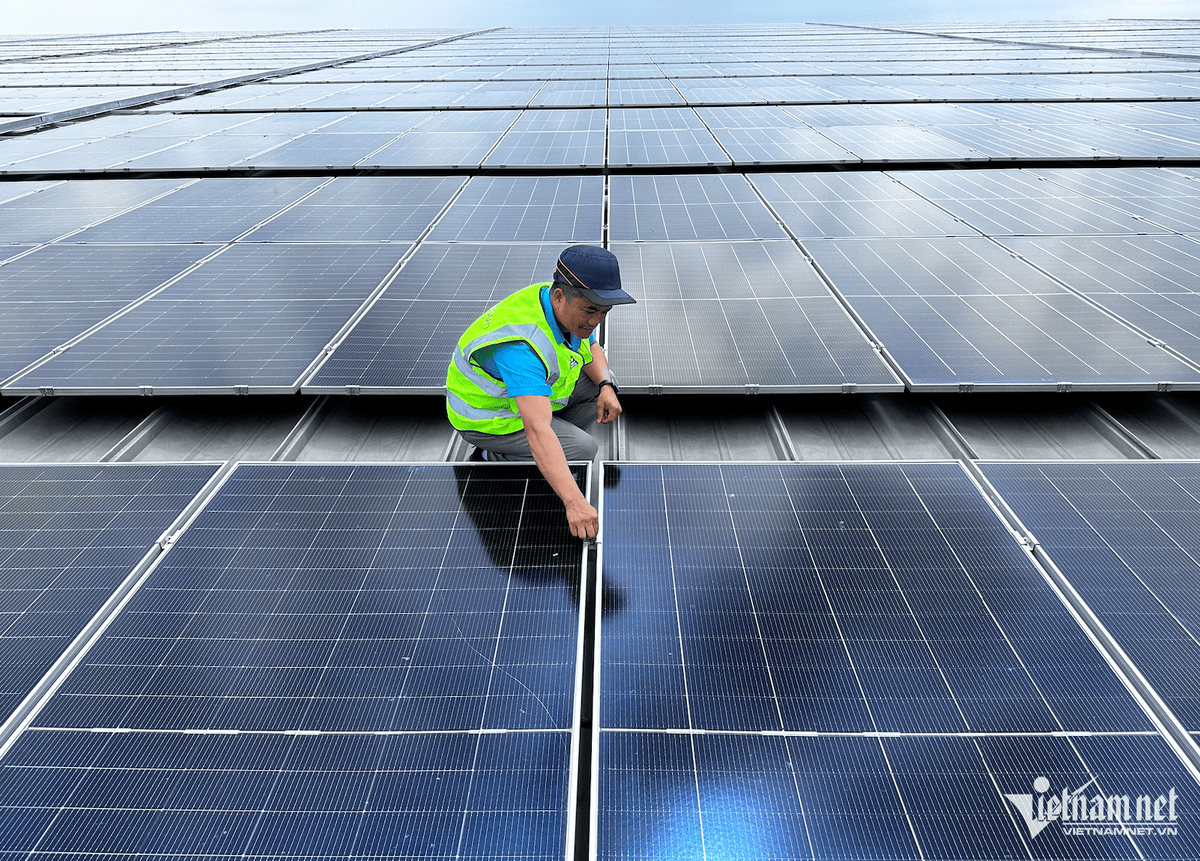
A senior executive of FLAT Vietnam (DEEP C Industrial Zones Complex, Hai Phong City) told VietNamNet that the firm has commissioned over 11 MWp of rooftop solar capacity and is researching an additional investment of 1.5 MWp on its remaining factory roof space.
Every day from 6am to 5pm or 6pm, from the moment production lines start running until workers end their shifts, the rooftop solar system generates power.
This generative rhythm aligns directly with the factory's peak daily power consumption. The company views rooftop solar as an integral part of its production line rather than a standalone investment project.
FLAT calculated that on hot sunny days, the rooftop solar system can reach a peak output of over 9 MW, equivalent to 80 to 85 percent of designed capacity and meeting roughly one-third of the factory's power demand, which ranges from 30 to 35 MW.
On average, daily output maintains around 6.5 to 7 MW, depending on weather conditions.
Under current electricity tariffs, self-generated power from this system saves the company about VND100 million per day while substantially reducing peak-hour grid consumption.
However, power output from the rooftop solar system varies seasonally. On sunny days, the system generates around 50,000 kWh per day; under less favorable weather, output reaches 35,000 to 40,000 kWh. In winter, production drops to 10,000–20,000 kWh per day due to reduced sunlight hours and lower radiation intensity.
Dao Van Thuan, electrical manager at DEEP C Industrial Zones Complex, said that many other enterprises in the industrial zone also have invested hundreds of billions of dong to install self-produced, self-consumed rooftop solar systems.
Within DEEP C alone, prior to 2025, rooftop solar systems totaling 5.38 MWp were put into operation. This year DEEP C will commission an additional 6.2 MWp of rooftop solar power across factory roofs.
According to Thuan, following the issuance of new policies, many tenants in the industrial zone invested in rooftop solar installations. As a result, from April to June this year, total rooftop solar capacity in the complex surged by more than 70 percent.
These figures illustrate that the rooftop solar investment trend is gaining increasing corporate traction, not only to cut power costs but also to meet sustainability requirements, reduce emissions, and boost competitiveness when entering global supply chains, Thuan added.
Hai Phong Power Company reported that as of late June 2026, the entire city had 967 customers implementing rooftop solar systems with a registered capacity of approximately 60 MW.
With this strong momentum, Hai Phong Power Company aims to have 1,200 customers utilizing self-produced, self-consumed rooftop solar power, with total developed capacity reaching 110 MW, equivalent to 122.2 percent of its assigned target.
According to the Northern Power Corporation (EVNNPC), many localities have taken innovative approaches to promoting rooftop solar alongside green transition and efficient energy usage. This proactive stance creates favorable conditions for citizens and businesses to invest in rooftop solar systems in compliance with regulations.
After over a year of implementing Decree No 58, Directive 09, and Directive 10, the development of self-produced and self-consumed rooftop solar power across Northern Vietnam is expanding rapidly.
In the first six months of 2026, EVNNPC added 8,500 new rooftop solar customers, representing a total capacity of 394.5 MW. This achieved 167 percent of the target for customer numbers and 116 percent of the target for capacity assigned for the six-month period.
In June alone, the corporation developed 2,084 new customers, reaching 243 percent of its monthly target, with total installed capacity reaching 96.1 MW, equivalent to 170 percent of the monthly plan.
These figures demonstrate that rooftop solar in Northern Vietnam is no longer confined to isolated models. From industrial parks and manufacturing facilities to households, schools, and medical centers, an increasing number of customers are harnessing existing roof space to generate on-site power.
Decree 243, issued on June 26, introduces several incentive policies enabling citizens and businesses to deploy rooftop solar power. The decree regulates that surplus electricity can be bought and sold based on mutual agreements between the two parties, provided it does not exceed 50 percent of the total output generated at the rooftop solar power system's output terminal based on radiation intensity.
Tam An
.svg)
