 Vietnamnet.vn

 Podcast



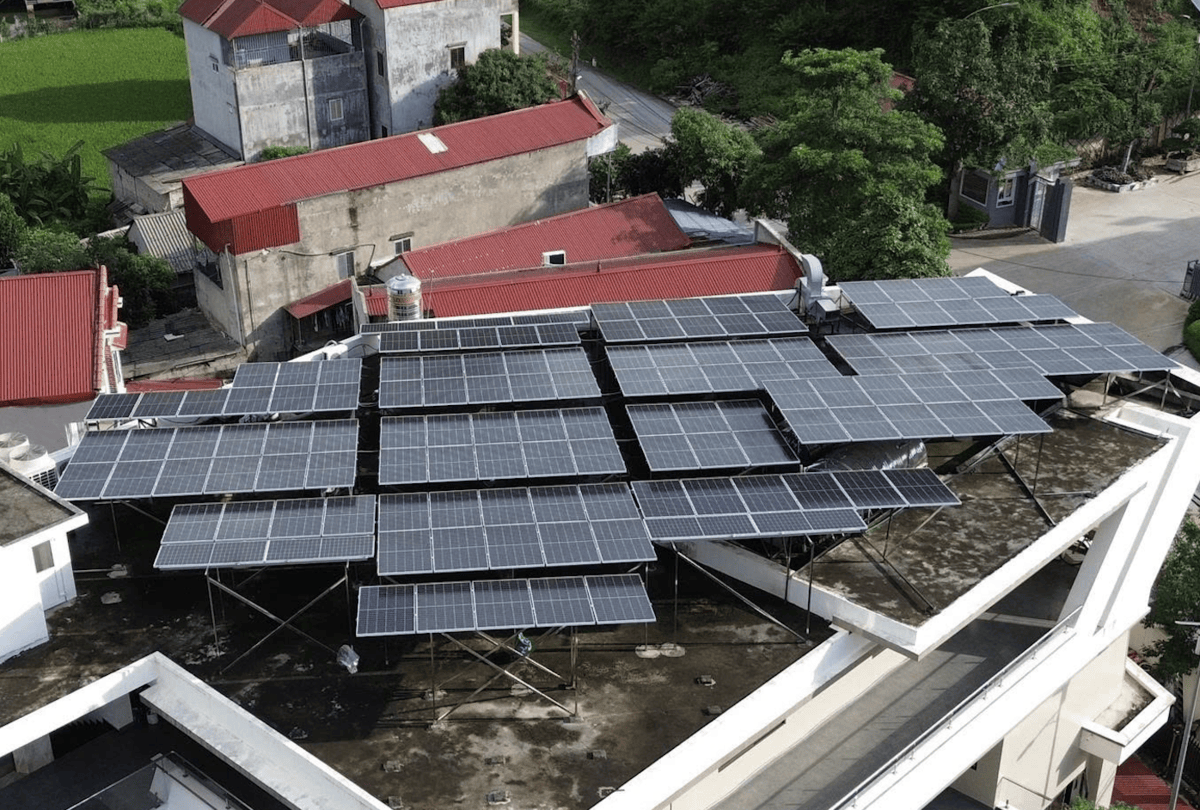
Nguyen Cong Toan in Bac Ninh, the owner of a 15 kWp rooftop solar system and a 32 kWh Battery Energy Storage System (BESS), said his family's recent electricity bill had dropped to just a few hundred thousand VND.
"Not only has our electricity bill plunged, but my family has also started selling excess power back to the grid," he said. In the first 22 days of July alone, the volume of surplus electricity sold to the grid reached 204 kWh.
Toan said his family uses many electrical appliances. In summer, without a rooftop solar system with BESS, the family's electricity bill could reach VND 6-7 million per month.
Since installing rooftop solar with battery storage valued at VND250 million, household power supply during both day and night has become sufficient, eliminating worries about blackouts. Unused electricity can even be sold to the grid.
"In the sunny summer months, we use electricity comfortably, and the BESS is always fully charged. In winter, if the weather is clear, the power generation efficiency of the solar panels remains strong," Toan noted.
However, on overcast, cloudy, or rainy days, generation efficiency drops, requiring his family to purchase power from the grid.
Vu Xuan Thoan, deputy director of Song Cong Diesel, said the company invested in a self-produced, self-consumed rooftop solar system with a capacity of 4 MW in March 2026.
With this system, the company saves billions of VND in electricity costs annually. The enterprise also satisfies green manufacturing and greenhouse gas reduction mandates required by clients from Germany, Italy, Japan, and other markets.
"We must create plans and register with them on how we curtail power usage and utilize renewable energy. The major objective when investing in rooftop solar relates directly to economic benefits and customer requirements," Thoan said.
According to EVNNPC, during the first 6 months of 2026, in 17 northern provinces and cities under its management (excluding Hanoi), the unit developed 8,500 new customers installing self-produced, self-consumed rooftop solar systems. Total capacity reached 394.5 MW, achieving 167 percent in customer numbers and 116 percent in capacity relative to assigned targets.
As of June 30, 10,099 customers have installed rooftop solar systems with a combined capacity of 718.3 MW, among which 98 customers are selling excess electricity.
EVNNPC reported that after over a year of implementing Decree 58/2025, the development of self-produced and self-consumed rooftop solar in the region has registered positive results.
Additional mechanisms
Energy expert Ha Dang Son noted that rooftop solar power brings very clear benefits. The peak temperature period of the day usually aligns with when solar systems generate electricity most efficiently. This creates synchronization between power generation and cooling power demand.
Additionally, installing solar panels on rooftops helps lower rooftop surface temperatures by roughly 2 to 3oC, saving additional energy.
Regarding costs, the benefits for households and businesses are evident. If incentives from the Ministry of Industry and Trade are promoted, users can also significantly trim electricity costs by avoiding high-tier electricity tariffs.
For businesses, rooftop solar carries strategic importance, as many export markets, especially Europe, increasingly mandate green energy usage across supply chains. Also, developing rooftop solar combined with energy storage solutions contributes to enhancing the nation's power supply assurance capabilities.
The Government has issued Decree 243/2026/ND-CP, which regulates mechanisms for trading excess power output. Accordingly, surplus electricity from rooftop solar systems, including power from storage systems charged by solar energy, is permitted for purchase and sale based on mutual agreements between parties.
From June 26, 2026, through December 31, 2030, surplus electricity output can be bought and sold according to mutual agreement, provided it does not exceed 50 percent of the total electricity generated by the rooftop solar system.
The condition is that the power grid in the connection area guarantees absorption capacity, and the sale of surplus electricity complies with grid safety operation requirements and power system operational methods.
For mountainous, border, and island regions not yet connected to the national power grid, no volume limits are imposed on the sale of surplus electricity. Paid surplus electricity covers all energy fed into the buyer's grid as measured at the meter.
Tam An
.svg)
