 Vietnamnet.vn

 Podcast



Starting with just 100 square meters of mushroom-growing space, Tuan Linh Clean Mushroom Cooperative has expanded its production area to nearly 8,700 square meters and now generates more than VND18.5 billion ($700,000) in annual revenue. Behind that growth is a model built on technical expertise, farmer partnerships and value-added processing.
A mushroom cooperative built on the ‘five selfs’ and ‘five togethers’
The business built by Nguyen Quoc Huong and his wife, Ngo Thi Kim Lien, in Son Ly Village, Dong Trach Commune, Quang Tri Province, began with a personal family need.
About 15 years ago, Huong was looking to buy lingzhi, or reishi mushrooms, a medicinal mushroom his family hoped could support his ailing father’s health. The search gave him the idea of growing the mushrooms himself.
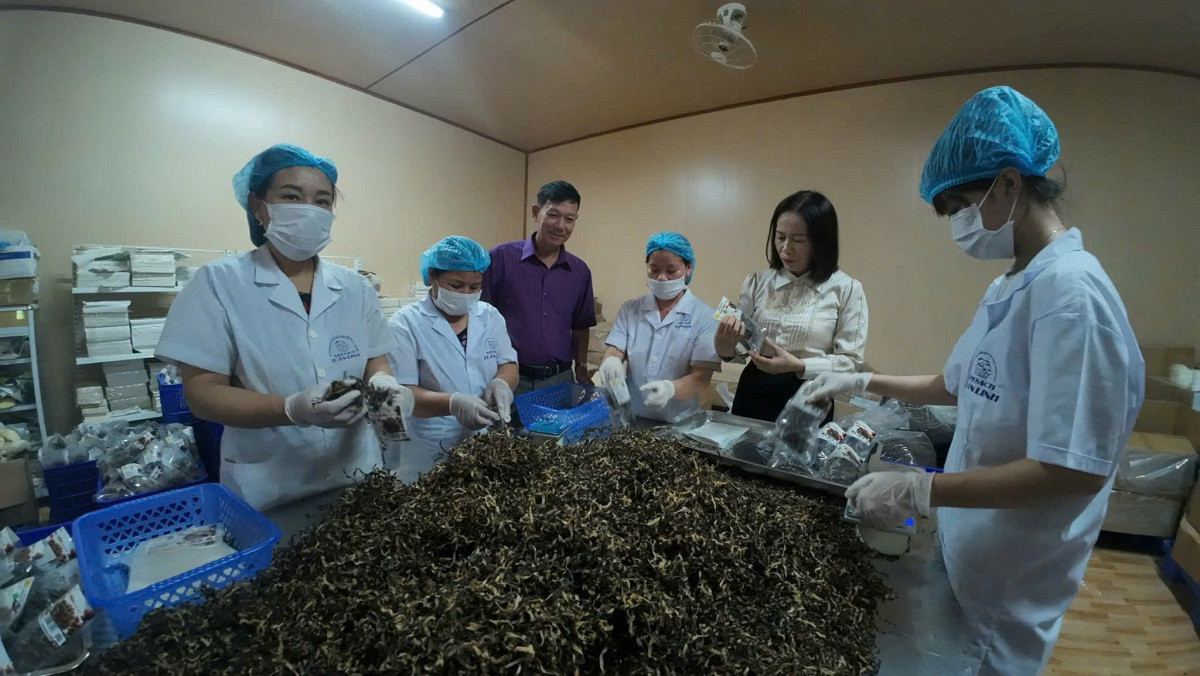
Initially, the goal was simply to secure a supply for his family while reducing costs. But after recognizing market demand, Huong and his wife decided to learn more about mushroom cultivation and turn it into a business.
The couple visited several large mushroom farms to study their techniques before setting up their own production site of about 100 square meters.
According to Huong, mushroom cultivation does not require exceptionally large initial investment, but growers need a firm command of the technical process.
Each variety has different growing characteristics, he said, and every stage - from preparing mushroom substrate and spawn to controlling temperature, humidity and the growing environment - must be handled precisely.
In 2016, Lien founded Tuan Linh Clean Mushroom Cooperative, focusing on clean and organic production through an integrated value chain.
The cooperative developed a process covering spawn production, cultivation, processing and distribution while building partnerships with local farmers.
Today, it works with 34 cooperative groups and more than 500 farming households, providing spawn, materials and technical support, purchasing their output and connecting them with markets.
Its operating model follows what it calls the “five selfs”: self-awareness, voluntary participation, self-reliance, self-management and self-responsibility.
These are combined with the “five togethers”: thinking together, working together, sharing the benefits, sharing responsibility and developing together.
Participation in the network has enabled many households to expand production while reducing the risks associated with fragmented, small-scale farming and uncertain markets.
Partner households earn an average of VND70 million to VND150 million ($2,650-$5,700) a year.
Beyond purchasing their mushrooms, Huong personally trains farmers through a hands-on approach.
Some participating households have subsequently established their own cooperative groups and mushroom cooperatives, with Tuan Linh continuing to provide technical assistance and market access.
From 100 square meters to $700,000 in annual revenue
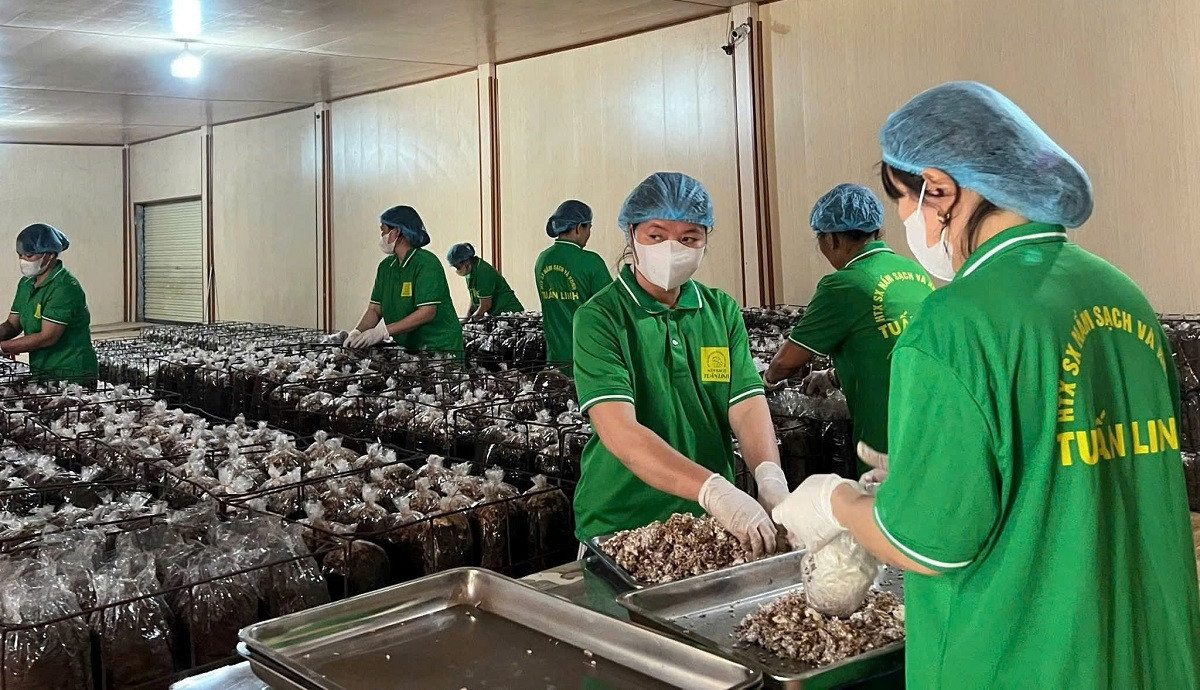
As production increased, the cooperative invested in machinery and technology and expanded into value-added processing rather than depending primarily on fresh mushroom sales.
Its facilities now include equipment for grinding raw materials, producing and packaging tea bags, extraction and concentration, vacuum packing, ingredient mixing and preparing mushroom growing bags, as well as sterile cold-room systems.
Mechanization has helped increase productivity, stabilize quality and control production costs.
Using reishi mushrooms, the cooperative has developed products including concentrated reishi extract, instant reishi tea, reishi tea blended with ca gai leo, green tea and whole-spore reishi products.
Turkey tail mushrooms have also been introduced for commercial cultivation and processed into tea bags.
Notably, in 2024, Lien was granted a patent by the Intellectual Property Office of Vietnam under the Ministry of Science and Technology for a “process for producing vegetarian fish sauce from mushrooms.”
Building on its mushroom business, the cooperative has expanded into processed products made from locally grown agricultural ingredients including peanuts, sesame, mung beans and red beans. It has also developed pennywort tea and herbal teas made from ca gai leo and xa den.
The cooperative now has around 20 products, 14 of which have received ratings of three to five stars under Vietnam’s One Commune One Product, or OCOP, program.
Some products also meet VietGAP and ISO 22000:2018 standards and have obtained organic certification.
Tuan Linh has increasingly adopted digital tools for sales, including QR-code traceability, electronic sales channels, e-commerce, livestreaming and connections with distribution networks.
Its products are available at supermarkets and clean-food stores across Vietnam and have also been exported to Laos, Thailand and Russia.
The cooperative has also developed a circular production model. Sawdust and rice straw are used as mushroom-growing materials, spent mushroom substrate is composted into organic fertilizer, and plastic bags are sorted for recycling.
After nearly a decade of operation, Tuan Linh Clean Mushroom Cooperative generates average annual revenue of more than VND18 billion ($680,000). Revenue exceeded VND18.5 billion ($700,000) in 2025 alone.
The cooperative provides regular and seasonal employment for around 60 workers, who earn VND7 million to VND12 million ($265-$455) a month.
Through its wider partnership network, hundreds of other workers have gained additional livelihoods from mushroom cultivation and supplying raw materials.
In 2026, Lien was named among Vietnam’s Outstanding Farmers marking 40 years of the country’s Doi Moi, or economic reform, era.
According to Huong, the cooperative plans to target the Halal market while continuing to standardize its production processes and strengthen product quality and brand value.
Hai Sam
.svg)
