 Vietnamnet.vn

 Podcast



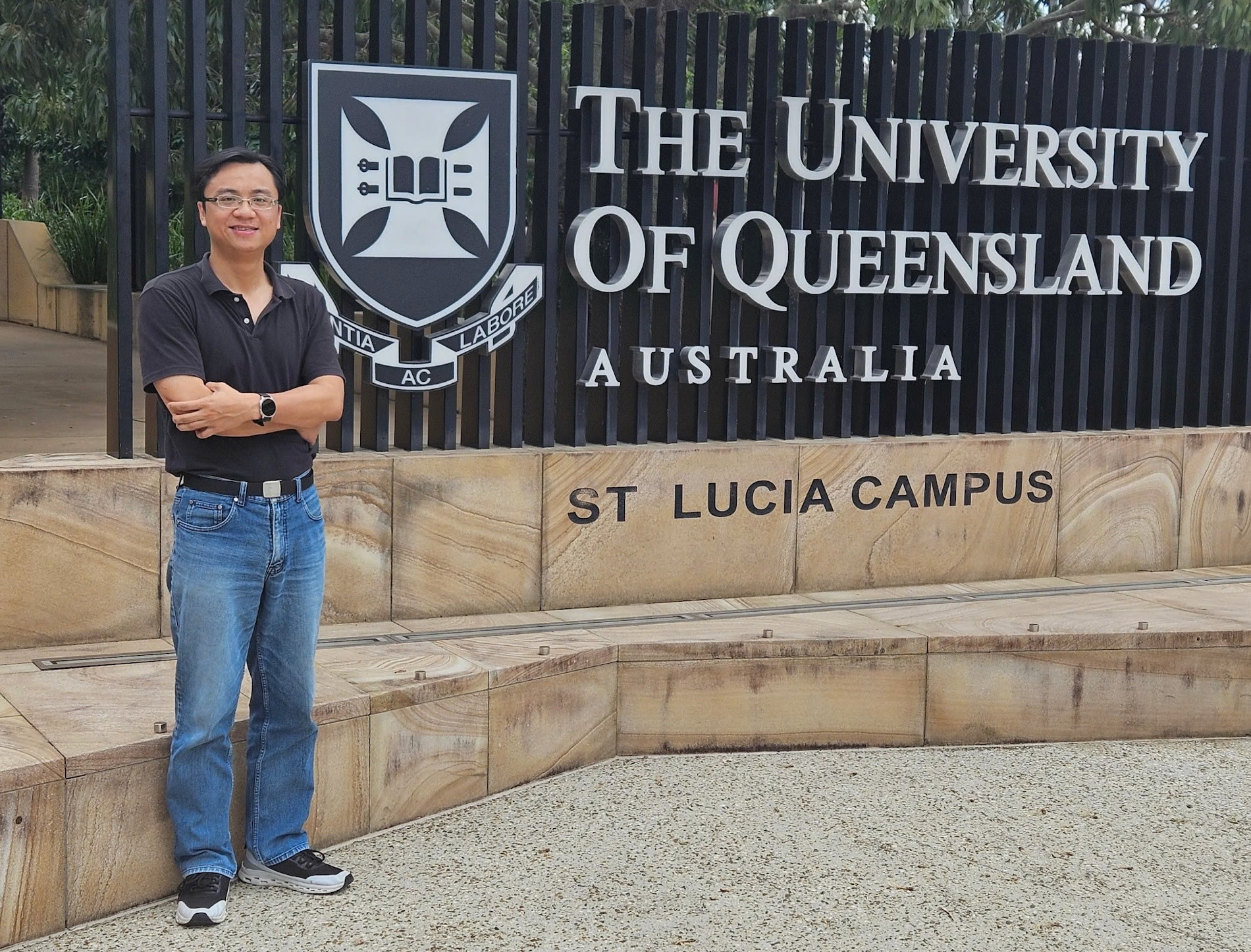
Dr. Nguyen Pham Nhat Thien Minh is currently a lecturer in Robotics at the University of Queensland (Australia). Originally from Can Tho, he has authored nearly 30 scientific papers published in international journals, attracting more than 2,200 citations, including two papers ranked among the top 1 percent most cited globally.
Despite these achievements, he says he never views scientific research as a race for accomplishments nor pressured himself to publish excessively.
"Some papers took nearly three years to complete, with experiments conducted across three countries and more than a dozen co-authors. But when such a work is accepted and cited by leading research groups, I feel the effort was worth it," he said.
Over 10 years ago, upon graduating from HCMC University of Technology (HCMUT), Minh had not yet envisioned his future path. He spent a year searching and applying for international scholarships.
In July 2015, Professor Xie Lihua from Nanyang Technological University (NTU, Singapore) accepted him as a doctoral student, which allowed the young Vietnamese researcher to accumulate experience in one of Asia’s top engineering research environments.
“When I first joined the research group, I had the least experience, so I mainly learned from senior members,” he recalled.
At NTU, Professor Xie’s group was well known for control theory and systems, and later robotics. Minh and his colleagues were among the pioneers in this research direction.
He soon became the first member of the group to publish in journals and conferences of the IEEE Robotics and Automation Society.
After completing his PhD, he continued postdoctoral research at NTU and the KTH Royal Institute of Technology in Sweden. In December 2025, he officially joined the University of Queensland as a lecturer in robotics.
Looking back, Minh believes his achievements stem largely from the foundation built during his undergraduate years in Vietnam.
“Many things once seemed normal, but only after going abroad did I realize their true value. For example, students at HCMC University of Technology develop ‘steel discipline’: classes start at 6:40am, and in lab sessions, even a small mistake or lack of preparation can mean being sent out,” he said.
These experiences helped him build a meticulous working style in research.
“Rejection is not a reflection of your ability”
Minh said that his journey has not been smooth. In recent years, he applied for teaching positions at multiple universities and faced several rejections despite his academic record.
“I don’t see rejection as a denial of my ability. Each hiring committee has different priorities. I just kept improving my profile, expanding collaborations, organizing workshops, and serving as a reviewer and editor for journals. I thought if I keep doing good work and stay persistent, the right opportunity will come,” he said.
Besides job applications, he faced rejections for his scientific papers. The first time a paper of which he was the lead author was rejected occurred after being a postdoctoral researcher for over a year. Looking back, he realized that work was merely an extension of previous research and lacked a strong enough impact.
In another case, a paper underwent six months of review but was ultimately rejected due to unclear presentation of contributions. After revising it for another six months with input from colleagues, the paper was finally accepted.
Through these experiences, he learned not to let rejection define his self-worth, but instead to focus on producing meaningful work.
Currently, his research focuses on three fields: robot perception, cooperative control, and robot learning. All stem from a central question: how to enable robots to perform complex tasks in real-world environments beyond human limitations.
He also believes Vietnam has the potential to produce impactful robotics research, particularly by developing datasets tailored to local environments such as dense urban areas.
This data can serve as a foundation for research in robot learning and autonomous systems, paving the way for scientific publications and practical applications.
After joining the University of Queensland, Minh is now building a new research group and hopes to expand collaborations with Vietnamese researchers.
“I want to contribute to Vietnam through knowledge and connections, supporting young research teams to grow in robotics and autonomous systems,” he said.
.svg)
