 Vietnamnet.vn

 Podcast



Samsung has officially unveiled the Galaxy Z Flip 8, its latest-generation clamshell foldable phone, with a series of notable refinements.
While it does not deliver a hardware revolution, the device is still a sensible upgrade, focusing on improving the overall user experience rather than chasing specifications.
Meanwhile, Motorola continues to show that it is no longer an outsider in the premium foldable phone market.
The Razr Ultra (2026) combines a premium design, high-quality display and powerful hardware, making it the Galaxy Z Flip 8's most formidable rival.
Design: Samsung refines the experience, Motorola retains an edge in flexibility
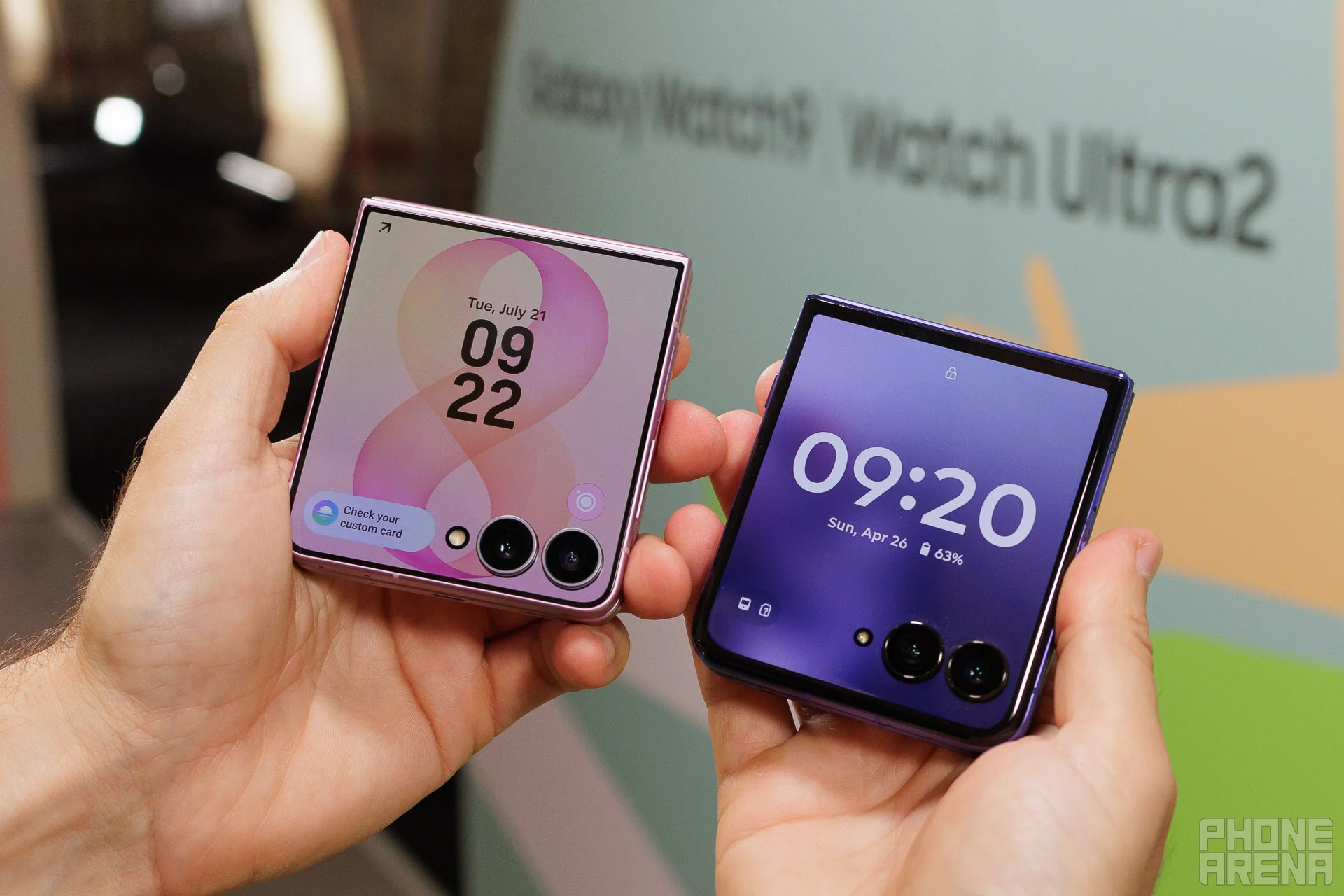
Galaxy Z Flip 8 compared with the Motorola Razr Ultra. Photo: PhoneArena
One area Samsung has clearly improved on the Galaxy Z Flip 8 is one-handed opening.
With the previous Galaxy Z Flip 7 and Z Fold 7, many users complained that separating the two halves of the folded device was difficult. Some even resorted to attaching small pieces of rubber for extra grip.
On the Galaxy Z Flip 8, Samsung has added a slight bevel around the frame. This small detail creates a groove that makes it easier for users to slip a finger between the two halves and open the phone more quickly.
It is not a major design change, but it makes a noticeable difference in everyday use.
Motorola does not face the same issue because it retains its traditional rounded frame. The two halves separate relatively easily, making the opening motion feel natural.
Cover display: Motorola still leads, but Samsung is catching up
Motorola pioneered the edge-to-edge cover display on the Razr series and allows users to run an almost complete Android interface directly on it. Most apps can be opened without unfolding the phone.
Samsung initially took a different approach, offering only widgets, information panels and dedicated utilities on its Flex Screen.
Starting with the Galaxy Z Flip 7, however, the company also moved to an edge-to-edge cover display.
On the Galaxy Z Flip 8, the Flex Screen still serves primarily as an information hub by default, offering a range of smart widgets.
Users can, however, use Good Lock - Samsung's official customization app - to turn the outer display into an almost complete Android interface if they want to make full use of the device.
Galaxy Z Flip 8 gets a sturdier hinge and better display
Samsung continues to demonstrate its experience in foldable phones with a highly refined hinge.
Opening and closing the Galaxy Z Flip 8 feels solid and precise, while the hinge can hold the device at multiple angles when used in Flex Mode.
The Motorola Razr Ultra (2026), by comparison, has a lighter, smoother hinge, but it is less versatile when it comes to holding the phone at different angles.
Both devices carry an IP48 water- and dust-resistance rating. This means they offer strong water resistance, including when submerged for a certain period.
However, protection against fine dust remains limited, meaning neither is an ideal choice for frequent use in sandy environments such as beaches.
Samsung retains a minimalist design with two volume buttons and a power button incorporating a fingerprint sensor.
Motorola, meanwhile, adds a dedicated AI button on the left side solely for activating Moto AI, with no option to assign another function to it.
That has been seen as somewhat redundant because the power button can already summon the Gemini assistant.
The Galaxy Z Flip 8 has a 4.1-inch cover display with slightly thinner bezels than the Razr Ultra's 4-inch screen.
Motorola has the advantage on the main display, however, with a 7-inch panel, slightly larger than Samsung's 6.9-inch screen.
The Razr Ultra also supports a maximum refresh rate of 165Hz, compared with 120Hz on the Galaxy Z Flip 8. In practice, the difference is not particularly noticeable in everyday use, but it remains an advantage on paper.
Samsung also continues to do a better job of minimizing the crease in the middle of the display. The crease is still visible, but it is considerably less pronounced than on the Motorola.
Performance: 2nm Exynos 2600 makes its mark
The Galaxy Z Flip 8's most notable upgrade is its Exynos 2600 processor. It is the first mobile processor Samsung has manufactured on a 2nm process, promising improvements in performance, power efficiency and thermal management.
Motorola, meanwhile, continues to rely on Qualcomm's Snapdragon 8 Elite Gen 5, a chip known for its powerful performance.
The Razr Ultra (2026) comes in a single configuration with 16GB of RAM and 512GB of internal storage.
The Galaxy Z Flip 8 offers more flexibility, with 256GB and 512GB storage options, both paired with 12GB of RAM.
The AI race is becoming one of the most important battlegrounds among smartphone makers, and Samsung appears determined to lead.
One UI 9 on the Galaxy Z Flip 8 introduces a range of next-generation Galaxy AI features, most notably the ability for AI to carry out tasks across multiple apps.
Users can ask the phone to make a restaurant reservation, search for photos, handle work tasks or perform various other actions directly from the cover display without unfolding the device.
The Now Nudge feature has also been upgraded to proactively surface relevant information depending on when and how the phone is being used.
Motorola's Moto AI, by contrast, remains relatively limited. The system supports note-taking and content summarization, while more complex requests are handed off to Perplexity or Microsoft Copilot. As a result, the dedicated AI button on the Razr Ultra has yet to demonstrate much practical value.
Samsung also has a clear advantage in software support, promising seven years of Android and security updates. Motorola promises only three Android upgrades and four years of security updates.
Camera: Samsung still rated more highly
Clamshell foldable phones have to prioritize thin, lightweight designs, so cameras have never been their strongest suit.
Even so, Samsung has built an advantage over the years through consistent image-processing algorithms, attractive color reproduction and a broad range of AI-powered editing tools.
Super Steady video recording also remains a notable strength.
The Galaxy Z Flip 8 features a 50MP main camera, a 12MP ultra-wide camera and a 10MP selfie camera.
The Motorola Razr Ultra (2026) is more impressive on paper, with all three cameras offering 50MP resolution, including the main, ultra-wide and front cameras.
However, real-world image quality will require further testing before any conclusions can be drawn.
Battery and charging: Motorola pulls clearly ahead
This is one area where Motorola holds a significant advantage. The Razr Ultra (2026) packs a 4,700 mAh battery into its very slim body, considerably larger than the Galaxy Z Flip 8's 4,300 mAh battery.
Samsung expects the Exynos 2600's 2nm process to significantly improve battery life, but its battery capacity remains lower than its rival's.
In charging speeds, the Razr Ultra supports 68W wired fast charging and 30W wireless charging. The Galaxy Z Flip 8 tops out at 25W wired and 15W wireless charging. Both support 5W reverse wireless charging.
Early verdict: Samsung leads on experience, Motorola stands out with character
The Motorola Razr Ultra (2026) is a premium foldable phone with an upscale design, attractive display, large battery, extremely fast charging and an Android experience close to stock.
It is an option worth considering for users who want something different rather than simply choosing between Samsung and Apple.
The Galaxy Z Flip 8, meanwhile, shows that Samsung continues to refine its foldable smartphone lineup.
It offers a better hinge, a less visible display crease, a smarter AI system and one of the longest software support policies on the market.
The real-world performance of the 2nm Exynos 2600 and the camera quality still require more thorough testing in in-depth reviews.
Initial impressions, however, suggest that the Galaxy Z Flip 8 has every chance of becoming one of the most compelling clamshell foldable smartphones to buy in 2026.
Hai Phong
.svg)
