 Vietnamnet.vn

 Podcast


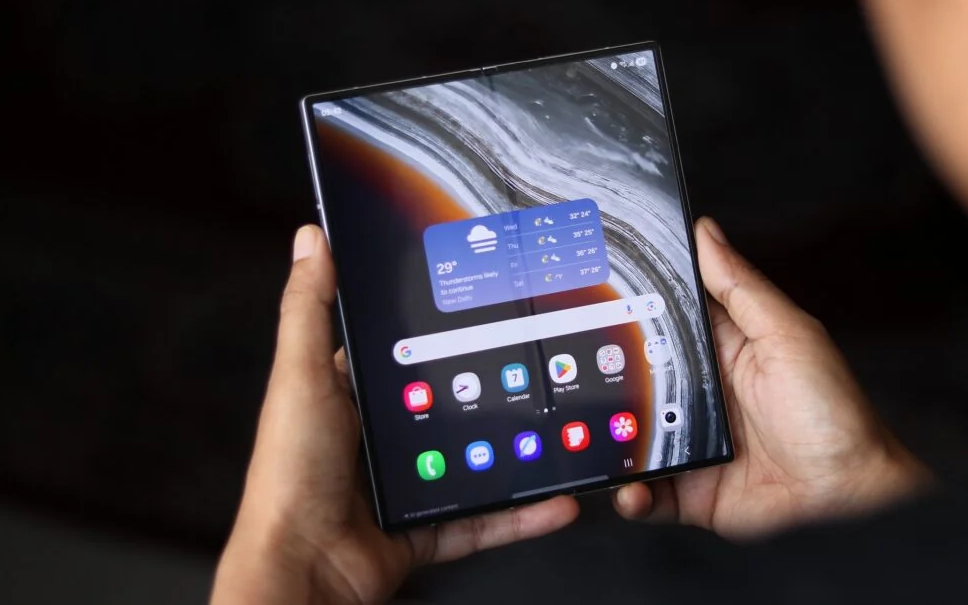
Samsung already holds a significant position in the global foldable smartphone market, with the Galaxy Z Fold series helping establish the South Korean company as one of the segment's leading manufacturers.
Meanwhile, Apple has recently faced criticism over reported durability issues affecting the iPhone Duo, particularly cracks appearing around the foldable display's crease.
The controversy has reportedly prompted Samsung to release advertisements mocking its American rival.
Now, fresh leaks suggest the Galaxy Z Fold 9 could put further pressure on Apple by reviving a technology Samsung previously introduced in its foldable lineup.
The Galaxy Z Fold 9, expected to launch in 2027, is rumored to feature an under-display selfie camera on its main folding screen.
Unlike conventional front-facing cameras that require a visible punch-hole cutout, UDC technology places the camera beneath the display's pixel layer, allowing the screen to appear uninterrupted.
If the rumors prove accurate, Samsung would be bringing back a feature previously available on earlier Galaxy Z Fold generations.
The move could also position the Galaxy Z Fold 9 as a direct competitor to Apple's iPhone Duo, which reportedly uses a similar under-display camera system.
Does a foldable smartphone really need an invisible selfie camera?
Despite the potential design advantages, an under-display camera may not be essential for every foldable smartphone user.
Many consumers are not particularly bothered by a small selfie camera cutout, especially when it is positioned discreetly in a corner of the display.
Some manufacturers have already demonstrated how careful camera placement can minimize visual disruption.
Oppo's Find N6, for example, uses a corner-positioned camera design that helps maintain a relatively clean display appearance.
More importantly, the internal selfie camera is not necessarily the most useful camera on a foldable smartphone, particularly for users seeking high-quality portrait photographs.
One of the biggest advantages of book-style foldable phones is their ability to use the main rear camera system for selfies.
By unfolding the device and using its external display as a viewfinder, users can frame their shots while taking advantage of the superior sensors and lenses typically found in the rear camera system.
This approach can deliver better image quality than relying on the smaller internal selfie camera.
The inner camera remains convenient for video calls, online meetings and casual snapshots.
However, for users who prioritize portrait photography, the rear camera system is generally the more capable option.
That raises an important question about Samsung's rumored decision to reintroduce under-display camera technology: Would the change provide a meaningful improvement to everyday smartphone use?
Samsung must prove under-display camera quality has improved
Longtime Samsung fans will remember that under-display cameras are not new to the Galaxy Z Fold lineup.
The technology appeared in several earlier generations before Samsung abandoned the approach with the Galaxy Z Fold 7.
The main reason was image quality.
Cameras positioned beneath a display must capture light through the screen's pixel structure, creating technical challenges that can affect sharpness, brightness and overall image quality.
Earlier implementations struggled to deliver the photographic performance consumers expected from expensive flagship smartphones.
That limitation remains the biggest obstacle Samsung would need to overcome if it decides to bring UDC technology back with the Galaxy Z Fold 9.
Another possible motivation is Apple's iPhone Duo.
The American company's foldable smartphone reportedly incorporates an under-display camera, giving Samsung an additional reason to compete directly on this feature.
If the Galaxy Z Fold 9 can deliver convincing photo and video quality through an invisible selfie camera, Samsung could gain a competitive advantage in the increasingly crowded foldable smartphone market.
However, the technology would need to offer more than a cleaner appearance.
An uninterrupted display could make the Galaxy Z Fold 9 look more modern and immersive, particularly when watching videos, gaming or multitasking on its large folding screen.
But those visual benefits would be difficult to justify if they came at the expense of noticeably worse image quality.
Ultimately, the success of Samsung's rumored under-display camera revival may depend less on whether the camera is invisible and more on whether users can rely on it to perform as well as a conventional selfie camera.
For now, the Galaxy Z Fold 9's camera specifications remain unconfirmed, and the reported feature should be treated as a rumor until Samsung makes an official announcement.
Hai Phong

