 Vietnamnet.vn

 Podcast


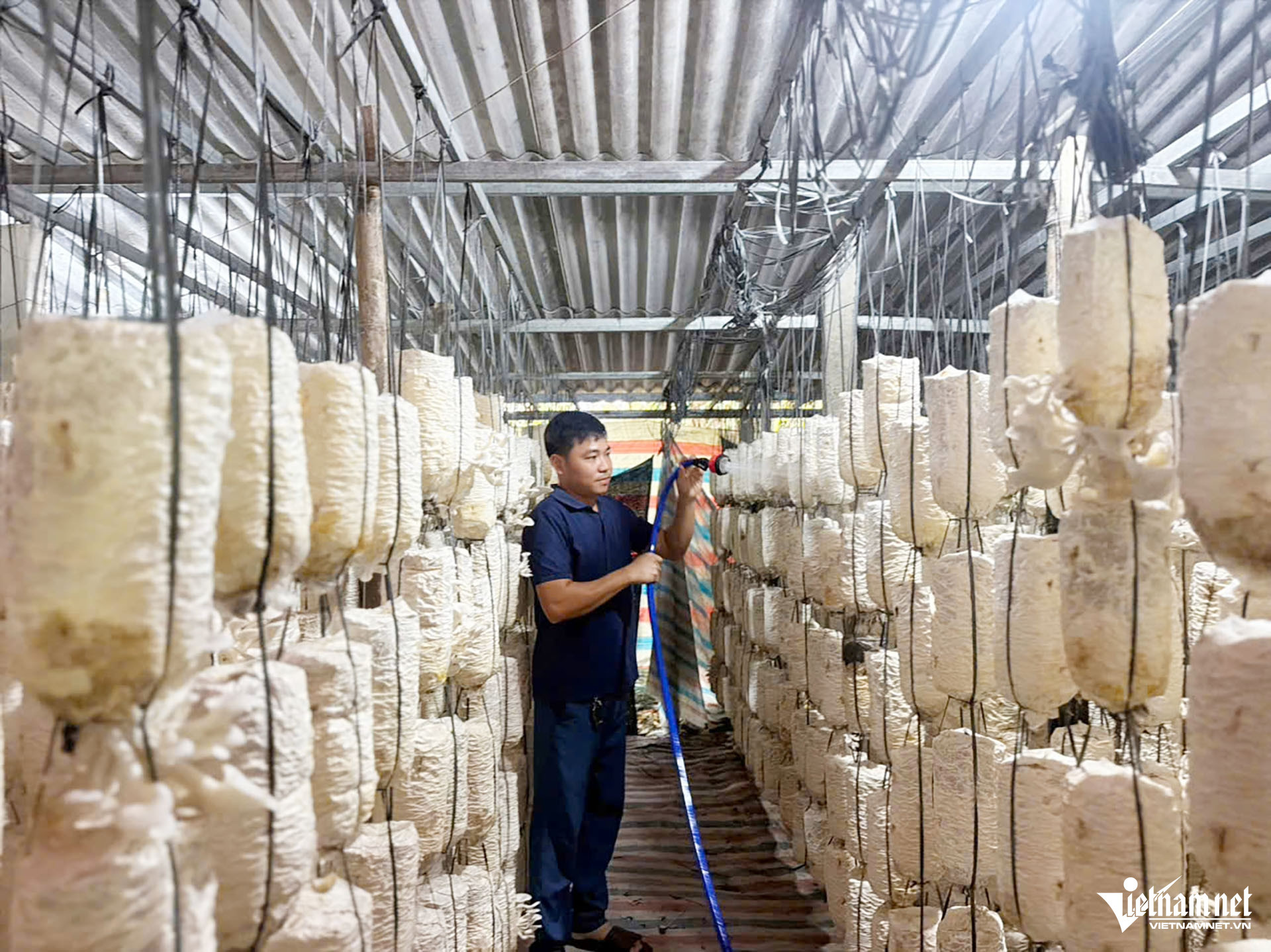
From mushroom technician to production facility owner
At the 1,000-square-meter mushroom farm in Binh Loc village, Loc Ha commune, Ha Tinh province, Duc (born in 1990) and his wife, Pham Thi Cham (born in 1990), busily care for, harvesting, and packaging mushrooms.
Prior to returning to their hometown, Duc spent nearly 10 years working at the Center for Mushroom Research and Development under the Agricultural Genetics Institute. His tenure there enabled him to accumulate rich experience in technical skills and mushroom cultivation workflows.
Duc graduated in mechanical engineering from an industrial college and had a background in machinery operation. Working in the mushroom sector helped him realize the vast potential of this model, sparking the idea of returning home to establish his own production facility.
“During my time there, I gained hands-on experience with mushroom cultivation and realized that it was an effective model with strong potential for development and expansion, so I decided to return to my hometown to start a business,” Duc said.
In 2022, he and his wife returned to Ha Tinh to put their plan into action. Cham had worked as an accountant but later switched to helping her husband grow mushrooms. With initial capital of around VND500 million, the couple gradually built their facility on an area of 1,000sqm.

Initially, Duc experimented with only around 5,000-10,000 mushroom-growing substrate blocks to gain experience and refine the production process. Once production became more stable, they increased their scale to around 50,000 blocks a year.
“Our facility focuses on oyster mushrooms, also known as abalone mushrooms. We also produce wood ear mushrooms and lingzhi mushrooms. Rather than buying ready-made substrate blocks, we handle the production process ourselves, from preparing the raw materials to inoculating them with mushroom spawn.
“The main raw materials are sawdust and rice straw, which are finely ground and mixed with corn bran, rice bran and lime powder. The mixture is packed into blocks, which are then sterilized in a chamber for around 12 hours at 100 degrees Celsius. The blocks are cooled before being inoculated with mushroom spawn,” Duc said.
He sources mushroom spawn from the Agricultural Genetics Institute, where he worked for many years. According to Duc, it takes around 45-60 days from inoculation to the first harvest. Each substrate block can produce mushrooms for about three months before it must be replaced to begin the next production cycle.
Work at the mushroom farm begins early in the morning. At around 5am, the couple starts harvesting, usually finishing by about 7am. The mushrooms are then packaged and delivered to local markets for sale that day.
Attractive profits
The couple's facility currently harvests an average of around 100kg of oyster mushrooms a day, selling them wholesale for about VND30,000 per kilogram. Toward the end of the year, daily output can rise to around 200kg.
Because oyster mushrooms have a short shelf life, they must be packaged and delivered to sales outlets on the day of harvest. As a result, the couple have to keep the operation running continuously, from cultivation and harvesting to distribution.
Duc said mushrooms grow well at temperatures of around 22-28 degrees Celsius and humidity levels of approximately 90 percent. The facility is equipped with monitoring devices to track these conditions and help them adjust the growing environment.
Duc said demand for mushrooms had been relatively strong in recent years. However, current production was still insufficient to meet all customer orders. The facility supplies around 70-80kg of mushrooms to Binh Huong Market alone each day.
“Sales have been relatively easy over the past few years, but we still cannot supply enough to meet demand,” Duc said.
He believes mushroom cultivation in Ha Tinh benefits from the province's relatively abundant agricultural raw materials and labor supply, which help keep costs manageable. Growers can use agricultural byproducts such as rice straw and sawdust as raw materials, reducing input costs.
Nevertheless, the local climate remains a significant challenge. Ha Tinh experiences cold winters and hot summers, with the hot, dry Lao winds adding to the heat. Mushrooms, meanwhile, require relatively stable growing conditions, so output drops considerably during the summer.
Duc's family business now produces more than 30 tonnes of mushrooms annually, generating around VND1 billion in revenue. After expenses, its estimated annual profit is VND300 million.
Thien Luong

