 Vietnamnet.vn

 Podcast


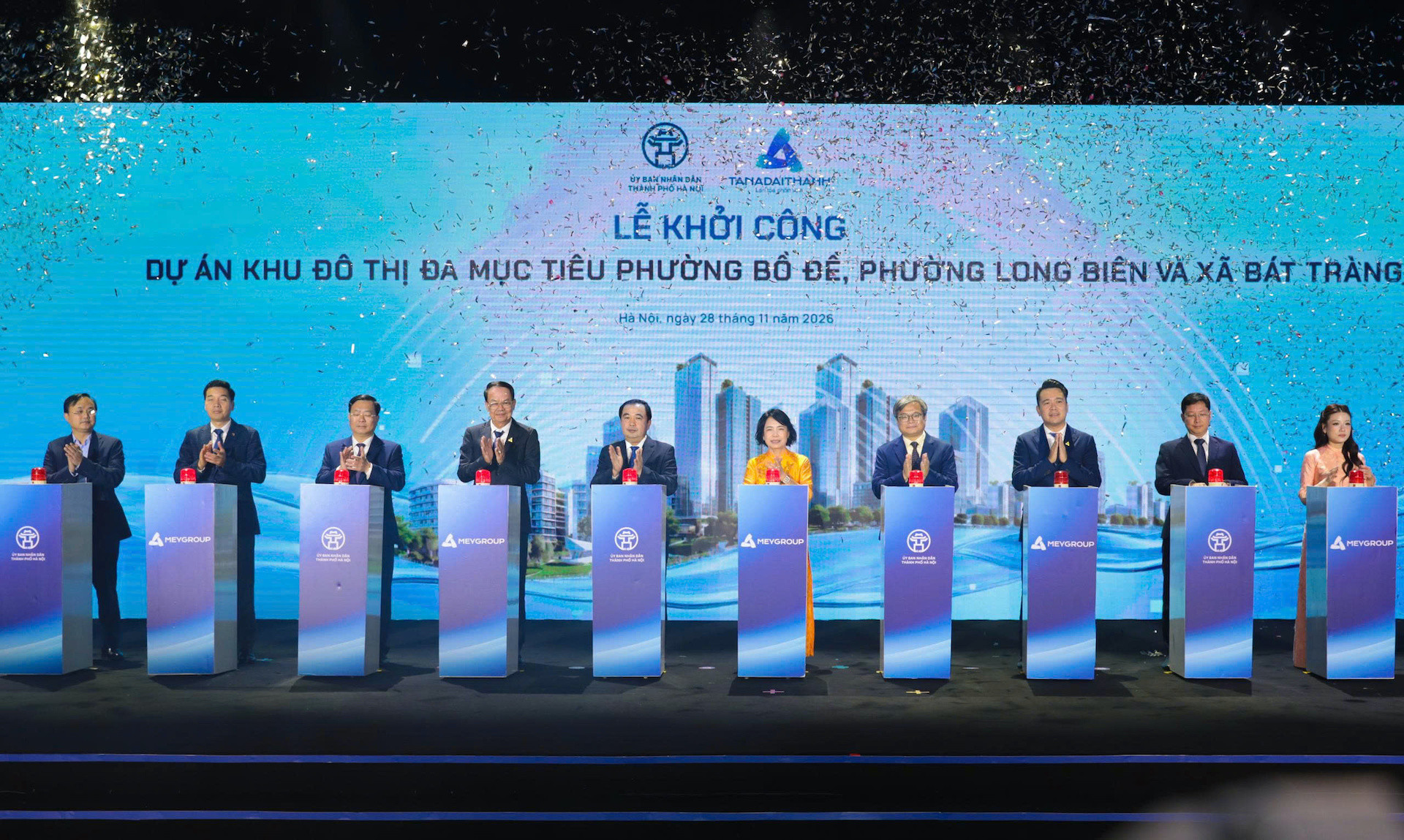
On November 28, Tan A Dai Thanh Group broke ground on a multipurpose urban development spanning Bo De and Long Bien wards and Bat Trang Commune in Hanoi.
This is the fifth multipurpose urban development project launched in the capital, with preliminary investment estimated at VND102.77 trillion ($3.95 billion). The project is scheduled for implementation from the third quarter of 2026 to the fourth quarter of 2030.
The project is being developed by a consortium of three companies, represented by Tan A Dai Thanh Group’s real estate arm, Meyland.
Speaking at the groundbreaking ceremony, Hanoi People’s Committee Vice Chairman Truong Viet Dung said developing multipurpose urban areas represents a significant shift in the capital’s approach to urban development.
According to Dung, Hanoi has developed a distinctive urban development model based on practical needs, which has been institutionalized under the 2026 Capital Law.
The overarching principle is that urban development should not merely expand urban space but also create more development opportunities for every resident.
Hanoi aims to establish urban areas with comprehensive housing, technical and social infrastructure, integrating commercial services, education and healthcare facilities while creating employment opportunities and ensuring local livelihoods.
Through this approach, the city seeks to proactively establish a housing supply for resettlement associated with major infrastructure projects, increase the availability of social housing and integrate urban development with social welfare.
“In particular, for residents who relinquish their land for projects serving the capital’s development, the city aims not only to provide new homes but also to create better opportunities for employment, education, healthcare and long-term livelihoods,” Dung emphasized.
More than 38,000 apartments, including 5,200 resettlement units
According to Tan A Dai Thanh Group, the project covers a planning area of approximately 296.95 hectares.
Of this total, around 245.37 hectares are designated for urban development, while 51.58 hectares are reserved for the section of the Red River Landscape Boulevard running through the project.
Stretching along the eastern bank of the Red River from Chuong Duong Bridge to Thanh Tri Bridge, the development connects central Hanoi with the eastern part of the capital and economic centers such as Hung Yen, Hai Phong and Bac Ninh through an interregional transportation network.
According to the developer, the project is expected to provide more than 38,000 apartments, accommodating approximately 74,000 residents.
Under the land use plan, around 37 hectares will be allocated to public green spaces, another 37 hectares to educational, healthcare, cultural and sports facilities, and 51 hectares to commercial and service activities.
Notably, the project will provide 5,200 on-site resettlement apartments in a conveniently located area of Bo De Ward for residents of Bo De, Thach Cau and Ha Trai villages.
Construction of these apartments will be prioritized during the initial development phase to help residents quickly settle into their new homes, improve their living conditions and maintain community ties in familiar surroundings.
According to Nguyen Phuong Anh, deputy general director of Tan A Dai Thanh Group, the developer also plans to preserve and restore several cultural heritage sites within the project area.
These include the Ha Trai communal house, pagoda and traditional well complex, the Lam Du communal house and pagoda, and Ngoc Temple.
Hanoi expands its multipurpose urban development model
The development spanning Bo De, Long Bien and Bat Trang is the fifth project of its kind to be launched in Hanoi.
Four other multipurpose urban development projects have previously broken ground in the northern and southern parts of the capital.
In northern Hanoi, two projects are being developed, including a development covering more than 474 hectares in Thien Loc and Phuc Thinh communes by a consortium comprising Handico, Sunshine and Thai Nam.
The other project, covering nearly 700 hectares in Thu Lam and Dong Anh communes, is being developed by Red River Future Company.
In southern Hanoi, Vinhomes is developing a multipurpose urban area covering more than 600 hectares in Tam Hung and Binh Minh communes.
Meanwhile, in Linh Nam Ward, a consortium comprising Red River Future, Dai Quang Minh and Hoa Phat is developing a multipurpose urban project expected to provide more than 36,000 apartments.
Hong Khanh

