 Vietnamnet.vn

 Podcast



Hanoi officially broke ground on a major urban transport corridor project along National Highway 1A on May 19, with total investment nearing VND162 trillion, equivalent to around $6.2 billion.
The groundbreaking ceremony was jointly organized by the Hanoi People’s Committee and Vingroup.
Attending the event were National Assembly Chairman Tran Thanh Man along with senior representatives from central ministries, government agencies and Hanoi authorities.
The ceremony coincided with nationwide celebrations marking the 136th anniversary of President Ho Chi Minh’s birth on May 19.
The project is considered strategically important to Hanoi’s long-term urban development and regional connectivity plans.
Major transport axis through southern Hanoi
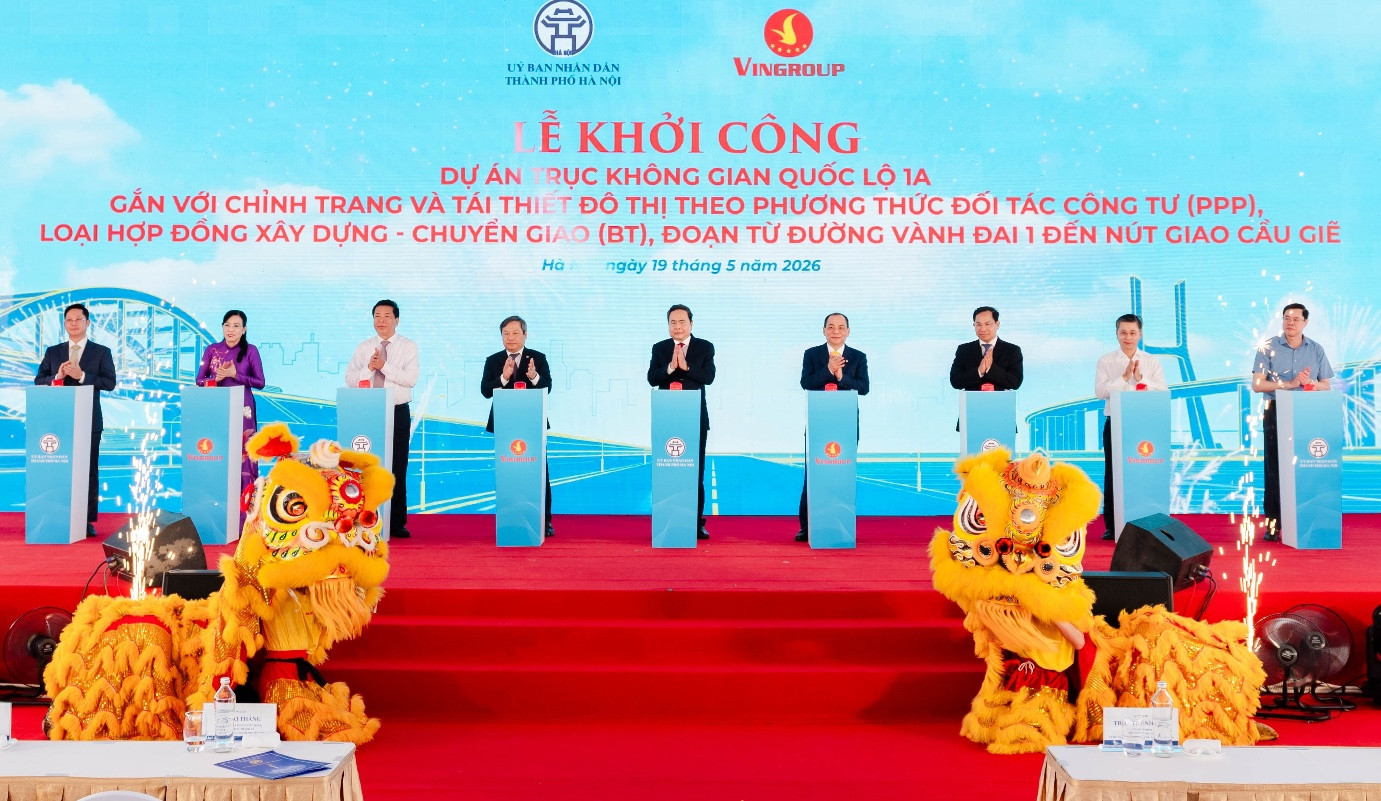
The National Highway 1A urban corridor project will stretch approximately 36.3km through 18 wards and communes across Hanoi.
It will be implemented under a public-private partnership (PPP) model using a build-transfer (BT) contract structure.
The route will begin at Ring Road 1 near the Kim Lien tunnel area in Kim Lien and Bach Mai wards, before extending southward to the Cau Gie interchange in Chuyen My commune.
According to project plans, the corridor will feature a cross-section width of up to 90m, including 10 main traffic lanes and six parallel service lanes on both sides.
The designed speed limit will be 80km/h.
Authorities expect the project’s infrastructure construction to be completed by 2027.
Officials say the new corridor will play a key role in completing Hanoi’s road transport network under the capital’s long-term master planning vision extending over the next century.
Reducing congestion and reshaping urban space
Beyond improving traffic flow, the project is expected to redistribute transport pressure among ring roads and inner-city corridors while strengthening connections between central Hanoi, southern urban zones and neighboring provinces.
The redevelopment is also intended to support urban renewal along the existing National Highway 1A corridor and stimulate economic growth in surrounding districts.
Speaking at the ceremony, Hanoi People’s Committee Chairman Vu Dai Thang described the project as a critical piece of infrastructure for the capital’s next phase of urban expansion.
According to Thang, transport infrastructure remains the foundation for economic growth in large metropolitan areas.
“A modern transport corridor not only serves mobility demand but also creates new development space, stimulates commerce, services and logistics, and enhances urban competitiveness,” he said.
He added that Hanoi is entering a new stage of development requiring urban restructuring toward a more modern, green, smart and highly connected city model.
Southern gateway identified as strategic development zone
Authorities emphasized that southern Hanoi serves as a strategic gateway linking the capital with major economic centers nationwide.
For years, however, the National Highway 1A section passing through Hanoi has suffered from chronic congestion, limiting traffic capacity, logistics operations and urban planning efficiency.
Officials believe the new project will help resolve long-standing infrastructure bottlenecks while laying the groundwork for more synchronized and modern urban development.
Hanoi authorities also called on relevant agencies and local administrations to coordinate closely with the investor to accelerate land clearance and resettlement work while ensuring residents’ legal rights are protected.
The city pledged continued support to remove obstacles and maintain project progress under transparent legal procedures.
Representing the investor, Nguyen Viet Quang said Vingroup hopes the project will contribute to the comprehensive redevelopment of a modern and integrated urban corridor that could redefine the southern entrance to Hanoi.
Vu Diep
.svg)
