 Vietnamnet.vn

 Podcast



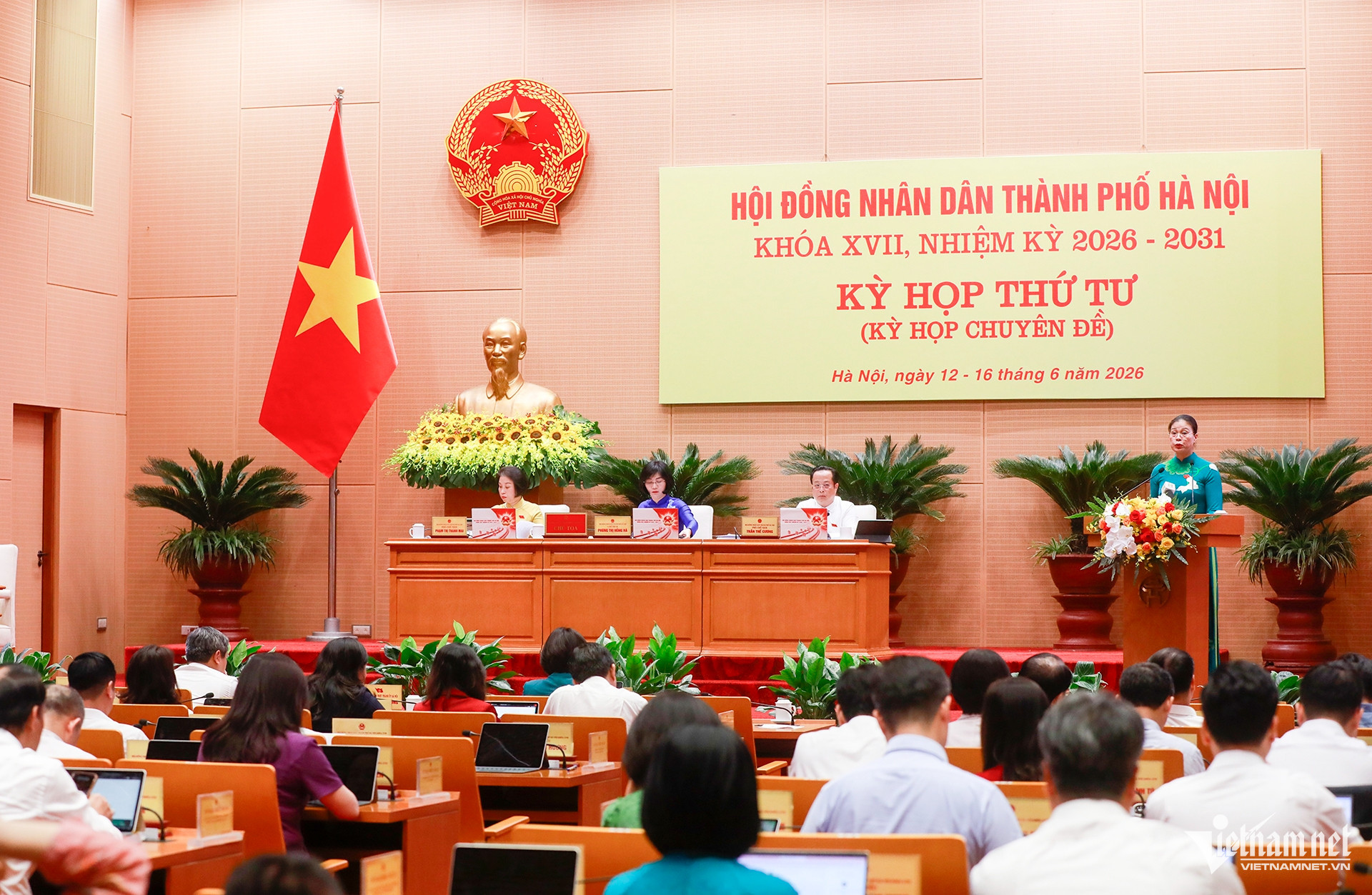
The proposal was presented on June 15 during a special session of the Hanoi People’s Council.
Representing the municipal government, Permanent Vice Chairman Duong Duc Tuan delivered a report explaining revisions related to the number, establishment, reorganization and dissolution of specialized agencies and other administrative bodies, as well as the composition of executive committee members at city and commune levels.
At present, Hanoi’s administration consists of 15 departments and two administrative organizations under the municipal People’s Committee.
According to city authorities, the current organizational framework prescribed under national regulations does not fully address several emerging and highly specialized areas of governance, including smart city management, underground urban development, regional coordination, digital transformation and innovation, as well as efforts to resolve longstanding development bottlenecks.
Officials noted that the volume of administrative files and executive documents handled by departments and members of the municipal People’s Committee has become exceptionally large, creating localized overload and slowing decision-making processes.
The Hanoi People’s Committee argued that these challenges require a more flexible mechanism allowing adjustments to the number, functions and organizational structures of specialized agencies operating across the capital.
Under the proposal, Hanoi would be permitted to establish up to 18 departments, three more than the current total and equivalent to a 20 percent increase.
As an immediate priority, municipal agencies are studying options for establishing a Food Safety Department in line with central government policies.
For other administrative organizations, the city proposes a maximum of three entities, one more than the current two organizations, which include the Public Administrative Service Center and the Management Board for High-Tech Parks and Industrial Parks.
More administrative units proposed at commune level
The city government also argued that the current number of specialized offices at commune level is insufficient to meet operational needs following recent administrative restructuring.
At the same time, Hanoi is reviewing plans to implement a two-tier public administrative service model, under which commune-level Public Administrative Service Centers would function as administrative organizations under local authorities.
As a result, the city considers it necessary to expand the allowable number of specialized agencies and administrative bodies at the commune level.
The proposal would permit each commune-level administration to establish up to five specialized offices and up to two additional administrative organizations.
The five proposed offices would include the Office of the People’s Council and People’s Committee, two departments responsible for socio-cultural affairs, and two departments covering economic development, infrastructure and urban management.
Hanoi also plans to establish Public Administrative Service Centers at the commune level.
Department directors would not automatically serve on city executive committee
The proposal also includes changes to the composition of members of the Hanoi People’s Committee.
Currently, executive committee membership generally includes all directors of city departments and agencies.
According to the municipal government, while this structure ensures broad representation, it can also prolong decision-making because many issues require consultation with officials whose agencies are not directly involved.
The report argues that not all department directors should automatically become members of the city executive committee.
Instead, membership should be determined based on management requirements, the capital’s status as a special urban center, and the practical scope of responsibilities assigned to individual agencies.
City officials believe this approach would contribute to a leaner administrative system, strengthen individual accountability and improve the efficiency of discussions and decisions on matters within the authority of the municipal People’s Committee.
Thanh Hue
.svg)
