 Vietnamnet.vn

 Podcast



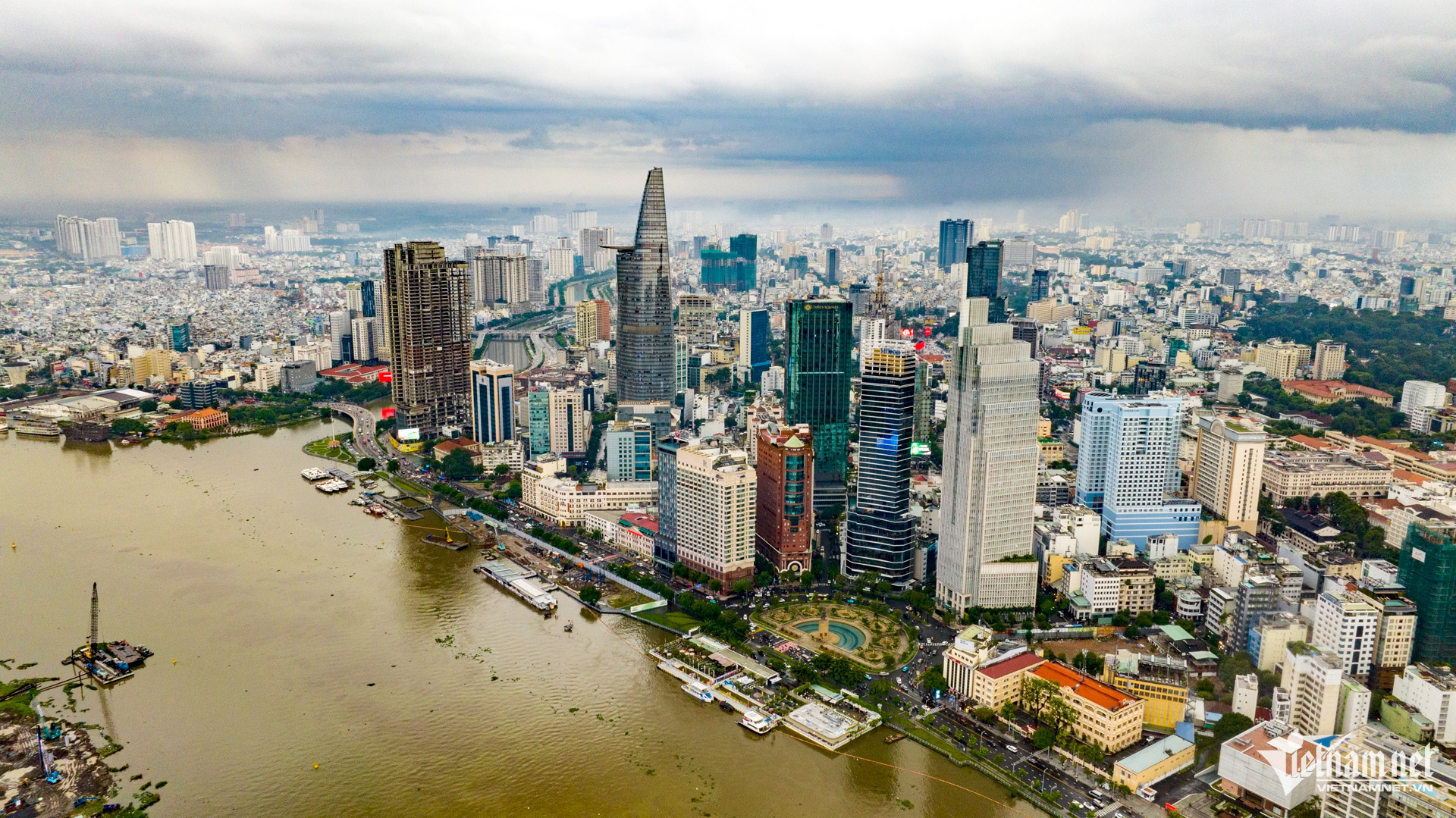
Reality suggests that leaving a mark in a once underdeveloped region can sometimes be easier than charting a breakthrough path for a mega-city that has already grown “large and prosperous.” A report summarizing the adjustment of budget retention ratios for Ho Chi Minh City for the 2022-2025 period, with a vision to 2026-2030, has sounded a warning: the city’s Gross Regional Domestic Product (GRDP) growth is slowing, while its transport infrastructure and environmental systems are under severe strain.
More concerning is the fact that new-generation foreign direct investment (FDI) flows have yet to prioritize the city as a destination. Clearly, Ho Chi Minh City needs a new growth engine to reposition itself in the era of digital transformation and green transition.
According to Dr. Tran Du Lich, although the city contributes around 23.5% of national GDP and 30% of state budget revenue, its current growth model still relies heavily on capital investment, outsourcing and low-cost labor, resulting in declining efficiency. Labor productivity is rising slowly, the incremental capital-output ratio (ICOR) remains high, and the contribution of science and technology is still limited, while key industries and services are under pressure to transition toward green and digital models.
It is evident that the city’s economic space cannot remain confined within its current 6,773 square kilometers. Stronger linkages with neighboring provinces such as Dong Nai and Tay Ninh will be essential to form a globally competitive metropolitan region.
To address inter-regional transport and logistics challenges, the city needs a mechanism similar to Australia’s Greater Sydney Commission, dedicated to coordinating development across the Southern Key Economic Region. Such a body would require sufficient legal authority to integrate land-use planning with infrastructure development, while preventing fragmented, locality-driven decision-making.
At the same time, despite contributing the largest share of national revenue, the city retains only about 21% of its budget, which has become a bottleneck for infrastructure investment.
While Resolution 98 has opened new avenues for capital mobilization, the experience of New York in 1975 serves as a cautionary tale. The city relied on short-term borrowing to cover recurrent expenditures, leading to a shortage of funds for development investment and serious consequences for infrastructure. Ho Chi Minh City should avoid using financial instruments for regular spending and instead establish an independent budget oversight mechanism.
Lessons in mobilizing capital and sharing costs
To unlock capital flows, the city should continue leveraging the role of the Ho Chi Minh City Finance and Investment State-owned Company (HFIC). Statistics show that its seed capital model can mobilize nearly 30 times the initial investment from social resources.
Diversifying funding sources is also critical, including tapping into ODA and concessional loans for infrastructure, technical, economic and social development projects, in line with the city’s strategic priorities.
Shanghai’s cost-sharing model in urban redevelopment offers another valuable lesson. Residents contribute around 15-20% of relocation costs for new housing, combined with revenue generated from redeveloped prime land, creating substantial financial resources for urban transformation.
As the advantage of low-cost labor diminishes, the city must move up higher tiers of the global value chain. To develop semiconductor and AI industries, it could draw from Malaysia’s Penang Skills Development Centre (PSDC), where local authorities empower multinational corporations and FDI enterprises to participate directly in vocational education, co-investing in facilities to train a workforce tailored to supply chain demands.
For the proposed Vietnam International Financial Centre (VIFC), its viability depends on a model of “legal separation,” similar to Dubai’s approach. Financial free zones operate under common law systems, particularly in contract and commercial law, offering flexibility and predictability highly valued by global investors.
In addition, administrative procedures that delay licensing processes must be fully eliminated, and long-standing delays in land clearance must be addressed decisively, as they continue to hinder infrastructure development.
Urban planning in the 21st century must go beyond land-use allocation to become a tool for transforming living environments. Redevelopment of canal-side housing should avoid the mistakes of Sao Paulo, where large-scale social housing projects were placed in distant suburbs, forcing low-income workers into long daily commutes and increasing urban emissions.
Meanwhile, Medellin offers a contrasting model, using urban design, architecture and transport as tools to reduce inequality. Integrating high-quality public spaces such as libraries and parks into disadvantaged areas can help rebuild vibrant and inclusive communities.
Finally, in central urban areas, the city could pilot Barcelona’s “superblock” model, restricting through traffic and reallocating up to 60% of space to pedestrians, thereby encouraging carbon reduction and supporting the nighttime economy.
When prosperity is no longer the driving force, bold institutional reforms, a vision that transcends spatial limits and a strong financial strategy will be essential for Ho Chi Minh City to reposition itself and enter a new cycle of growth in the 21st century.
Nguyen Phuoc Thang (Hoa Binh University)
.svg)
