 Vietnamnet.vn

 Podcast



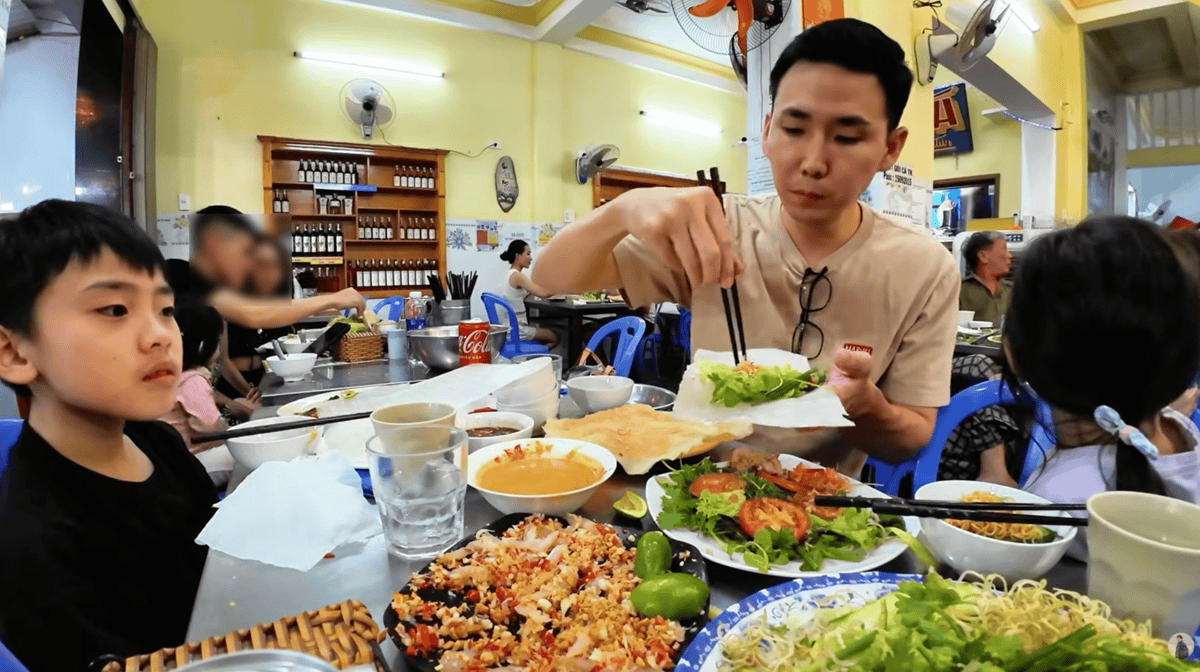
Papaken (born 1989), is a Japanese content creator living in Hanoi for about three years.
On his YouTube channel, with hundreds of thousands of followers, Papaken regularly posts videos about travel and culinary experiences in various Vietnamese provinces he visits.
Recently, in a video about a trip to Quy Nhon commune, Gia Lai province (formerly Quy Nhon city, Binh Dinh province), with his two children, Papaken showcased local dishes he tried, such as banh xeo (crispy Vietnamese pancake), bun tom (shrimp noodle soup), and bun ram (vermicelli with crab).
Among them, one dish he tried for the first time left a strong impression, earning continuous praise: goi ca mai (white sardine salad).
Papaken said while searching for information about good eateries in Quy Nhon, he found many recommendations for goi ca (fish salad). Seeing appetizing images of the dish on Instagram, he decided to take his kids to try it.
They visited a well-known goi ca restaurant tucked in a small alley on Tran Hung Dao Street.
Open for about 40 years, the restaurant is a favorite among locals and tourists. It serves only two dishes – bo nuong (grilled beef) and goi ca, but is always bustling with customers.
There, Papaken and his children ordered a grilled beef dish for VND120,000 and a goi ca dish for VND110,000.
When the food arrived, the Japanese visitor found the goi ca visually appealing, served with fresh herbs, aromatic greens, banh da (grilled rice paper), and two dipping sauces: peanut soy sauce and chili-garlic soy sauce.
Papaken admitted to some hesitation since the dish is made from raw fish, not cooked with heat like typical dishes.
Still, having experience with unique Vietnamese dishes, he boldly squeezed extra lime juice to partially “cook” the fish.
“This is the first time Dad’s trying goi ca, so I don’t know how it tastes,” Papaken said to his children.
To enjoy the dish, he showed his kids how to soften the rice paper by dipping it in water, then wrap it with goi ca, herbs, and crispy banh da before dipping it in sauce.
After tasting the first bite, the Japanese YouTuber exclaimed, “So delicious!” He noted the fish’s white flesh had a mild flavor.
However, being freshly prepared, it had no fishy smell, and the dipping sauce added a rich taste.
He added that the goi ca was truly fresh, blending the sourness of mango and lime juice with the fish’s refreshing flavor.
Kai, Papaken’s son, agreed, describing the goi ca as “crisp and crunchy.”
“This goi ca tastes better with peanut soy sauce than regular soy sauce. It’s especially delicious with lots of fish,” Papaken shared.
Goi ca mai is not only popular in Quy Nhon but also in other Vietnamese coastal regions, particularly in the South Central Coast and Southern regions like Khanh Hoa, Binh Thuan (now Lam Dong), Ba Ria - Vung Tau (now HCMC), Kien Giang, and Ca Mau.
The dish is made from ca mai (white sardine), a fish resembling anchovies, about one to two fingers long, with a transparent body and silver scales.
Ca mai meat is chewy, crisp, sweet, and blood-free, making it ideal for goi (salad) dishes.
Minh Hai, a seasoned chef in Quy Nhon, explained that ca mai for goi must be extremely fresh, freshly caught, and uniformly sized.
The fish is scaled, cleaned, filleted, and deboned. This process requires a skilled chef to handle the fish gently yet decisively to avoid damaging the meat, ensuring dish quality.
After filleting, the fish can be lightly “cooked” with lime juice or vinegar, then drained and mixed with ingredients like garlic, chili, and lemongrass, seasoned to taste.
In some places, with lime juice is served separately for customers to add as desired.
The dish’s highlight is the dipping sauce. Besides chili-garlic soy sauce, local eateries offer peanut soy sauce, skillfully blended to a golden-orange hue, with a thick, harmonious balance of salty, sweet, sour, and spicy flavors.
Diners can enjoy goi ca mai two ways: scooping the goi with grilled rice paper and dipping it in sauce, or wrapping it with crumbled rice paper, fresh herbs, and greens before dipping.
The dish is praised for its refreshing quality. The fresh, chewy, crisp, and naturally sweet ca mai, combined with the thick, aromatic dipping sauce, leaves a lasting impression on diners.
Thao Trinh
.svg)
