 Vietnamnet.vn

 Podcast



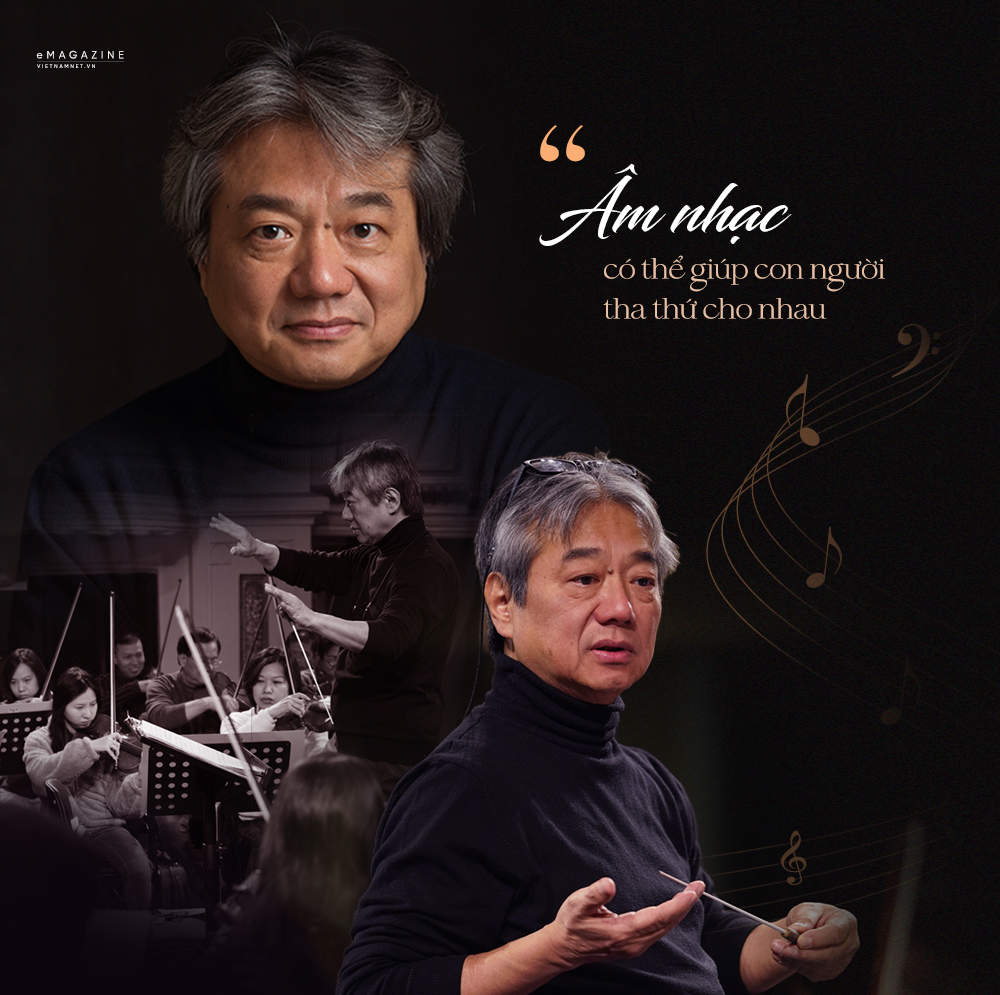
What brought you to classical music and inspired you to become an orchestra conductor?
I still remember my very first day of primary school. I heard the older students perform L’Arlésienne with an accordion orchestra. It left an incredibly powerful impression on me.
By middle school, I played the trombone in the school band. Since this instrument has many rests, I often observed the conductor. From there, a spark was ignited: "One day, I want to stand in that position."
Do you remember the first time you stood on the conductor's podium?
That was in September 1977, at the Tokyo University of the Arts festival. We performed excerpts from Wagner's Die Meistersinger von Nürnberg and Tristan und Isolde.
The Sogakudo Concert Hall, a venue with history dating back to the Edo period, featuring magnificent acoustics and an antique pipe organ, left me with an unforgettable memory.
In your opinion, what is the most important quality of a conductor?
It is an endless spirit of inquiry, and one's human character. Of course, score-reading skills, understanding the composer, and conducting techniques are vital, but the core remains the person themselves.
I believe a conductor does not just control, but guides, like saying to the orchestra, "Let us move in this direction together."
On your artistic journey, were there any difficulties or crises that left a deep impression on you?
There are two events I can never forget.
In 2013, a tour in Kyushu (Japan) was canceled just 10 days before departure. Everyone had prepared so thoroughly, so when I received the news, I was stunned and speechless.
I called an orchestra-wide meeting to announce it, and what moved me deeply was that not a single person complained. The tolerance and warmth of the Vietnamese people truly touched my heart.
In 2023, a similar incident occurred. Yet, everyone accepted it calmly. At the same time, the opera Princess Anio was a resounding success. Those experiences helped me understand the people here on a much deeper level.
Which event made you feel the most moved or proud?
Having started working with the Vietnam National Symphony Orchestra (VNSO) since 2001, what I am most proud of is establishing the regular concert system in 2005. Before that, the concept barely existed.
Thanks to subscription concerts, artists know in advance what pieces they will play and with which conductor, allowing them to practice and prepare before full orchestra rehearsals. This naturally elevates the orchestra's technique.
We have performed many works by Vietnamese composers, such as Co Sao by Do Nhuan and La Do by Do Hong Quan, alongside the complete symphonies of Beethoven, Brahms, and Mahler, and many other great masterpieces.
The most unforgettable memory is likely conducting Mahler’s Symphony No 8, the "Symphony of a Thousand", in 2010 to mark the Millennium of Thang Long – Hanoi. It featured a 150-piece orchestra and a 600-member choir from various countries. It was truly a lifetime memory.
Why did you decide to stick with Vietnam for the long term?
The first time I came to Hanoi was to conduct Saint-Saëns' concerto with the artist Ngo Hoang Quan. At the Hanoi Opera House, I thought: "I want to come back here in 2011 to conduct Mahler's Symphony No9."
After the performance, artist Ngo Hoang Quan told me, "Please come back!" And that was how my destiny with the VNSO began in February 2001. I never thought I would work here for so long; it was simply following destiny, yet, 26 years have passed.
How do you evaluate the development of symphonic music in Vietnam?
The current growth is astonishing. I believe that in the near future, Hanoi could become a global city of music.
However, challenges remain, particularly the shortage of wind instrument players and the need for dedicated performance spaces, like a proper opera house and a concert hall.
In your opinion, what is the biggest difference between the orchestral environments in Japan and Vietnam?
Japan is heavily influenced by Germany and France, whereas Vietnam, besides France, also carries influences from the former Soviet Union. This creates a very fascinating identity.
Aside from music, what do you enjoy?
I love coffee. Hanoi, in my opinion, is one of the "coffee kingdoms" of the world.
There are so many coffee shops here with diverse styles of enjoyment. Vietnamese people savor coffee at a leisurely pace, which makes me, as a Japanese person, feel quite envious.
Le Thuy TInh
.svg)
