 Vietnamnet.vn

 Podcast



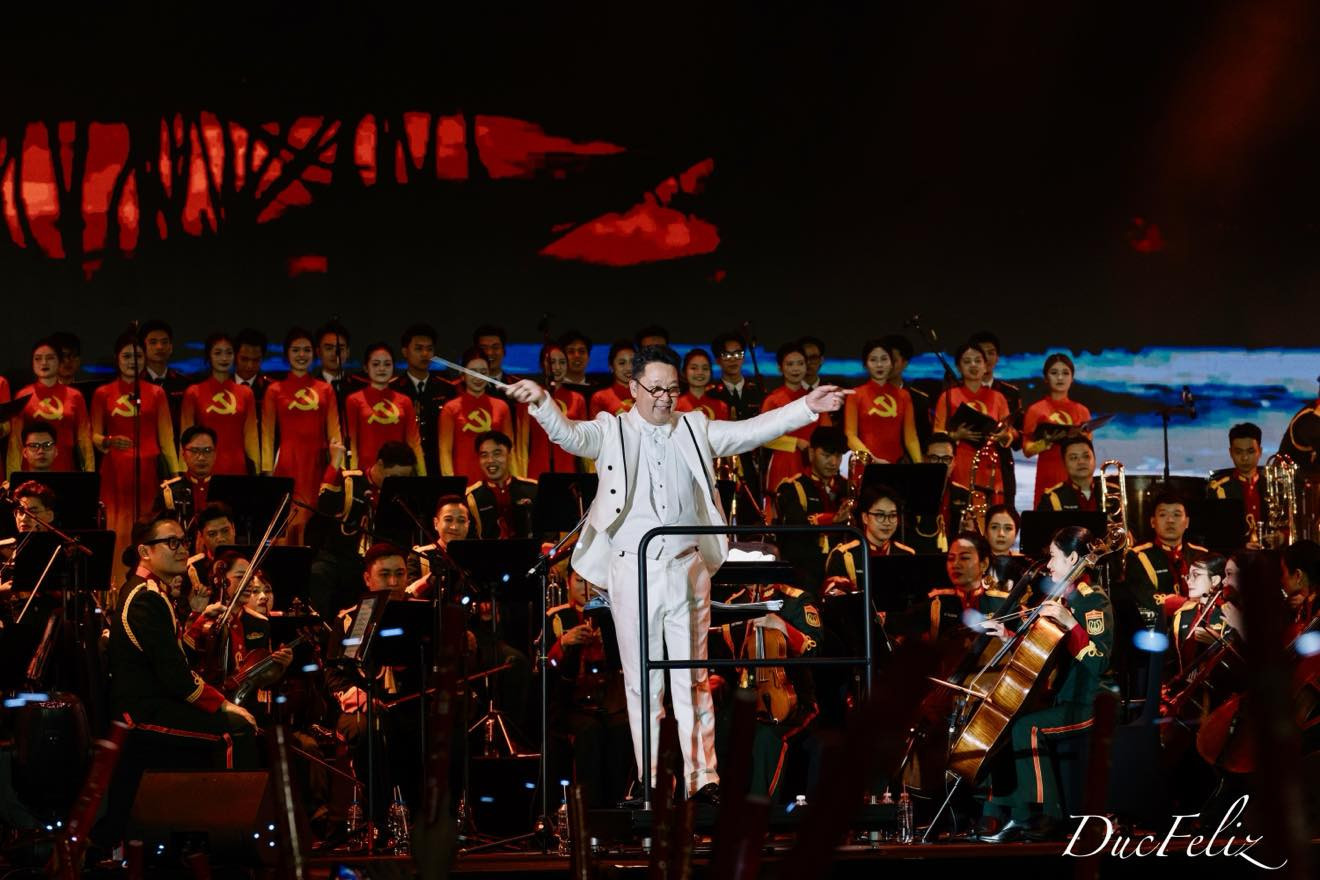
Recently, you conducted programs for the Military Symphony Orchestra, including an event marking the 51st anniversary of the country's reunification. What is unique and exciting about conducting the Military Symphony Orchestra?
I feel a special excitement working with the newly established Military Symphony Orchestra because I want to join hands in laying the very first bricks to build and develop it. I highly appreciate the founding of the Military Symphony Orchestra in terms of upgrading development ideas and elevating the cultural and musical stature for the soldier-artists.
The Military Symphony Orchestra is fundamentally similar to other symphony orchestras, but it differs slightly due to its exceptionally high level of discipline during rehearsals and performances, a trait that is crucial for the success of any concert.
What made the "Symphony of the Nation" concert at the end of April stand out to you? The piece Quang Binh Que Ta Oi (Quang Binh, Our Homeland) by the late composer Hoang Van was chosen for this program; that must have been very special for you?
The program was unique because it took place outdoors on the Tran Nhan Tong pedestrian street, right in front of Thong Nhat Park. Location-wise, it carried immense meaning as it was a concert celebrating the April 30 National Reunification Day. The program featured familiar works written about soldiers, humanity, and life, alongside contemporary music for Gen Z, all brought to life by a symphony orchestra, a choir, and vocalists.
Many programs have selected major musical works by composer Hoang Van over the years. As a conductor, but also as a son, what are your emotions when you wave the baton to conduct pieces composed by your own father?
My father's works have been deeply embedded in my soul from childhood until now. Every time I conduct one of his pieces, I am profoundly moved, remembering my performances in Hanoi where he would always act as a teacher, analyzing his own works for his son. He was also the most frequent audience member at the concerts conducted by his son.
If your father had not been composer Hoang Van, do you think your love for music would still have been nurtured from a young age, leading you to become a conductor? Did your path to becoming a conductor bear his influence?
I believe that the laws of nature and destiny blessed me with a father who was composer Hoang Van. He was the one who sang and played instruments for his children when we were little. Our home was always filled with his music as well as that of the composers he loved.
He was the person who taught the first piano notes to his children, educating my childhood soul with music from my earliest days. My soul and my emotional love for music stemmed from him. My becoming a conductor was also partly guided by his direction.
You’re now a conductor known both at home and abroad, but before building your own name, did you ever feel pressure having such a famous and talented father? Was his shadow too big for his children?
I’m incredibly proud and honored that my father is composer Hoang Van, loved by so many generations. Being his son only gives me more motivation and love for my work as a conductor. I’ve never thought his shadow was too big or felt I needed to escape it.
I know that people mention the name conductor Le Phi Phi out of respect and recognition for what I’ve contributed to the country’s music, not because I’m composer Hoang Van’s son. And I’m extremely proud when I hear the added note “son of composer Hoang Van.
Your father left behind a vast musical legacy, but both you and your sister mainly live and work abroad. Your mother has also passed away. Who takes care of the family home in Hanoi now? Have you and your sister thought about turning it into a Hoang Van memorial house?
Yes, we’ve thought about it. But making it happen doesn’t depend only on the family, there are many other external factors. I think a Hoang Van memorial house would mean a lot to the people of Hanoi, to the country in general, and to international tourists. Hoang Van is not just a Vietnamese composer; his works have been recognized by UNESCO as part of the Memory of the World.
Tinh Le
.svg)
