 Vietnamnet.vn

 Podcast



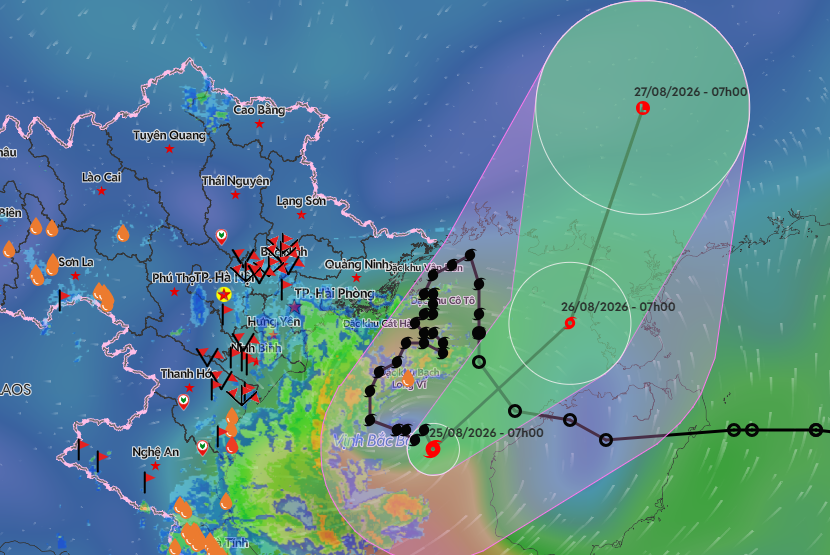
Storm Narra has weakened into a tropical depression, but its unusually slow movement, repeated changes in direction and rare looping track kept the system over the Gulf of Tonkin for five to six days, far longer than most storms in the area.
A looping track with repeated changes in direction
On the afternoon of August 25, Storm Narra, the fourth storm to affect Vietnam in 2026, weakened into a tropical depression over the Gulf of Tonkin.
The tropical depression was forecast to move northeast over the following 24 hours, make landfall on China’s Leizhou Peninsula and then weaken into a low-pressure area before gradually dissipating.
Mai Van Khiem, director of Vietnam’s National Center for Hydro-Meteorological Forecasting, described Narra’s track and evolution over the Gulf of Tonkin as highly unusual.
According to Khiem, the storm moved extremely slowly, averaging just 3-5 km/h, while changing direction several times. Instead of quickly making landfall or weakening after entering the Gulf of Tonkin, as storms commonly do, Narra followed a looping path, repeatedly shifted direction and at one point moved back toward the outer part of the gulf.
Notably, after forming and entering the Gulf of Tonkin on August 21, the storm maintained a powerful circulation for several days. At its strongest during this period, winds reached levels 8-9 on Vietnam’s Beaufort-based scale, with gusts at level 11.
Its complex track, slow movement and unusually long lifespan meant Narra’s circulation affected the Gulf of Tonkin and mainland areas for significantly longer than is typical.
Why did Narra linger over the Gulf of Tonkin?
Meteorologists said the unusual behavior was linked to weak and complex steering conditions in the region.
The storm developed within the intertropical convergence zone, while large-scale atmospheric steering currents failed to provide a stable direction for its movement.
At the same time, Narra was influenced by a combination of surrounding atmospheric systems and dynamic processes within the storm circulation itself.
As these factors changed over time, so did the storm’s direction and speed. Meteorologists said this explains Narra’s curved and looping trajectory, as well as several sections of its track where it changed direction sharply.
A rare knot-like track
Khiem said Narra behaved very differently from most storms entering the Gulf of Tonkin.
Typically, a storm takes only one or two days to cross the gulf and make landfall. In some cases, storms remain over the area for only about 12 hours.
Narra, however, formed and moved over the Gulf of Tonkin from August 21, maintaining winds at levels 8-9 and gusts at level 11 while repeatedly circling the relatively confined body of water for five to six days.
For a tropical cyclone to retain storm structure for several consecutive days within the relatively small Gulf of Tonkin is extremely rare.
Khiem said historical records have documented storms and tropical depressions in the East Sea, following complicated tracks and repeatedly changing direction during August.
Narra stood out in 2026, however, for tracing an unusual knot-like path directly over the Gulf of Tonkin.
Similar behavior has occasionally occurred in other months. In July 1994, Storm Amy, the fifth storm of that year, remained over the Gulf of Tonkin for four days, from July 27 to 30.
Narra’s prolonged presence over the gulf also meant its circulation affected the mainland for an extended period, bringing days of rainfall and triggering flooding on rivers across northeastern Vietnam and the north-central region.
Although Narra has now weakened into a tropical depression, Khiem warned affected areas not to underestimate the lingering effects of its circulation.
Communities in vulnerable areas should remain alert to heavy rain, flash floods, landslides and inundation, particularly in places already facing elevated risks after several days of unsettled weather.
Bao Anh
.svg)
