 Vietnamnet.vn

 Podcast



The spirit of Resolution 57 is vividly embodied in the redefined “Make in Vietnam” message: it's no longer just about manufacturing locally, but about owning technology platforms, data, and digital ecosystems.
Resolution 57, issued by the Politburo, puts science, technology, innovation, and digital transformation at the heart of Vietnam’s national development strategy. These are now seen as core drivers to boost productivity, enhance competitiveness, and secure national autonomy in a rapidly changing world.
At its core, the resolution emphasizes mastering strategic and core technologies, reducing external dependency, and building resilient internal capacity.
This vision is echoed in Make in Vietnam 2025, where “Make in Vietnam” now signifies technological ownership-of platforms, data, and innovation ecosystems. In this context, presentations by tech giants CMC and FPT highlight the alignment between state policy and enterprise strategy.
From slogans to long-term strategy
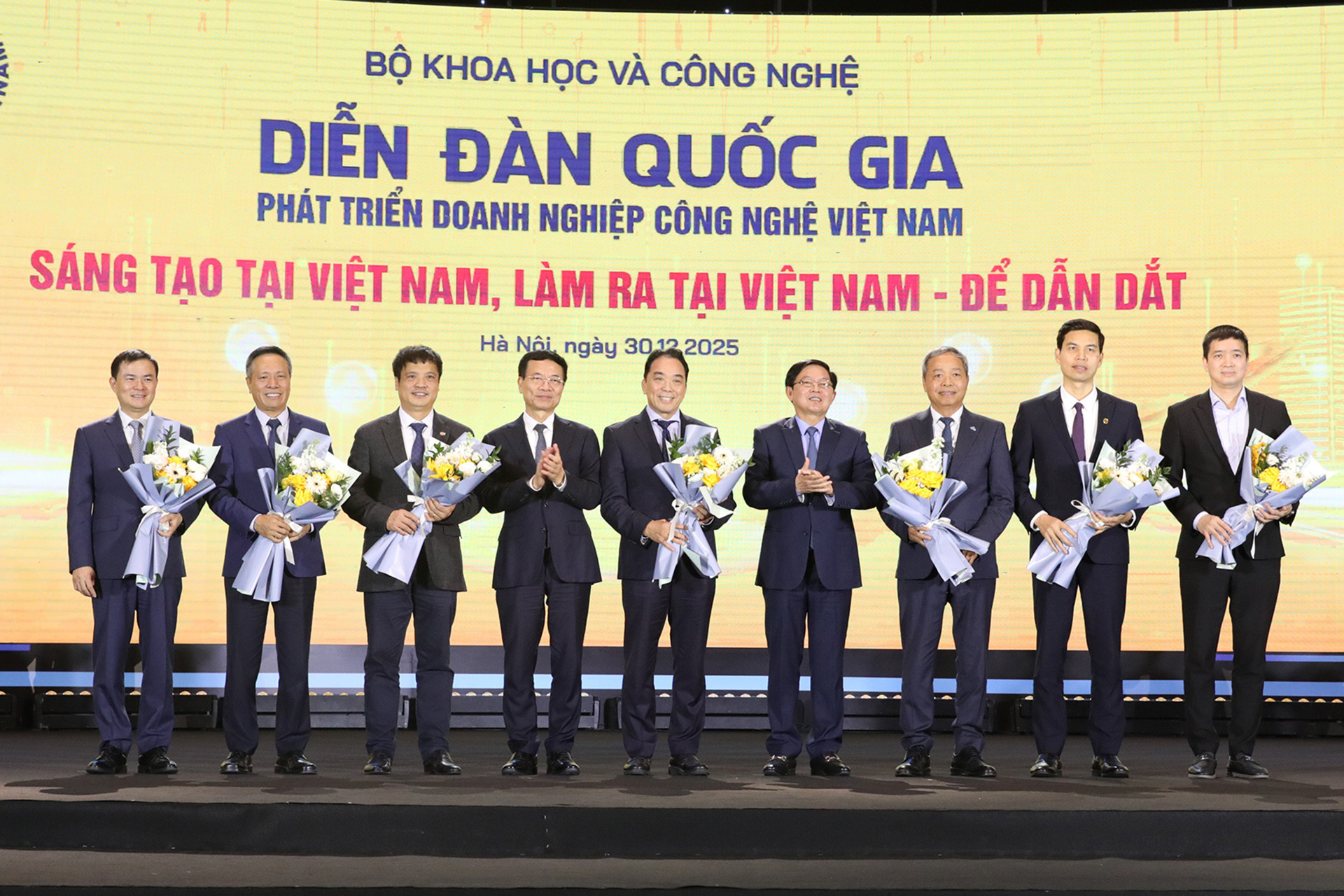
As Make in Vietnam enters a new phase, the pursuit of technological autonomy is no longer rhetorical-it’s now being translated into national missions, shared platforms, and long-term investment commitments.
At the Make in Vietnam 2025 National Forum, the strategic shifts of CMC and FPT stood out. Both firms are transitioning from low-value outsourcing to building proprietary platforms and strategic technologies for sustainable autonomy.
It’s no coincidence that this year’s forum focused heavily on internal capabilities, technological sovereignty, and the role of enterprises as innovators.
The strategies presented by CMC and FPT reflect not only their corporate ambitions but also hint at a broader shift in how Vietnamese tech companies are choosing to position themselves.
CMC: From national tasks to AI sovereignty
At the forum, CMC attracted attention for executing two national missions in 2025-CMC AI Cloud and CMC OpenAI/CLS-while registering six more for 2026. Among them, the C-HEALTH platform has been approved by the Ministry of Science and Technology for implementation in 2026.
According to CMC, being entrusted with these national tasks is more than recognition-it reflects confidence in the company’s ability to master technology. It also sets high benchmarks for quality, safety, and scalability.
In AI, the CMC OpenAI/CLS roadmap includes two major components: a legal virtual assistant to serve two levels of government, and a large language model (LLM) for Vietnam’s legal sector.
These are complex, high-reliability systems, tailored to a rapidly growing and evolving body of legal documents.
CMC’s approach suggests that AI is not just for efficiency-it must also serve high-responsibility fields requiring accuracy and accountability.
Simultaneously, CMC AI Cloud is being developed as a national cloud computing platform under the 2025 roadmap.
More importantly, CMC envisions “Make in Vietnam” in cloud not just as a service delivery effort but as a path toward autonomy in infrastructure, operations, and core platforms.
CMC’s technological maturity roadmap is based on the philosophy of “Vietnamese intelligence and data.” The goal: master core technologies, reduce reliance on foreign platforms, and create scalable systems at the national level.
Nguyen Trung Chinh: Outsourcing leads to loss of sovereignty
In a notable speech, CMC’s Chairman Nguyen Trung Chinh warned that without control over core technologies, Vietnam risks falling into a low-value outsourcing trap and suffering a “brain drain” of data and intellectual capital-ultimately undermining national economic and security sovereignty.
He urged that investments in science and technology should be seen as investments in national sovereignty, not merely business growth.
According to him, the world is seeing a form of “new-age digital colonialism,” where global tech centers control platforms, data, and standards.
Vietnam must escape this by developing its own technological base. History, he argued, shows that nations mastering science and technology control their development destiny.
In today’s world, innovation is the only way to enhance growth quality, improve productivity, and escape the middle-income trap. It’s also the key to surviving global competition.
CMC proposed a framework for “enterprises as national innovation architects,” centered on four strategic pillars: institutional reform, core technology development, enterprise empowerment, and the “three-way alliance” of government, academia, and business.
Their goal is to start with national needs and build core tech solutions with practical implementation at scale-not just ideas.
FPT: From outsourcing giant to tech leader
While CMC highlighted its national mission portfolio, FPT offered a complementary view on how a major tech company is embracing technology ownership.
In his speech, FPT CEO Nguyen Van Khoa stated that Make in Vietnam is not a slogan-it is a survival strategy. For both himself and his company, it is both an inspiration and a tough question about the enterprise’s true value.
For years, FPT’s global operations were mostly service-based, with up to 90% of activities in outsourcing. But in the past five years, that share has dropped to around 35%.
Make in Vietnam represents a strategic turning point-difficult but inevitable.
Recognizing science and technology as national priorities, FPT has changed its growth mindset: from chasing short-term profits to long-term investments in R&D and internal capabilities.
One major step is the formation of the Strategic Technology Steering Committee, focusing on five domains: Quantum AI and Cyber Security (QACI), FPT UAV, FPT Railway Tech (FMT), FPT Cyber Security, and DC5.
According to Nguyen Van Khoa, this is not just a structural move but a practical commitment to owning core technologies. It allows the company to leverage global experience to accelerate product development.
Building Vietnam’s knowledge ecosystem
In education and R&D, FPT is shifting from a practice-based training model to one focused on research, with global experts and faculty co-developing real products, aiming to create a genuine knowledge ecosystem.
Managing a 85,000-strong workforce while pursuing a long-term deep tech strategy comes with immense pressure, he admitted. It demands patience from shareholders and support from regulators-especially in creating sandbox environments to test and launch core tech products.
He concluded with a commitment to invest in people, apply science and tech to real-world problems, export Vietnamese-developed core technologies, and contribute meaningfully to Make in Vietnam-even if it means embracing failures along the way.
The bigger picture: Building tech autonomy through action
From CMC’s national tech mandates to FPT’s pivot from outsourcing to core innovation, the Make in Vietnam 2025 forum highlighted more than past achievements-it showcased a fundamental shift in the mindset of Vietnamese tech enterprises.
A common theme emerged: a move from short-term gains to long-term resilience, from cost optimization to building internal capabilities, and from dependency to leadership.
Though they take different approaches, both CMC and FPT have chosen a clear path: tech ownership is no longer a “what if” question-it’s about “how” and “how far.”
These companies are no longer just market participants. They are shaping Vietnam’s journey toward independence, autonomy, and prosperity-through their own technological strength.
Thai Khang
.svg)
