 Vietnamnet.vn

 Podcast



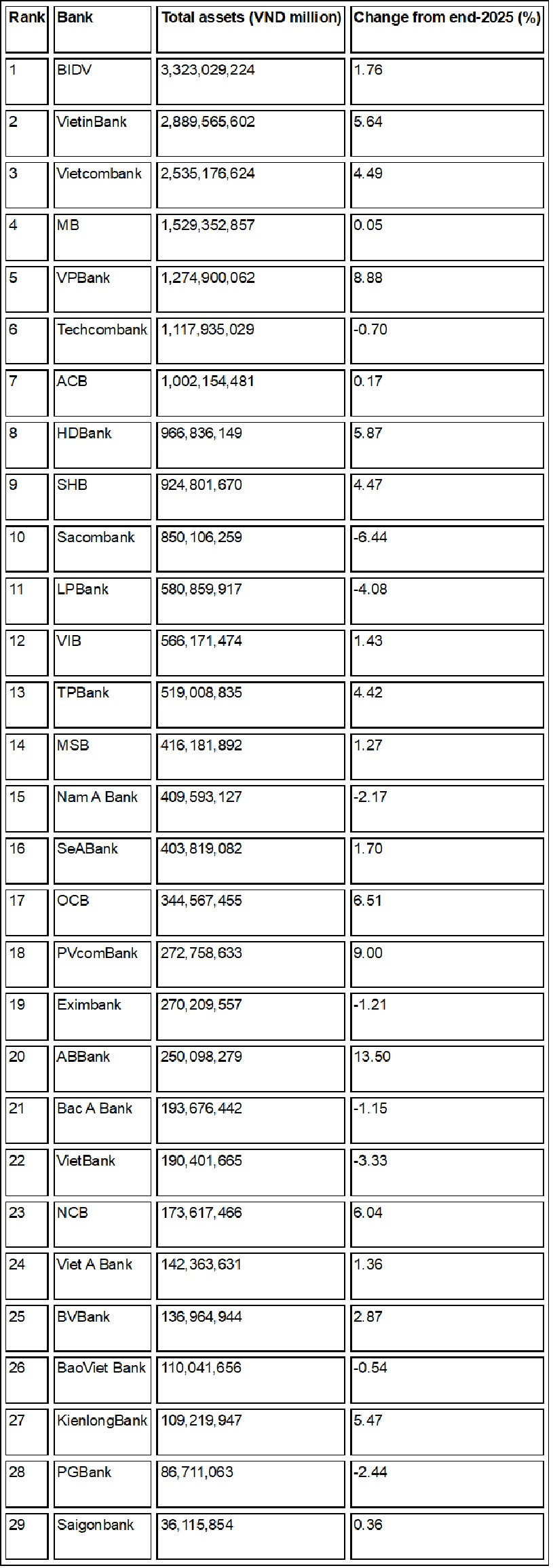
While Vietnam's largest lenders continue to dominate the race for scale, the first quarter of 2026 saw nine banks report shrinking balance sheets. Meanwhile, HDBank and SHB are rapidly approaching the VND1 quadrillion asset milestone.
As of March 31, 2026, seven joint-stock commercial banks in Vietnam had total assets exceeding VND1 quadrillion ($38.4 billion). Including Agribank, the number of banks above the threshold rises to eight, unchanged from the end of 2025.
The seven joint-stock banks with assets exceeding VND1 quadrillion were BIDV with VND3.32 quadrillion ($127.5 billion), VietinBank with VND2.89 quadrillion ($110.9 billion), Vietcombank with VND2.53 quadrillion ($97.3 billion), MB with VND1.52 quadrillion ($58.7 billion), VPBank with VND1.27 quadrillion ($49 billion), Techcombank with VND1.11 quadrillion ($42.9 billion), and ACB with VND1 quadrillion ($38.5 billion).
HDBank is now nearing the VND1 quadrillion mark, while SHB has already surpassed VND900 trillion ($34.6 billion).
However, compared with the end of 2025, total assets declined at a number of banks. Statistics show that nine lenders reported contractions in their balance sheets.
The largest declines were recorded at Sacombank, whose total assets fell by more than VND58 trillion ($2.23 billion), or 6.4%, followed by LPBank with a decrease of nearly VND25 trillion ($961 million), or 4%. Nam A Bank's assets dropped by VND9 trillion ($346 million), Techcombank's by VND7.8 trillion ($300 million), VietBank's by VND6.5 trillion ($250 million), Eximbank's by VND3.3 trillion ($127 million), Bac A Bank's by VND2.25 trillion ($86 million), PGBank's by VND2.17 trillion ($83 million), and BaoViet Bank's by VND594 billion ($22.8 million).
In contrast, VietinBank, Vietcombank and VPBank posted the strongest increases in total assets, each expanding by more than VND100 trillion during the quarter.
VietinBank moved closer to the VND3 quadrillion milestone after adding VND154 trillion ($5.92 billion), or 5.63%, bringing total assets to VND2.89 quadrillion. Vietcombank increased assets by VND109 trillion ($4.19 billion), or 4.48%, to VND2.53 quadrillion, while VPBank added VND104 trillion ($4 billion), or 9%, reaching VND1.27 quadrillion.
BIDV remained the largest bank in the system with total assets of VND3.32 quadrillion and ranked fourth among the fastest-growing lenders during the quarter, adding more than VND57 trillion ($2.19 billion) in assets.
Other banks posting notable asset growth in the first quarter included SHB, HDBank, ABBank, PVcomBank, TPBank and OCB.
According to compiled data, the combined assets of 29 domestic joint-stock commercial banks reached VND21.626 quadrillion ($830 billion) by the end of the first quarter. Including Agribank, total assets across 30 banks stood at approximately VND24 quadrillion ($923 billion).
Bank assets include cash holdings, deposits at the State Bank of Vietnam, customer loans, investment securities, equity investments and other assets.
Within banks' asset structures, outstanding loans account for the largest share. Credit growth of 19.01% in 2025 provided a foundation for many lenders to expand their balance sheets throughout 2025 and into the opening months of 2026.
MB, VPBank, HDBank and Vietcombank were granted higher credit growth quotas after taking over weaker financial institutions. As a result, these banks recorded strong asset expansion in 2025 and maintained growth momentum during the first quarter of 2026.
Total assets of Vietnamese banks as of March 31, 2026
Tuan Nguyen
.svg)
