 Vietnamnet.vn

 Podcast



Many people assume every full moon is identical. After all, bright moonlight often washes out the stars, making deep-sky objects much harder to observe.
Yet every June, astronomy enthusiasts eagerly await the return of the Strawberry Moon as though welcoming an old friend after a year apart.
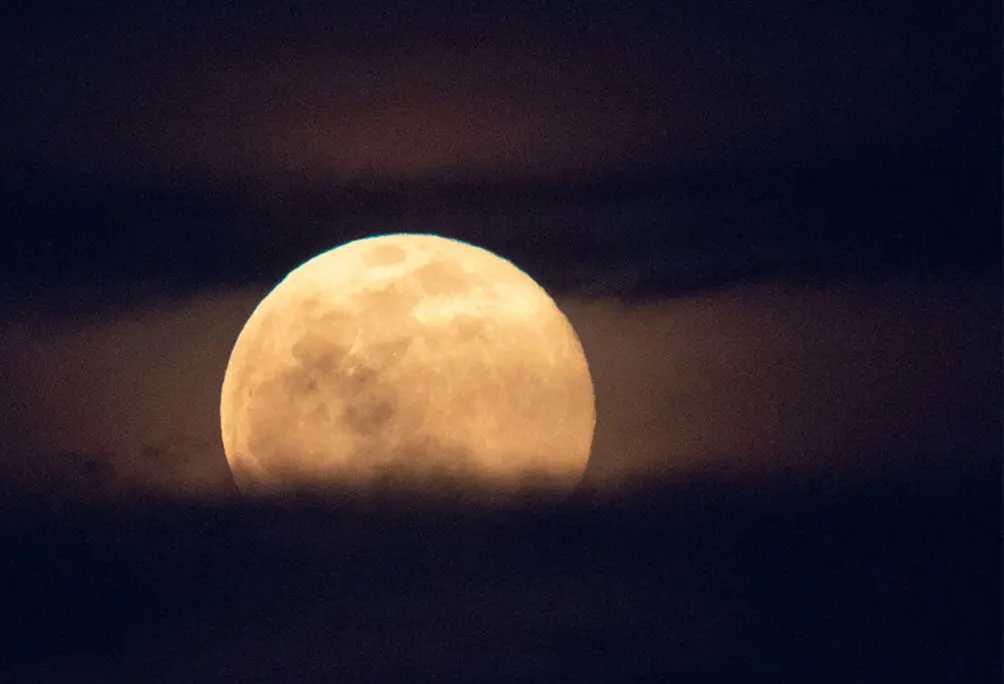
What makes the Strawberry Moon unique is not its actual color or physical size, but the remarkable path it follows across the sky.
From the Northern Hemisphere, the Moon rises unusually far to the southeast and remains low above the horizon for hours instead of climbing quickly overhead as it does during winter full moons.
As twilight fades, the Strawberry Moon slowly emerges through the warm haze of early summer. It appears reluctant to leave the horizon, drifting quietly across the southern sky with a beauty that feels both familiar and surreal.
Even people who rarely pay attention to the night sky often pause to admire this striking natural spectacle.
An 18.6-year astronomical cycle creates a rare celestial display
Last year's Strawberry Moon appeared exceptionally low because it coincided with the major lunar standstill, a phenomenon that occurs only once every 18.6 years.
During this cycle, the Moon reaches the most extreme northern and southern rising and setting points along the horizon. Last year marked the Moon's southernmost rise since 2006, and a similarly dramatic display will not occur again until the 2040s.
Many astronomy enthusiasts said observing last year's Strawberry Moon felt like stepping into another world.
The Moon appeared in an unfamiliar part of the sky, rising behind the city skyline and creating an image that was both recognizable and dreamlike.
Yet most people around them never noticed anything unusual.
This year, the Strawberry Moon will not rise quite as far southeast as it did last year, but it will still display its defining characteristic - remaining unusually low in the sky, making it appear much larger than it actually is.
Many people believe the Strawberry Moon is physically bigger than usual. In reality, this is largely due to the well-known Moon illusion, an optical effect that causes the human brain to perceive the Moon as larger when it is close to the horizon.
Fortunately, appreciating the Strawberry Moon does not require an understanding of celestial mechanics or lunar orbital dynamics.
Finding an unobstructed view toward the southeast and later the southern horizon is enough to enjoy the Moon hugging the landscape as it rises.
Behind the spectacle, however, lies a fascinating scientific explanation.
The Moon's orbit is tilted by about five degrees relative to the ecliptic, the Sun's apparent path across the sky. Combined with the Earth-Moon system's motion, this inclination produces an 18.6-year cycle that gradually shifts where the Moon rises and sets from year to year.
Interestingly, while observers in the Northern Hemisphere see the Strawberry Moon unusually low in the sky, those in the Southern Hemisphere witness the opposite phenomenon, with the Moon climbing much higher overhead.
The contrast demonstrates that the night sky we observe is not merely a local phenomenon but reflects the broader dynamics of the Earth-Moon system.
Timing is everything for the best Strawberry Moon views
Experts recommend thinking of the Strawberry Moon as a landscape photograph rather than simply an astronomical event.
Choosing the right observation site is essential. Beaches, open fields, hilltops or long unobstructed roads provide ideal viewing locations.
Even a line of trees or a few buildings near the horizon can block the Moon's most spectacular moment as it first appears.
Applications such as Photo Ephemeris can accurately predict where the Moon will rise from virtually any location on Earth.
This is especially useful because the Strawberry Moon often appears in a different part of the sky than many people expect.
The best viewing opportunity comes at sunset on June 29, just as the Moon begins to rise.
At that moment, the soft blue glow of twilight blends with the Moon's warm orange hues, producing a far more dramatic scene than later in the night.
A common misconception is that the Strawberry Moon remains orange throughout the night. In reality, it does not.
Its vivid colors are caused primarily by Earth's atmosphere scattering shorter wavelengths of light while the Moon remains close to the horizon.
As the Moon climbs higher, the amount of atmosphere its light passes through decreases, causing it to quickly regain its familiar silvery-white appearance.
The distinctive "Strawberry Moon atmosphere" lasts only about 20 to 30 minutes after moonrise before the laws of physics return everything to normal.
As June draws to a close, the Moon will continue waxing before reaching the full Strawberry Moon phase on Monday, June 29.
During the nights leading up to the full moon, moonlight will increasingly dominate the night sky. After the full moon, the Moon will rise later each evening.
On the evening of June 27, observers looking south after dark will be able to spot the nearly full Moon close to Antares, the bright red star in the constellation Scorpius.
During the final days of June and early July, Mars will appear below the Pleiades star cluster (M45) in the northeastern sky before dawn, while Uranus will also be visible nearby.
Hai Phong
.svg)
