 Vietnamnet.vn

 Podcast



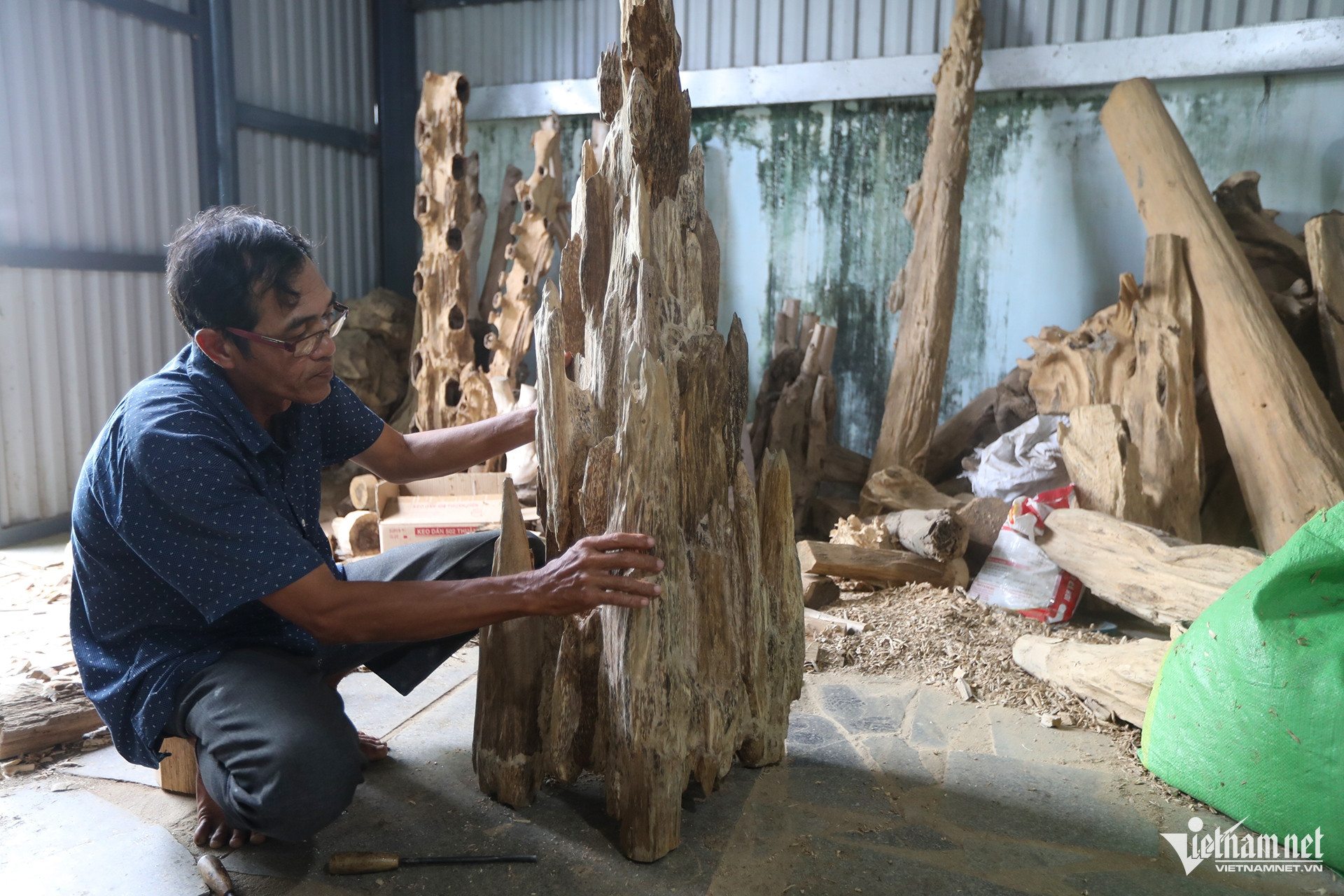
In a small workshop in Van Thang commune, the sound of knives and chisels touching wood trunks rings evenly. Agarwood sawdust thinly covers the floor, and the smell of wood blends with a faint agarwood fragrance.
Duong Ngoc Thai, 64, bends close to the wood blank, one hand firmly holding the agarwood block, the other hand using a small chisel to go into each wood crack. In front of him is a piece of agarwood weighing about 200 grams, being carved.
"It looks simple, but to keep the natural shape and the precious essential oil inside, sometimes you have to sit all day. Just one wrong cut, the blank can be punctured, the shape broken, losing the value of the agarwood," Thai said.
Since he was 19 years old, Thai has been attached to the profession when following his father to learn how to hold a knife, look at wood grain, and recognize the agarwood hidden in the trunk of the agarwood tree.
According to Thai, to have an original piece of agarwood, the craftsman must go through many stages. The agarwood trunk, after being sawn, is chipped to remove the bark and the white sapwood outside.
When approaching the core, the craftsman uses a large chisel to break the body, opening the way to the agarwood region. Finally, small gouges are used to remove each part of excess wood, keeping the natural agarwood shape.
For more than 40 years, the craft of carving agarwood has become the livelihood and tradition of his family. For him, the work is not too difficult but requires patience and meticulousness.
"If you are distracted for a moment, the knife goes wrong and punctures the blank, it's considered a loss. Hot-tempered people can hardly follow this profession," he said.
Being friends with sharp knives and chisels, cuts and skin tears are things most agarwood workers have experienced. Many young people who learn the trade, after a few bleeding times or sitting for a long time without making a product, have given up. With this profession, patience is a necessary virtue.
For each day working, Thai earns about 300,000 VND. When free from workshop work, he returns home to take care of 5 sao of fields (1 sao = 360 sqm) to have additional income. Among his four children, three follow the agarwood profession.
Not far away, Sau Thoi, 64, also has more than 40 years living with the profession of crafting agarwood sculptures. In front of him is an wood blank weighing about 10kg, about 80cm high, 50cm wide. To turn this block of wood into a feng shui item placed in a living room or worship room, he has to spend nearly a month carving.
"This profession has been handed down by our ancestors. Once you get used to it, you just stick with it for life," Thoi said.
He said agarwood crafting cannot be stereotyped like other carpentry professions. Each wood blank has its own shape, forcing the craftsman to observe carefully to know which part to keep, which part to remove. Sometimes the curved shape of wood creates value; sometimes only a small streak of agarwood deep in the trunk determines the selling price of the whole product.
Craftsman in Van Thang make many products such as artistic agarwood sculptures, bracelets, necklaces, Buddha pendants, and incense sticks. Selling prices range from several hundred thousand VND to several million VND per product.
Previously, the main raw material was forest agarwood. Currently, most agarwood is taken from agarwood trees planted on mountains, in gardens. The value of agarwood depends on the amount of essential oil, fragrance, clarity and ability to retain scent. High-quality agarwood can be traded at prices from several hundred thousand to several million VND per gram.
Tran Cong Duc, Chair of the Van Thang Agarwood Cooperative, stated that the locality currently has over 400 households practicing agarwood carving, offering diverse product lines.
The Van Thang Agarwood Cooperative alone has 14 official members, connecting with about 50 households. Products are retailed to individual users, tourists, or purchased as gifts. Some items have been exported to China, Japan, and India.
Xuan Ngoc
.svg)
