 Vietnamnet.vn

 Podcast



When speaking with wood exporters - an industry that brings Vietnam around 17 billion USD each year - most business owners share the same concern: profits are getting thinner and thinner, hovering at just around 5%, with many saying they are simply “working for labor income rather than real profit.”
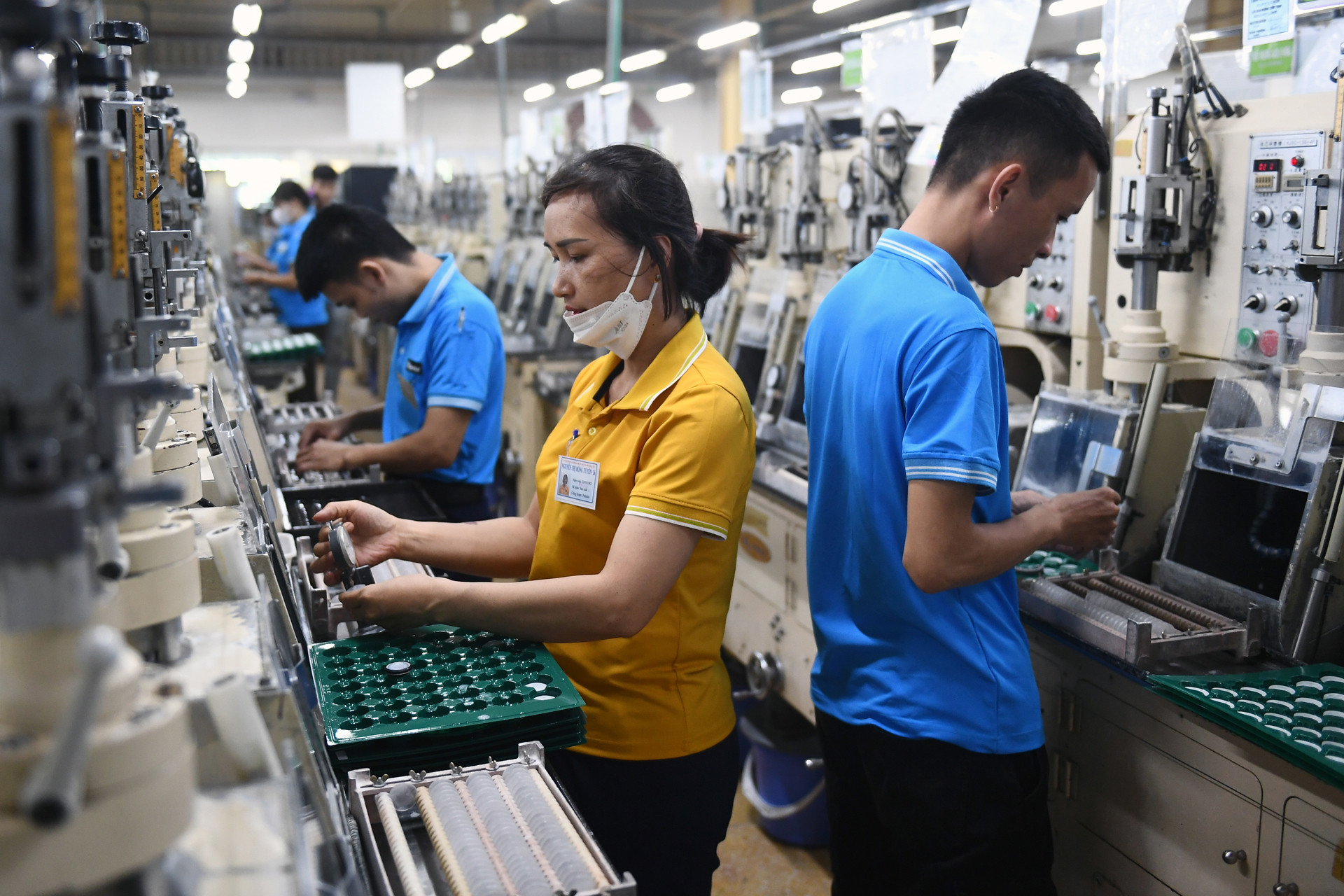
Some textile and footwear companies tell a similar story.
Listening to them, one gets the feeling that many Vietnamese businesses are running very fast, yet still unable to escape constant instability.
Meanwhile, foreign-invested corporations continue expanding production, increasing exports and weathering global shocks relatively well.
The two sectors coexist within the same economy, but the differences between them are becoming increasingly visible.
A recent Vietnam economic update by the World Bank paints that gap quite clearly. The World Bank describes it as a “dual economy,” where FDI enterprises and companies participating in global value chains - though accounting for only around 5% of total businesses - generate roughly half of the country’s added value and employment while contributing as much as 73% of total exports.
In contrast, around 98% of domestic businesses remain small-scale or informal operations, with limited productivity and little participation in global supply chains.
FDI corporations currently import more than 50% of inputs for export production, while Vietnamese companies still lack the capacity to integrate deeply into those supply networks. Even in key industries, local firms struggle to gain a foothold due to gaps in technology, skills and management capability.
After more than 30 years of attracting FDI, Vietnam still has not created a strong enough spillover effect for domestic enterprises.
That gap has become increasingly obvious in recent developments.
After the United States announced new reciprocal tariff measures, exports from the FDI sector surged by 42% year-on-year in April 2026, while exports from domestic enterprises fell by as much as 24.5%.
The blow hit sectors dominated by Vietnamese firms - such as textiles, footwear and wood products - particularly hard, with effective tariffs ranging from 15% to 38%, far higher than the roughly 9% imposed on electronics and machinery, industries largely controlled by the FDI sector.
According to the World Bank, the biggest difference lies in resilience.
FDI corporations benefit from long-term contracts, internal supply chains, parent-company financing and stronger pricing power thanks to complex technology products. These advantages provide enough financial cushioning to absorb shocks.
Meanwhile, most Vietnamese businesses remain small, thinly capitalized and heavily dependent on short-term bank credit. Whenever markets fluctuate, they often have almost no financial buffer left to protect themselves.
As a result, the domestic private sector is becoming the area carrying the heaviest burden of economic disruption - precisely at a time when Vietnam is targeting double-digit growth.
That creates a paradox: an economy growing rapidly, exports continuously setting records, yet the domestic business sector - which should serve as the backbone of the economy - is becoming increasingly fragile.
When Vietnamese businesses fail to grow proportionally
At the same time, domestic enterprises are facing mounting difficulties, according to the Vietnam Private Economy Report 2025 by VCCI.
The biggest challenge for private businesses today is not technology or exports, but simply… finding customers. The percentage of companies complaining about difficulties in finding buyers jumped from 45.3% to 60.2% in just one year, suggesting domestic demand is weakening rapidly.
An economy can hardly achieve double-digit growth if businesses cannot even sell products in their own domestic market.
Even more worrying is the financial health of Vietnamese enterprises. For many small businesses, borrowing money still requires one thing above all else: land.
As many as 75.5% of businesses cannot obtain loans without collateral, while 93.5% of loans require secured assets - significantly higher than regional and global averages.
That reality suggests many Vietnamese businesses are surviving based more on assets than actual business capability. Without collateral, entering a bank is nearly impossible, while credit remains the primary lifeline for most small firms.
Yet the mood in the market differs sharply from the optimistic tone often heard in reform forums.
According to VCCI surveys, difficulties related to policies and legal regulations increased from 16.9% to 24.3% in 2025, while only around 6-8% of businesses said they could “frequently” or “always” predict policy changes.
No one wants to make long-term investments in an environment where the rules of the game can suddenly change overnight.
As a result, 2025 no longer appears to be a year of expansion for the domestic private sector, but rather a period of harsher filtering.
Although the number of newly established businesses has increased, the number of businesses exiting the market has also surged sharply. New firms continue appearing, but they are becoming smaller and more cautious. After multiple shocks, many entrepreneurs now seem focused simply on survival rather than growth.
Perhaps the most vulnerable part of the economy lies within household businesses.
Around 6.1 million household businesses employing roughly 10 million workers are currently operating under weakening conditions, with as many as 81.5% reporting declining revenue.
That means the story of businesses is not merely about GDP or growth rates, but also about the livelihoods of tens of millions of people.
In reality, Vietnam does not lack success stories in attracting FDI. After more than three decades of economic opening, the country has become one of the world’s major manufacturing hubs. The problem is that many Vietnamese businesses still occupy the lowest-profit segments within their own economy.
A structurally imbalanced economy
That imbalance is also clearly reflected in Vietnam’s economic structure.
The FDI sector, consisting of roughly 30,000 enterprises, currently accounts for around 73% of exports and contributes more than 22% of GDP.
Meanwhile, the formally registered domestic private business sector - with more than one million enterprises - contributes just over 10% of GDP, while household businesses account for approximately 33% of GDP, according to official statistical data.
This shows that Vietnam’s economy still depends heavily on the FDI sector, while small-scale, fragmented and vulnerable production units continue to dominate the domestic landscape.
If the FDI sector were removed, the remaining parts of Vietnam’s economy would still appear relatively weak, while incomes for most workers remain modest, commonly around 330 USD per month, despite years of strong growth and record-breaking exports.
It is an economy exporting hundreds of billions of dollars, yet where many workers still survive on salaries that barely cover monthly living costs.
The greatest concern is not that FDI corporations have become too strong, but that after more than 30 years of opening up, many Vietnamese businesses remain trapped in low-margin outsourcing roles and vulnerable positions even within their own home market.
Tu Giang
.svg)
