 Vietnamnet.vn

 Podcast



The story of Sin Ho sweet potatoes and Binh Lu vermicelli going online not only highlights how technology is reshaping agricultural trade but also reveals a transformation in mindset, production models, and how people earn from traditional values.
From ‘good harvest, low price’ to digital economy from the yard
For years, Binh Lu has been known for its handcrafted vermicelli made from canna root grown on mountain-side fields. But like thousands of traditional craft villages across Vietnam, the familiar cycle of “good harvest, poor prices” continued to repeat.
At times, farmers produced more but had to sell for as low as 16,000 VND (around 0.65 USD) per kilogram of vermicelli flour. Even with their best efforts, producers could only wholesale to traders, remaining dependent on bulk buyers and unable to directly access consumers in distant markets.

Ngoc Vang Van, chairman of the Binh Lu Farmers’ Association, was clear: technology is changing the production-consumption logic in agriculture.
“We’ve seen cases where one household sold an entire ton of vermicelli in a single TikTok Shop livestream, whereas the traditional way sold only 10–20kg per day. To keep prices high, the only way is to boost direct sales through e-commerce,” he explained.
At one livestream hosted by TikToker Co Ba Hong, up to 4 tons of agricultural products from the ethnic communities of Sin Suoi Ho and Binh Lu were sold.
This marked a major shift in Binh Lu: from the mindset of “produce and wait for traders,” to “create the product and sell it directly to customers across the country.” Digital platforms have become the tools for this fundamental transformation.
Residents in Binh Lu began forming digital community groups, learning to use smartphones to record videos, livestream, tell stories about their products, and explain the traditional vermicelli-making process. Younger people helped guide middle-aged, elderly, and women who had never gone live before.
Now, agricultural goods are being sold right from their drying yards. And most importantly, the value of these products has risen according to market principles: direct selling, clear branding, storytelling, certification, and visible engagement.
Thanks to e-commerce, households that once had to accept 55,000 VND (around 2.24 USD) per kilogram from wholesalers can now sell directly for up to 120,000 VND (around 4.89 USD).
Thus, digital transformation in craft villages isn’t just about changing sales tools. It’s a shift in the foundational mindset of rural economics.
‘The journey of agricultural goods’ from the mountains to digital markets

Tong Thanh Hai, Deputy Chairman of Lai Chau People’s Committee, said digitalization in agriculture is vital, and e-commerce is a key tool for raising rural incomes.
In Lai Chau, digital transformation in agriculture has become a developmental direction. Deputy Chairman of Lai Chau People’s Committee, Tong Thanh Hai, emphasized that e-commerce is an inevitable trend in socio-economic growth.
The province now views agricultural digitalization as a key approach to help highland farmers increase their income by accessing domestic and international markets directly.
During implementation, local authorities have partnered with several tech and logistics firms, with Viettel Post playing a key role in building digital commerce infrastructure.
OCOP-certified products such as tea, bananas, honey, Seng Cu rice, and macadamia nuts have been launched on TikTok Shop and other e-commerce platforms, aiming to establish region-specific brands.
Tong Thanh Hai explained that digital skill workshops covering product photography, pricing, and online sales account setup have been widely offered to women and rural youth.
“We expect our highland people to become digital citizens, not only selling agricultural goods but also building local brands,” he added.
Meanwhile, Viettel Post in Lai Chau has launched the "Agricultural Journey" campaign, selecting unique local products for e-commerce promotion.

Tran Viet Huy, Director of Viettel Post Lai Chau, noted that the campaign has already been implemented in Sin Ho and Binh Lu. In Sin Ho alone, over 300 tons of sweet potatoes have been sold with Viettel Post’s support. Previously sold for a few thousand VND per kilogram, the same product now sells for three times more, with volumes five times higher than three years ago.
Next, Viettel Post plans to help farmers in Than Uyen sell Seng Cu and Tan Pom sticky rice.
Viettel Post is not only aiding sales but also providing logistics - from collection and packaging to delivery - alongside communication infrastructure to promote the image of highland farmers within a digital economy model.
Besides TikTok Shop, the company also supports farmers on Facebook, Shopee, and more. However, TikTok Shop remains the primary platform due to its large agricultural sales volume.
Tran Viet Huy explained that Viettel Post’s partnership with highland communities has increased both sales and profits compared to traditional wholesale methods.
On November 4, in Binh Lu commune, a Mega Live livestream event was held as part of the “Agricultural Journey” with participation from various KOLs/KOCs on TikTok Shop.
At one point during the livestream, TikToker Co Ba Hong sold 4 tons of agricultural goods for Lai Chau farmers. The event was livestreamed over Viettel’s 5G infrastructure, ensuring a stable connection in this mountainous area.
Beyond selling produce, Co Ba Hong also taught ethnic Mong and Thai communities in Binh Lu and Sin Suoi Ho how to sell on TikTok Shop. This showcased how digital methods are driving breakthrough results in agricultural sales.
At that moment, the story in Binh Lu was no longer just about selling vermicelli. It became a live example proving that e-commerce had reached rural households, drying yards, and vermicelli workshops.
Bringing technology into a 50-year-old tradition doesn’t erase heritage. It strengthens and amplifies it, helping it reach fair market value.
Nguyen Tien Thinh, Secretary of Binh Lu commune, said that the young leadership team is redefining development strategies, aiming to elevate Binh Lu’s agricultural products with technology. This is how agricultural economies rise on digital platforms - not as a pilot model for a report, but through real sales results that harness both local resources and people.
Local vermicelli producers are no longer thinking of vermicelli as a regional item but as a national brand, aiming to elevate Binh Lu and Lai Chau agricultural products.
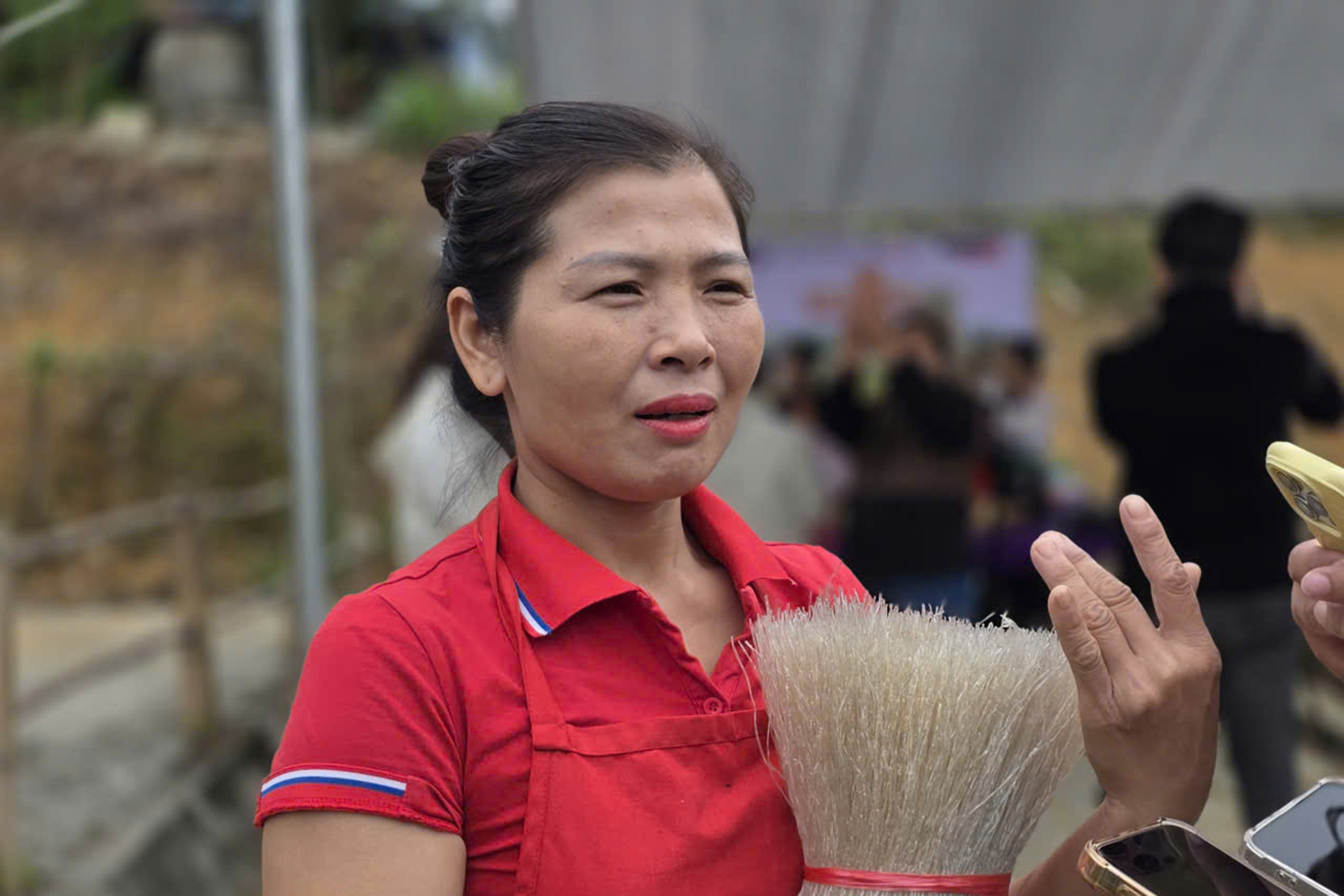
“If we can build a traditional craft village on a digital foundation, it will become a hallmark model for Vietnamese villages,” he added.
Nguyen Tien Thinh, Secretary of Binh Lu commune, Lai Chau, shared that with a two-tier government structure and new leadership, they aim to redefine development space, including agriculture, to raise the value of Binh Lu’s produce.
In this landscape, highland women are playing a central role - from production to livestreaming. Ms. Ha, owner of the Ha Thang vermicelli workshop, shared that her family used to sell wholesale or on Facebook with limited success. With Viettel Post’s help launching on TikTok Shop, she could now reach customers nationwide.
“I was nervous at first, but it opened a new door for clean agricultural products from Binh Lu,” she said.
She is a true example of agricultural digitalization - producers directly running their own online businesses.
Nguyen Thi Thu Ha, owner of Ha Thang vermicelli workshop, shared that her family once sold mainly to traders and a little on Facebook.
Sin Ho and Binh Lu emerge as rural e-commerce role models
The stories of Binh Lu vermicelli and Sin Ho sweet potatoes are just the beginning. Lai Chau plans to expand the “Agricultural Journey” to other products like Seng Cu rice, Tan Pom sticky rice, Thanh Xuan honey, and cham cheo seasoning.
Strategically, Binh Lu is becoming a model for rural digital transformation in Vietnam - a uniquely local and practical version. Technology starts from the ground up, addressing the age-old pain point of “produce without sales” and solving it through digital platforms that farmers can manage themselves.
Other mountainous areas, traditional villages, and provinces can replicate this model. There’s no need for giant factories or expensive high-tech projects. All it takes is a yard, a bamboo rack, and traditional knowledge - activated by accessible digital tools.
Digital transformation is no longer just a slogan. It’s a real shift, happening right now, from a rural craft village in Vietnam’s northwest - where Binh Lu’s vermicelli and Sin Ho’s sweet potatoes are making their way to national markets through technology, agricultural potential, and the determination of local people, guided by supportive authorities and enterprises.
Thai Khang
.svg)
