 Vietnamnet.vn

 Podcast



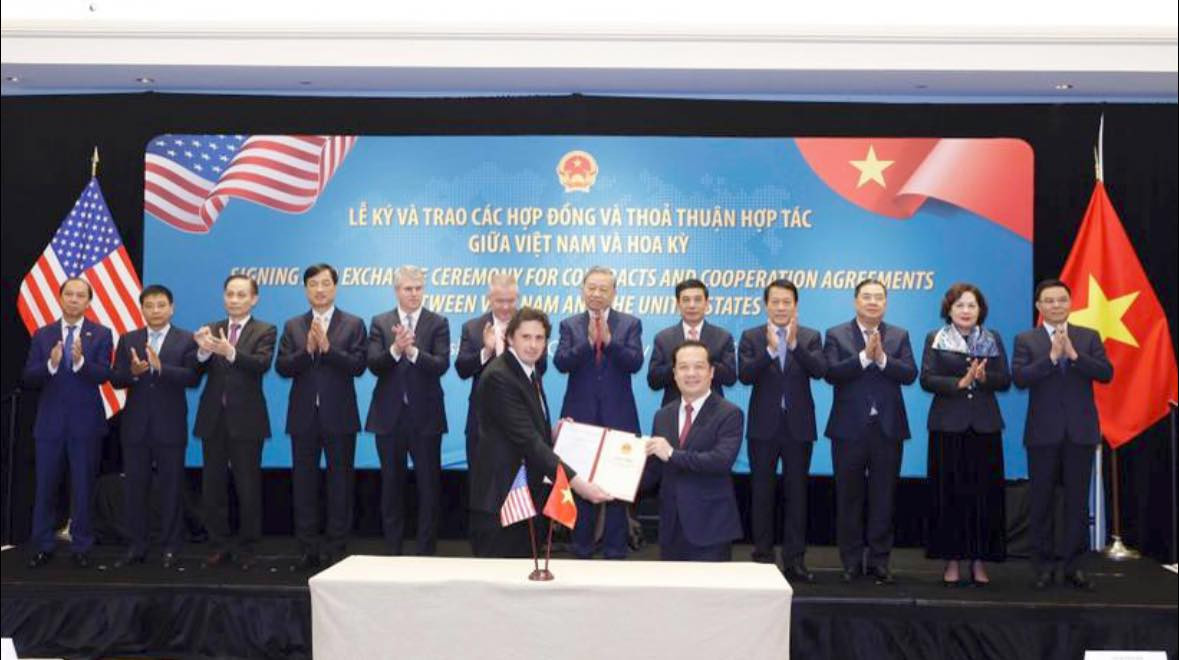
On the afternoon of February 18 in Washington D.C., in the presence of Party General Secretary To Lam, Deputy Minister of Science and Technology Pham Duc Long handed over a license to provide satellite-based telecommunications services, both fixed and mobile, to Starlink Services Vietnam Company.
Earlier, on February 13, an important milestone was marked in the completion of Vietnam’s national digital infrastructure when the Radio Frequency Department officially granted a license for the use of radio frequencies and radio equipment to Starlink Services Vietnam Co., Ltd.
This event was more than an administrative procedure. It signaled Vietnam’s stronger openness to next-generation space technology, where internet connectivity is no longer constrained by mountainous terrain, islands or traditional infrastructure “blind spots.”
Under the granted frequency license, the initial deployment phase will include four gateway stations and a maximum of 600,000 user terminals in Vietnam.
The scale reflects a methodical, controlled rollout aligned with the national telecommunications infrastructure development roadmap.
Earlier media reports said that SpaceX, the space company owned by billionaire Elon Musk, plans to invest US$1.5 billion in Vietnam.
The investment aims to deploy the Starlink satellite internet service, which is expected to provide broadband connectivity across the country, particularly in remote, border and island areas where traditional internet infrastructure remains limited.
The rollout of Starlink services is anticipated to accelerate digital transformation and help narrow the digital divide in Vietnam. However, achieving optimal effectiveness will require close cooperation between SpaceX and domestic telecommunications enterprises, along with investment in infrastructure and supply chains.
Such efforts are expected to expand access to digital services nationwide, especially in remote regions that lack fixed broadband or 4G and 5G coverage. Nonetheless, Starlink’s specific business model in Vietnam has yet to be disclosed.
Commenting on SpaceX being allowed to pilot low Earth orbit satellite internet services in Vietnam, Vu The Binh, Vice Chairman and Secretary General of the Vietnam Internet Association (VIA), described it as “a positive signal for Vietnam’s internet landscape. It provides an additional broadband option, especially for areas without fiber optic cables, remote regions and islands.”
Elaborating on the potential benefits, Vu The Binh noted that Vietnam ranks among the leading ASEAN countries in terms of internet penetration and both fixed and mobile broadband access.
So far, Viettel is the only domestic enterprise to publicly declare its intention to participate in the low Earth orbit satellite sector. Tao Duc Thang, Chairman of Viettel, said the group is conducting research into low Earth orbit satellites, although no results have yet been announced.
A frequency expert told VietNamNet that, in theory, Vietnam could still secure orbital slots for low Earth orbit satellites. In practice, however, registering satellite orbits is extremely challenging, as major countries have already claimed many of these positions.
Thai Khang
.svg)
