 Vietnamnet.vn

 Podcast



On May 22 and 25, the Ministry of Ethnic and Religious Affairs held meetings to review the progress and implementation of science, technology, information technology and digital transformation tasks under the chairmanship of Deputy Minister Nguyen Hai Trung.
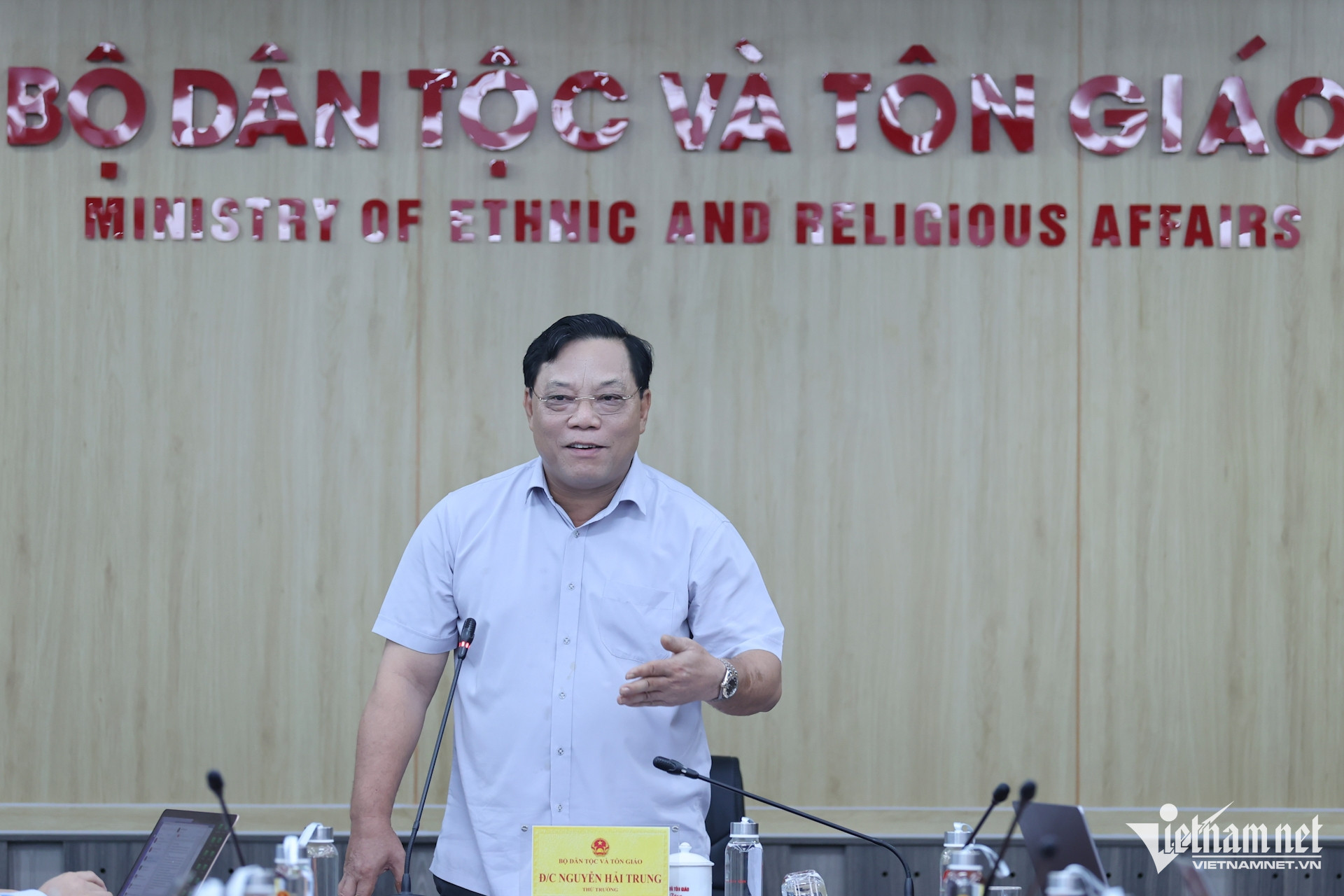
Deputy Minister of Ethnic and Religious Affairs Nguyen Hai Trung speaks at the opening session of the May 22 meeting. Photo: Le Anh Dung
No unit can stay outside the process
Speaking at the meetings, Deputy Minister Nguyen Hai Trung reiterated the critical role of science, technology, innovation and digital transformation.
“The Party has identified the development of science, technology, innovation and digital transformation as a new driving force for national development. Information technology and digital transformation are no longer merely tools, methods or means of production, but have officially become productive forces themselves,” he said.
The transition is expected to create important foundations for streamlining the ministry’s organizational structure, optimizing work efficiency and contributing to the country’s broader growth goals.
According to the deputy minister, the commitment and direct involvement of agency leaders are decisive factors in the success of digital transformation efforts. Heads of units were encouraged to actively participate in shaping the process rather than delegating responsibilities entirely to technical departments.
Nguyen Hai Trung stressed that digital transformation is the responsibility of the entire political system and the public as a whole.
“All units within the ministry must participate. No one can stand outside the process. Every unit must have implementation plans and action programs, including for regular tasks,” he said.
He added that digital transformation performance would become a mandatory criterion in periodic staff assessments and evaluations.
Early signs of progress
At the meetings, Bui Quoc Thang, acting director of the ministry’s Digital Transformation Center and standing agency of its digital transformation steering committee, presented an overview of progress in implementing information technology and digital transformation programs.

Bui Quoc Thang, acting director of the Digital Transformation Center, presents an overview of the ministry’s digital transformation and information technology initiatives. Photo: Le Anh Dung
According to the report, units under the ministry have begun making positive progress in digital transformation tasks.
Key priorities currently being implemented include upgrading the ministry’s administrative procedure information system, building an ethnic affairs database, developing a digital transformation evaluation framework for ethnic affairs agencies, and deploying projects related to digital infrastructure, cybersecurity, online public services and shared digital platforms.
The report also highlighted implementation results at several units.
The ministry’s Office has completed the deployment of 58 online public services on its testing system, including 35 fully online services and 23 partially online services.
The Academy for Ethnic Minorities is implementing a project aimed at improving digital capacity in ethnic minority and mountainous regions.
Media, publishing and communications agencies under the ministry have also gradually adopted information technology and digital transformation in professional operations, administration and content production.
However, alongside these early achievements, the Digital Transformation Center noted a range of persistent challenges, particularly in awareness, coordination mechanisms, implementation capacity and workforce quality.
According to the center, data remains the biggest challenge. Many units also face difficulties due to shortages of personnel with information technology expertise while simultaneously handling large workloads.
Defining the “problem statement” for technology firms

Leaders of various ministry units also reported on the progress of assigned tasks and outlined challenges related to coordination mechanisms, human resources and implementation processes.
In discussions with the units, Deputy Minister Nguyen Hai Trung said that amid limited resources, enhancing the proactiveness of each agency and each official was especially important.
According to him, digital transformation is not only about investing in infrastructure or software applications but fundamentally about changing management thinking, working methods and the way tasks are organized and executed.
The deputy minister emphasized that agency heads do not necessarily need deep technical expertise but must clearly understand the management operations within their fields in order to define the “problem statement,” generate ideas, design processes and coordinate effectively with technology partners.
For projects involving technology companies, he said external partners should only play a supporting role in digitizing administrative processes, while state agencies themselves must take the lead in defining management requirements and operational needs.
He also stressed the importance of restructuring workflows, eliminating overlapping procedures and strengthening data connectivity from the earliest stages of project implementation.
According to Nguyen Hai Trung, one of the ministry’s most urgent tasks is for all units to finalize implementation plans for Resolution 57 as well as digital transformation plans aligned with their specific functions and responsibilities.
These plans, he said, must include clear objectives, roadmaps, responsibilities and monitoring mechanisms.
The ministry’s leadership also requested heads of units to sign commitments ensuring assigned tasks are completed on schedule while strengthening accountability during implementation.
Concluding the meetings, Deputy Minister Nguyen Hai Trung said digital transformation efforts within the ministry had shown initial progress but needed to accelerate further in the coming period.
“There will inevitably be difficulties during implementation, but the most important thing is for each unit and each leader to think about how to overcome them. If there are obstacles related to institutions, laws or mechanisms, they must report them to supervising leaders. Difficulties cannot simply be left unresolved,” he stressed.
Du Lam
.svg)
