 Vietnamnet.vn

 Podcast



Escalating tensions involving the US, Israel and Iran, along with disruptions to oil shipments through the Strait of Hormuz, have pushed global fuel prices sharply higher, affecting many economies, including Vietnam.
Swift and decisive measures
One notable aspect is how quickly the policy system responded.
On the evening of March 10, the Ministry of Industry and Trade and the Ministry of Finance jointly adjusted domestic retail fuel prices while using the fuel price stabilization fund at a level of about VND4,000-VND5,000 per liter (US$0.16-US$0.20).
Thanks to this “buffer,” domestic fuel prices increased but did not spike in line with international market movements. According to calculations by regulatory authorities, without the stabilization fund, the price of RON95 gasoline could have exceeded VND33,000 per liter (US$1.30).
At the same time, Prime Minister Pham Minh Chinh chaired a meeting with the task force responsible for energy security, emphasizing a firm goal: under no circumstances should Vietnam face an energy shortage.
The government also announced that about 4 million barrels of oil had been mobilized from partners to supplement short-term supply and support production plans at domestic refineries.
On the fiscal policy front, the preferential import tax on gasoline and certain blending materials has been reduced to 0%. The Ministry of Finance is also proposing a plan to cut the environmental protection tax on petroleum products to VND0, a move that could lower gasoline prices by about VND1,000-VND2,000 per liter (US$0.04-US$0.08).
In addition, the price management mechanism has become more flexible.
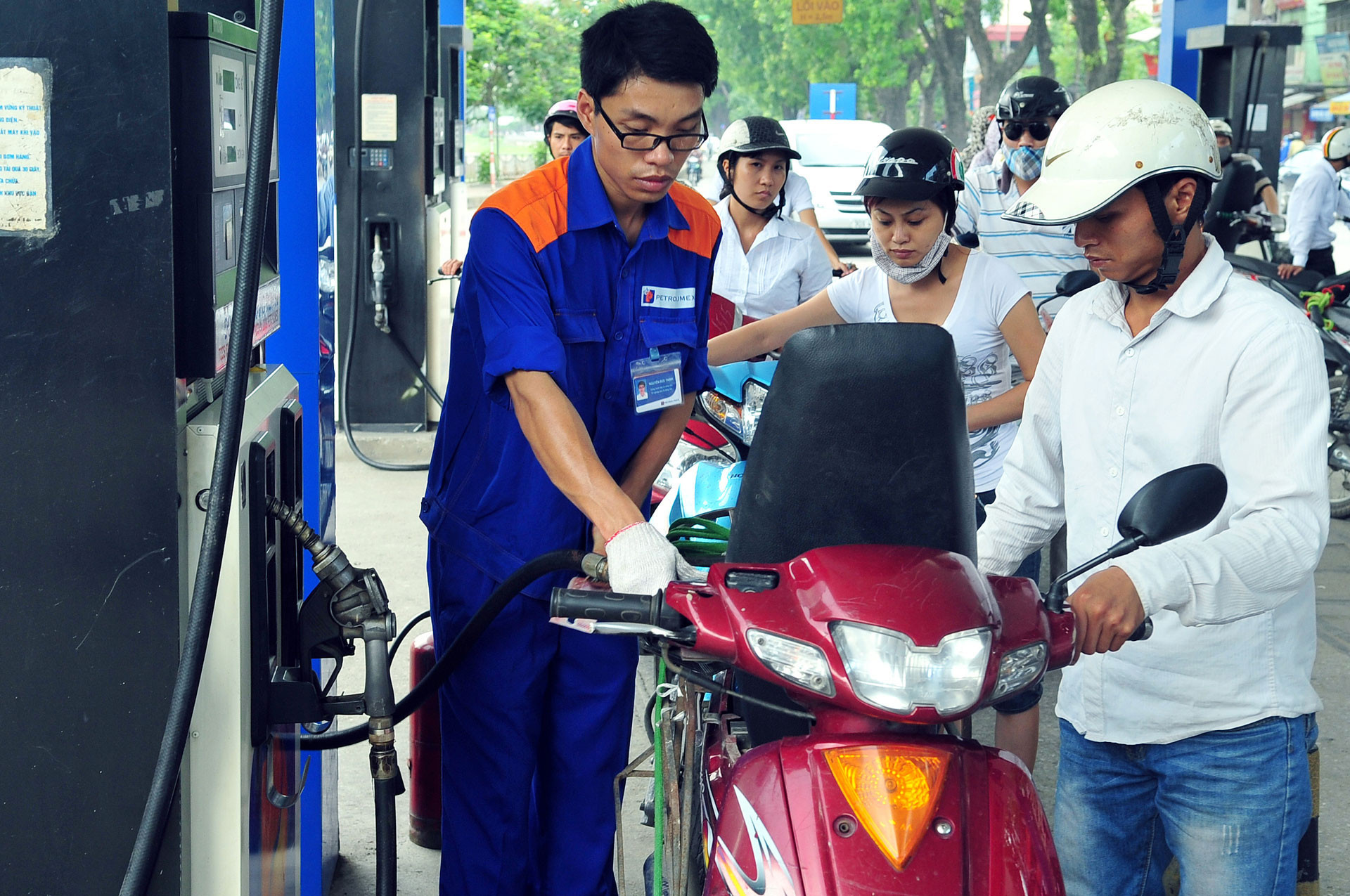
Under Resolution 36 of the government, when the base fuel price rises by 7% compared with the previous adjustment period, domestic retail prices can be revised immediately after the change occurs, instead of waiting for the end of the pricing cycle.
Taken together, these actions indicate that Vietnam’s fuel market management is becoming increasingly proactive. When global markets fluctuate sharply, multiple policy tools - from the stabilization fund and tax adjustments to supply measures and price management mechanisms - can be deployed simultaneously to cushion shocks and maintain market stability.
The structure of the domestic market
Recent volatility has also revealed certain structural characteristics of Vietnam’s energy market.
Currently, Vietnam can secure about 68% of its fuel supply domestically through two major refineries: Nghi Son and Dung Quat. This represents a significant improvement compared with more than a decade ago, when most petroleum products had to be imported directly.
However, this level of “self-sufficiency” still relies heavily on imported crude oil.
Nghi Son Refinery and Petrochemical Complex - one of the country’s largest fuel suppliers - depends on Kuwait for roughly 70-80% of its crude oil supply. At certain times, nearly all of the refinery’s crude oil came from the Middle Eastern country.
Meanwhile, Dung Quat Refinery has a more diversified crude supply but still imports around 30-35% from regions such as West Africa, the Mediterranean, the US and parts of the Middle East.
This means that even when petroleum products are refined domestically, the upstream raw materials remain closely tied to global oil supply chains.
When major energy shipping routes such as the Strait of Hormuz encounter disruptions, the impact can reach Vietnam’s domestic market within a relatively short time.
In addition, the cyclical pricing mechanism for petroleum products creates a certain time lag compared with global market movements.
Domestic retail prices are currently calculated based on refined product prices in the Singapore market over a specific period. As a result, when global prices rise rapidly and then fall quickly, the domestic market often reacts a step later.
This is not a weakness in policy management but rather a characteristic of a cyclical pricing mechanism. However, recent fluctuations suggest that the management system may need to become even more flexible to adapt to an increasingly unpredictable global energy market.
Viewed from a positive perspective, the latest oil price shock also demonstrates the resilience of Vietnam’s policy framework.
When global markets fluctuate strongly, the simultaneous use of multiple policy tools has helped the domestic market avoid severe shocks.
Issues that must be addressed
Vietnam’s fuel story is not only about price adjustments at each regulatory cycle. It is also closely tied to the broader challenge of energy security.
First is ensuring reasonable profit margins for the distribution system.
When actual costs - including transportation, inventory and financing - rise faster than the standard costs embedded in the base pricing formula, many retail stations say they face losses with every liter sold.
For a product with extremely thin profit margins such as fuel, this situation can easily cause distribution systems to operate cautiously or reduce sales. Adjusting cost norms and profit margins in line with reality is therefore not merely a business matter but also a prerequisite for smooth market operation.
Another issue is strengthening energy reserve capacity.
Currently, Vietnam’s circulating fuel inventory is equivalent to roughly 20 days of consumption. While this meets commercial requirements, it remains a relatively thin buffer from an energy security perspective, particularly as global oil markets grow increasingly sensitive to geopolitical disruptions.
Diversifying crude oil sources for domestic refineries is another important direction, reducing dependence on a limited number of suppliers.
At the same time, promoting biofuels, expanding new energy sources and improving energy efficiency in transportation can gradually reduce dependence on fossil fuels in the long term.
Historically, each oil crisis has often served as a catalyst for major shifts in global energy systems.
For Vietnam, recent developments may serve as a reminder that the energy challenge is not only about managing today’s market but also about shaping a long-term development strategy.
Stabilizing the economy’s “fuel tank” is therefore not simply a matter of periodic price adjustments. It is the result of layered policies - spanning price management, taxation, supply and energy reserves - designed to help the market withstand the unpredictable swings of the global energy landscape.
Tu Giang
.svg)
